New breakthrough in bubble research
September 2, 2009 Breakthrough in bubble research at Bath

Enlarge

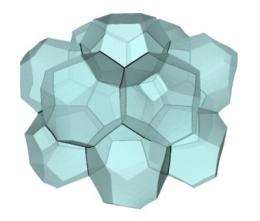
Ruggero Gabbrielli (University of Bath) has developed a new technique for mathematically modeling the structure of foam. He's proposed an alternative solution to the "Kelvin problem." Whilst the new shape doesn't beat the Weaire-Phelan structure in terms of packing efficiency, the methods he used are a new way of approaching the problem and could ultimately lead to a better solution to the Kelvin problem. Credit: Ruggero Gabbrielli (created using Javaview)

A researcher from the University of Bath has found a new approach to an old geometric problem of modelling the most efficient way of packing shapes to form a foam.

The discovery is not only making waves in the mathematical world, but could also lead to medical advances in creating hip replacements and replacement bone tissue for bone cancer patients.

The 'Kelvin problem', posed by Lord Kelvin in 1887, was to find the most efficient way of splitting space into cells of equal volume with the least area of surface between them.

Kelvin's solution to the problem was a honeycomb of truncated octahedrons - shapes with six square faces and eight hexagonal faces.

A better solution was devised by physicists Weaire and Phelan at Trinity College Dublin who created a which inspired the striking architecture of the Water Cube aquatic centre that featured in the 2008 Beijing Olympics.

The Weaire-Phelan structure is composed of two different shapes: an irregular pentagonal dodecahedron (12-faced polyhedron) and a polyhedron with 14 faces.

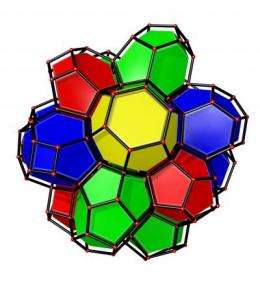
Whilst studying the honeycomb-like structure of bone replacement materials for his PhD in Mechanical Engineering at the University of Bath, Ruggero Gabbrielli devised a different way of mathematically modelling foams. His structure is instead composed of four different shapes that fit together.
Breakthrough in bubble research at Bath
Enlarge

Ruggero Gabbrielli (University of Bath) has developed a new technique for mathematically modeling the structure of foam. He's proposed an alternative solution to the "Kelvin problem.".Whilst the new shape doesn't beat the Weaire-Phelan structure in terms of packing efficiency, the methods he used are a new way of approaching the problem and could ultimately lead to a better solution to the Kelvin problem. Credit: Ruggero Gabbrielli (created using 3dt, part of the Gavrog Project)

Whilst this new shape doesn't beat the Weaire-Phelan structure in terms of packing efficiency, the methods he used are a new way of approaching the problem and could ultimately lead to a better solution to the Kelvin problem.

Ruggero, who has now completed his PhD and is continuing his research at Swansea University, explained: "I'm hoping that the method will lead to an even better solution of the Kelvin problem or to a proof of the Weaire-Phelan structure optimality.

"The method uses a partial differential equation, well-known in two-dimensional pattern formation. The novelty is that I've applied it to a three-dimensional problem to model the shape of foams."

The structures he has made are also much closer to the structures of the foams found in nature.

His structure and methods, published in Philosophical Magazine Letters, have already grabbed the attention of mathematicians, chemists and physicists across the world.

Ruggero was recently invited to the USA and to Australia to talk about his new structure and discuss his methods with top mathematicians.

He said: "The journey to Pennsylvania was fantastic. In two weeks I met with two of the greatest mathematicians in the US - Thomas Hales and Ken Brakke - and the physicist Randall Kamien at the University of Pennsylvania."

Physicists Barry Ninham and Stephen Hyde then invited him to Canberra, where the structure was shown to a broader audience.

Ruggero said: "It's not just about bubbles. Three-dimensional patterns spontaneously arise in many systems nature designed."

More information: Gabbrielli, R. “A new counter-example to Kelvin’s conjecture on minimal surfaces” is published in Philosophical Magazine Letters 89 (8): 483-491.

Source: University of Bath (news : web)


print this article email this article download pdf blog this article bookmark this article     Stumble it Digg this share on Facebook retweet share on Reddit add to delicious
Rate this story - 4.5 /5 (8 votes)


September 2, 2009 all stories

Comments: 0

4.5 /5 (8 votes)
  • Stumble this up

  • Digg this

  • share this

  • hide
  • Related Stories

  • The new 'look' of superconductivity
    created Jul 06, 2007 | popularity not rated yet | comments 0
  • 140-year-old math problem solved by researcher
    created Mar 03, 2008 | popularity not rated yet | comments 0
  • Super honeycomb shows more potential for carbon nanotubes
    created Jan 19, 2007 | popularity not rated yet | comments 0
  • Math Models Snowflakes
    created Jan 17, 2008 | popularity not rated yet | comments 0
  • Famous 40-Year-Old Math Problem Solved
    created Nov 23, 2005 | popularity not rated yet | comments 0


  • hide
  • Relevant PhysicsForums posts

  • Countable sets
    created 19 hours ago
  • Proving with Congruence of intergers
    created 22 hours ago
  • Congruence of Intergers and modular arthimetic
    created Nov 21, 2009
  • Pascal's pyramid
    created Nov 21, 2009
  • list of index notation properties ??
    created Nov 20, 2009
  • confused about the concept of equality
    created Nov 20, 2009
  • More from Physics Forums - General Math

Other News

Researcher: Faint writing seen on Shroud of Turin (AP)

Researcher: Faint writing seen on Shroud of Turin (Update)

Other Sciences / Archaeology & Fossils

created Nov 20, 2009 | popularity 2.1 / 5 (25) | comments 23

(AP) -- A Vatican researcher has rekindled the age-old debate over the Shroud of Turin, saying that faint writing on the linen proves it was the burial cloth of Jesus. Experts say the historian may be reading ...


Museum: Galileo's fingers, tooth are found (AP)

Museum: Galileo's fingers, tooth are found

Other Sciences / Archaeology & Fossils

created Nov 21, 2009 | popularity 4 / 5 (1) | comments 6

(AP) -- Two fingers and a tooth removed from Galileo Galilei's corpse in a Florentine basilica in the 18th century and given up for lost have been found again and will soon be put on display, an Italian museum ...


Maya

New insights into the life of the Maya

Other Sciences / Archaeology & Fossils

created Nov 16, 2009 | popularity 4.6 / 5 (15) | comments 7

(PhysOrg.com) -- Ancient artifacts are almost always concerned with rich and powerful religious and political leaders, but new excavations of an ancient Maya site have unearthed a pyramid decorated with murals ...


Three of a kind

Three of a kind: Revealing language’s universal essence

Other Sciences / Social Sciences

created Nov 20, 2009 | popularity 3.9 / 5 (11) | comments 6

(PhysOrg.com) -- On the surface, English, Japanese, and Kinande, a member of the Bantu family of languages spoken in the Democratic Republic of Congo, have little in common. It is not just that the vocabularies ...


Only tax increase can cure Illinois budget woes, study says

Other Sciences / Economics

created Nov 18, 2009 | popularity 1 / 5 (1) | comments 3

Tax increases are the only solution to a widening budget crisis that a new study says has landed Illinois among the nation's most financially troubled states, a soon-to-be-released report by a team of University of Illinois ...