'NanoPen' may write new chapter in nanotechnology manufacturing
September 2, 2009 'NanoPen' may write new chapter in nanotechnology manufacturing

Enlarge

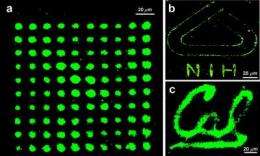
These highly-magnified images are composed of tiny nanoparticles produced by a "NanoPen." Credit: Wikimedia Commons

Researchers in California are reporting development of a so-called "NanoPen" that could provide a quick, convenient way of laying down patterns of nanoparticles — from wires to circuits — for making futuristic electronic devices, medical diagnostic tests, and other much-anticipated nanotech applications. A report on the device, which helps solve a long-standing challenge in nanotechnology, appeared in ACS' Nano Letters.

In the new study, Ming Wu and colleagues point out that researchers have already developed several different techniques for producing patterns of , which are barely 1/50,000th the width of a human hair. But current techniques tend to be too complex and slow. They require bulky instrumentation and take minutes or even hours to complete.

These techniques also require the use of very high temperatures to apply the to their target surfaces. Such limitations prevent widespread application of such techniques, the researchers say.

The scientists say their NanoPen solves these problems. In lab studies, the researchers used it to deposit various nanoparticles into specific patterns in the presence of relatively low light and temperature intensities. The process, which requires the use of special "photoconductive" surfaces, takes only seconds to complete, they note.

Manufacturers can adjust the size and density of the patterns by adjusting the voltage, light intensity, and exposure time applied during the process, the researchers say.

More information: "NanoPen: Dynamic, Low-Power, and Light-Actuated Patterning of Nanoparticles,"

Source: American Chemical Society (news : web)


print this article email this article download pdf blog this article bookmark this article     Stumble it Digg this share on Facebook retweet share on Reddit add to delicious
Rate this story - 4.4 /5 (7 votes)


September 2, 2009 all stories

Comments: 0

4.4 /5 (7 votes)
  • Stumble this up

  • Digg this

  • share this

  • hide
  • Related Stories


  • hide
  • Relevant PhysicsForums posts

  • Selenocysteine in pH=7
    created 15 hours ago
  • What is the formula for calculating the speed of thought?
    created 20 hours ago
  • What does word "absorption" mean in the intestine?
    created 20 hours ago
  • What is transpulmonary pressure?
    created Nov 24, 2009
  • More from Physics Forums - Biology

Other News

Nanowire Formation

Nanowires key to future transistors, electronics

Nanotechnology / Nanophysics

created 13 hours ago | popularity 4.8 / 5 (5) | comments 1

(PhysOrg.com) -- A new generation of ultrasmall transistors and more powerful computer chips using tiny structures called semiconducting nanowires are closer to reality after a key discovery by researchers ...


Nanotube defects equal better energy and storage systems

Nanotube defects equal better energy and storage systems

Nanotechnology / Nanomaterials

created Nov 19, 2009 | popularity 4.4 / 5 (10) | comments 2

(PhysOrg.com) -- Most people would like to be able to charge their cell phones and other personal electronics quickly and not too often. A recent discovery made by UC San Diego engineers could lead to carbon ...


Water droplets direct self-assembly process in thin-film materials

Nanotechnology / Nanomaterials

created Nov 23, 2009 | popularity 5 / 5 (4) | comments 2

You can think of it as origami - very high-tech origami. Researchers at the University of Illinois have developed a technique for fabricating three-dimensional, single-crystalline silicon structures from thin films by coupling ...


Using superconducting probes to get a picture of what it's like inside CNTs

Nanotechnology / Nanophysics

created Nov 20, 2009 | popularity 4.4 / 5 (9) | comments 0

(PhysOrg.com) -- "Carbon nanotubes are exciting for fundamental physics, and for potential technological applications," Nadya Mason tells PhysOrg.com. "However, we are generally limited in the way that we can study them. ...


Fast, easy, and highly sensitive arsenic detection with gold nanoparticles

Nanotechnology / Nanomaterials

created Nov 25, 2009 | popularity 5 / 5 (1) | comments 0

(PhysOrg.com) -- Mention of arsenic poisoning usually brings to mind underhanded murder. However, the danger of arsenic poisoning from contaminated drinking water is far greater. Low concentrations of arsenic are found in ...