First genetic link between reptile and human heart evolution
September 2, 2009
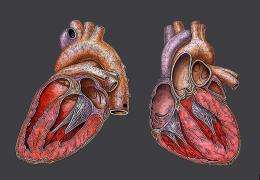
Image: Wikimedia Commons
Scientists at the Gladstone Institute of Cardiovascular Disease have traced the evolution of the four-chambered human heart to a common genetic factor linked to the development of hearts in turtles and other reptiles.
The research, published in the September 3 issue of the journal Nature, shows how a specific protein that turns on genes is involved in heart formation in turtles, lizards and humans.
"This is the first genetic link to the evolution of two, rather than one, pumping chamber in the heart, which is a key event in the evolution of becoming warm-blooded," said Gladstone investigator Benoit Bruneau, PhD, who led the study. "The gene involved, Tbx5, is also implicated in human congenital heart disease, so our results also bring insight into human disease."
From an evolutionary standpoint, the reptiles occupy a critical point in heart evolution.
While bird and mammalian hearts have four chambers, frogs and other amphibians have three. "How did hearts evolve from three to four chambers?" Bruneau said. "The different reptiles offer a sort of continuum from three to four chambers. By examining them, we learned a lot about how the human heart chambers normally form."
He explained that with four chambers—two atria and two ventricles—humans and all other mammals have completely separate blood flows to the lungs and to the rest of the body, which is essential for us to be warm-blooded.
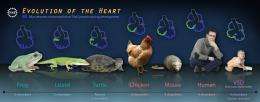
Embryo hearts show evolution of the heart from a three-chambered in frogs to a four-chambered in mammals. Credit: Zina Deretsky, National Science Foundation after Benoit Brueau, the Gladstone Institute of Cardiovascular Disease
When it comes to reptiles, such as turtles and lizards, there is debate about whether they have one or two ventricles, which are the pumping chambers. "The main question for us to understand the evolution of the heart was to identify the true nature of these early reptile ventricles and to figure out what controls the separation of the heart into left and right sides," said Dr. Bruneau.To better understand reptile heart evolution, Dr. Bruneau's team used modern molecular genetics to examine Tbx5. Mutations in the human gene that encodes Tbx5 result in congenital heart disease and, in particular, defects in the ventricular septum, the muscular wall that separates the ventricle into two sections. Tbx5 is a transcription factor, a protein that turns other genes on or off. In humans and other mammals, Tbx5 levels are high in the left ventricle and low in the right. The boundary of high and low levels is right where the septum forms to divide the ventricle into two parts. "Based on these observations," said Dr. Bruneau, "we thought Tbx5 was a good candidate as a key player in the evolution of septation."
The team looked at Tbx5 distribution in the turtle and the green anole lizard. During the early stages of heart formation in both reptiles, Tbx5 activity is found throughout the embryonic ventricular chamber. In the lizard, which forms only one ventricle, this pattern stays the same as the heart develops. However, in the turtle, which has a primitive septum that partially separates the ventricles into left and right sides, distribution of Tbx5 is later gradually restricted to the area of the left ventricle, resulting in a left-right gradient of Tbx5 activity. This meant that the gradient of Tbx5 forms later and less sharply in the turtle than in species with a clear septum, such as mammals, providing a tantalizing clue about how septation evolved.
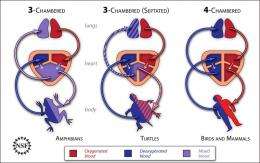
The three-chambered frog heart mixes oxygenated and deoxygenated blood in the ventricle. Therefore, the body never receives fully oxygen-rich blood. In turtles, where a septum begins to form and separate the ventricles, the body receives slightly richer blood in oxygen. It is only in the warm-blooded model, in birds and mammals, that the two circulatory systems become fully separate sending low-pressure pumping to the lungs, and a high-pressure flow of blood to the rest of the body. In this model, the animal's muscles receive fully oxygenated blood. Credit: Credit: Zina Deretsky, National Science Foundation
They then wanted to determine whether Tbx5 was really a main regulator of septation or merely a bystander. Mice were genetically engineered to express Tbx5 at a moderate level throughout the developing heart, just like in turtle hearts. By mimicking the turtle pattern, mouse hearts now resembled turtle hearts. The offspring from these mice died young and had only a single ventricle. This striking result conclusively showed that a sharp line delineating an area of high level of Tbx5 is critical to induce formation of a septum between the two ventricles."This really nailed the importance of Tbx5 in patterning the heart to allow septation to occur," said Dr. Bruneau.
During evolution, new genetic regulatory elements evolved to tell the Tbx5 gene to form a sharp boundary of Tbx5 expression. This resulted in two ventricles. Researchers will now work to identify those genetic regulatory mechanisms during the evolution of reptiles. The work also has important implications for the understanding of congenital heart defects, which are the most common human birth defect, occurring in one out of every one hundred births worldwide. Humans born with only one pumping chamber, resembling frog hearts, suffer the highest mortality and require extensive surgery as newborns.
"Our study provides exciting new insights into the evolution of the heart, which had not been examined in over 100 years," Dr. Bruneau explained. "In a larger context, it provides good support for the concept that changes in the expression levels of various regulatory molecules are important in evolution. From these studies we also hope to understand further how defects in septation occur in humans with congenital heart disease."
-
Scientists identify key factors in heart cell creation
Apr 26, 2009 |
not rated yet |
0
-
Scientists identify single microRNA that controls how heart chambers form
Oct 27, 2008 |
not rated yet |
0
-
Gene Mutation Leads to 'Broken Hearts'
Jul 21, 2006 |
not rated yet |
0
-
Researchers examine developing hearts in chickens to find solutions for human heart abnormalities (Video)
Jan 21, 2009 |
not rated yet |
0
-
Severe heart defect likely caused by genetic factors
Oct 10, 2007 |
not rated yet |
0
-
Engineers build first sub-10-nm carbon nanotube transistor
Feb 01, 2012 |
4.9 / 5 (30) |
30
-
Something old, something new: Evolution and the structural divergence of duplicate genes
Jan 31, 2012 |
4.6 / 5 (7) |
1
-
The hidden nanoworld of ice crystals: Revealing the dynamic behavior of quasi-liquid layers
Jan 30, 2012 |
5 / 5 (3) |
1
-
Stock market network reveals investor clustering
Jan 27, 2012 |
3.9 / 5 (23) |
8
-
Of microchemistry and molecules: Electronic microfluidic device synthesizes biocompatible probes
Jan 26, 2012 |
5 / 5 (1) |
0
-
Classical and Quantum Mechanics via Lie algebras
Apr 15, 2011
- More from Physics Forums - Independent Research
More news stories
FDA-approved drug rapidly clears amyloid from the brain, reverses Alzheimer's symptoms in mice
Neuroscientists at Case Western Reserve University School of Medicine have made a dramatic breakthrough in their efforts to find a cure for Alzheimer's disease. The researchers' findings, published in the journal Science, show t ...
Medicine & Health / Neuroscience
9 hours ago |
5 / 5 (30) |
7
|
Anyone can learn to be more inventive, cognitive researcher says
There will always be a wild and unpredictable quality to creativity and invention, says Anthony McCaffrey, a cognitive psychology researcher at the University of Massachusetts Amherst, because an "Aha moment" is rare and ...
Medicine & Health / Psychology & Psychiatry
5 hours ago |
4.7 / 5 (3) |
0
|
Cell biologists describes mechanism by which some people may be more susceptible to colon cancer
An international research team led by cell biologists at the University of California, Riverside has uncovered a new insight into colon cancer, the third leading cause of cancer-related deaths in the United ...
5 hours ago |
5 / 5 (1) |
0
|
Researchers weigh in on ethics of H5N1 research
(Medical Xpress) -- In a commentary on the biosecurity controversy surrounding publication of bird flu research details, a bioethicist and a vaccine expert at Johns Hopkins reaffirm that "all scientists have an affirmativ ...
7 hours ago |
not rated yet |
0
|
To perform with less effort, practice beyond perfection
Whether you are an athlete, a musician or a stroke patient learning to walk again, practice can make perfect, but more practice may make you more efficient, according to a surprising new University of Colorado Boulder study.
Medicine & Health / Neuroscience
8 hours ago |
4.4 / 5 (7) |
3
|
'Dark plasmons' transmit energy
Microscopic channels of gold nanoparticles have the ability to transmit electromagnetic energy that starts as light and propagates via "dark plasmons," according to researchers at Rice University.
Hydrogen from acidic water: Researchers develop potential low cost alternative to platinum for splitting water
A technique for creating a new molecule that structurally and chemically replicates the active part of the widely used industrial catalyst molybdenite has been developed by researchers with the Lawrence Berkeley ...
Ultraviolet protection molecule in plants yields its secrets
Lying around in the sun all day is hazardous not just for humans but also for plants, which have no means of escape. Ultraviolet (UV) radiation from the sun can damage proteins and DNA inside cells, leading ...
New method makes culture of complex tissue possible in any lab
Scientists at the University of California, San Diego have developed a new method for making scaffolds for culturing tissue in three-dimensional arrangements that mimic those in the body. This advance, published online in ...
Flexible paper robots
(PhysOrg.com) -- These inexpensive robots can stretch, bend and twist under control, and lift objects up to 120 times their own weight. Being soft, they can apply gentle and even pressure, and adapt to varied ...
Deadly bird parasite evolves at exceptionally fast rate
A new study of a devastating bird disease that spread from poultry to house finches in the mid-1990s reveals that the bacteria responsible for the disease evolves at an exceptionally fast rate. What's more, ...


Sep 02, 2009
Rank: 2.5 / 5 (2)
Sep 02, 2009
Rank: not rated yet
Sep 02, 2009
Rank: not rated yet
Sep 03, 2009
Rank: not rated yet
that would also test smiffy's point, which i am kinda skeptical about.
Sep 03, 2009
Rank: not rated yet
Find a new sponsor.
Oh yes
Go away.
Just go away.
Don't ya come back no more no more.
Ethelred
Sep 03, 2009
Rank: not rated yet
Ethelred
Sep 04, 2009
Rank: not rated yet
It doesn't have to happen simultaneously. Parts can develop at different rates. This can be seen by looking at that turtle. It has a mix of parts and survive.
The full four chambered heart is only needed once the rest of the organism has adapted to having such a thing and becomes dependent upon it not just for periods of great exertion but all the time.
This looks to me to have occurred in a common ancestor of dinosaurs, crocodilians and mammal like reptiles.
Ethelred
Sep 04, 2009
Rank: not rated yet
Looking at the graphic of the turtle's heart it's obvious that the more the septum grows the more efficient the heart becomes - and the septum can grow as fast or as slow as it likes. Given this setup, advancing to a four chambered heart is bound to happen. The only limitation I can see is that the lung tissues should have their own independent blood supply (that's to say they must not depend, if they ever did, on the partially oxygenated blood coming through the pulmonary artery which will become less oxygenated over time as the septum grows.)
What I have found out in my travels in GoogleLand is that the right ventricle has a different kind of lining to it than the left, owing to the fact that the right is no longer in contact with oxygenated blood. The lining is tougher as a result.
"...progressive ventricular septation is accompanied by progressive coronary support to the heart and the replacement of spongy myocardium with compact tissue."
EVOLUTION OF THE VERTEBRATE CARDIO-PULMONARY SYSTEM Farmer 1999
This might be an alternative explanation for the role of the gene, Tbx5. To replace the spongy tissue with the tougher stuff. Certainly the location of the gene seems to parallel that part of the lining which receives the least oxygenated blood and it advances around the lining as you would expect, as the septum grows. Removing the gene may have caused the mouse's septum to vanish if there was no spongy tissue to fall back on, as you might expect with a structure that never came into contact with oxygenated blood and therefore was always only compact tissue, at least on one side.