Israeli archaeologists find ancient fortification
September 2, 2009
Israeli archaeologists find ancient fortification (AP)

Enlarge

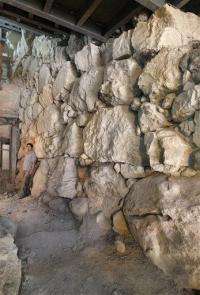
This image made available by Israel's Antiquities Authority Wednesday, Sept. 2, 2009 shows part of a a 3,700-year-old fortification wall discovered in Jerusalem. Archaeologists have discovered a 3,700-year-old wall in the City of David, part of the earliest fortification construction on such a large scale ever found in Jerusalem, the Israel Antiquities Authority said Wednesday. The 26-foot high wall is believed to have been part of a protected passage used by the Biblical Canaanites that led from a fortress on top of a hill to a spring. Ronny Reich, director of the excavation and a professor of archaeology at the University of Haifa, said the discovery marks the first time such "massive construction" before the time of King Herod was found in the oldest parts of the city. (AP Photo/IAA)

(AP) -- Archaeologists digging in Jerusalem have uncovered a 3,700-year-old wall that is the oldest example of massive fortifications ever found in the city, the Israel Antiquities Authority said Wednesday.

The 26-foot-high wall is believed to have been part of a protected passage built by ancient Canaanites from a hilltop fortress to a nearby spring that was the city's only water source and vulnerable to marauders.

The discovery marks the first time have found such massive construction from before the time of Herod, the ruler behind numerous monumental projects in the city 2,000 years ago, and shows that Jerusalem of the Middle Bronze Age had a powerful population capable of complex building projects, said Ronny Reich, director of the excavation and an archaeology professor at the University of Haifa.

The wall dates to the 17th century B.C., when Jerusalem was a small, fortified enclave controlled by the Canaanites, one of the peoples the Bible says lived in the Holy Land before the Hebrew conquest. The kingdom thought to have been ruled from Jerusalem by the biblical King David is usually dated to at least seven centuries later.

A small section of the wall was first discovered in 1909, but diggers have now exposed a 79-foot portion, and Reich believes it stretches much further. Reich said budget constraints related to the global financial crisis put an end to the excavation, at least for now.

"The wall is enormous, and that it survived 3,700 years - this is, even for us, a long time," Reich said. It was remarkable that a of this kind was not dismantled for later building projects, he said.

"When you just stand there and see it, it is amazing," he said.

The wall and other archaeological finds at the site will be opened to the public beginning Thursday, the Antiquities Authority said.

Archaeological research at the site known as the City of David, just outside the walls of Jerusalem's Old City, is caught up in the struggle for control over the city.

The archaeological site, one of the richest in a country full of ancient remains, is in the midst of a Palestinian neighborhood in east Jerusalem.

The City of David digs are funded by Elad, a Jewish settler organization that also buys Palestinian homes and brings Jewish families into the neighborhood. Palestinian and Israeli critics have charged that the archaeology is being used as a political tool to cement Jewish control over parts of Jerusalem that Palestinians want for the capital of a future state.

Israel captured the Arab section of Jerusalem in the 1967 Mideast war. Unlike other areas it captured, Israel quickly annexed east and declared the whole city as its capital. In some rounds of failed peace talks, Israel has indicated willingness to cede Arab sections to a Palestinian state, but no agreement was reached.

The current Israeli government of Prime Minister Benjamin Netanyahu has taken such offers off the table, and no peace negotiations are in progress now.

©2009 The Associated Press. All rights reserved. This material may not be published, broadcast, rewritten or redistributed.

3.9 /5 (10 votes)  

Filter


Move the slider to adjust rank threshold, so that you can hide some of the comments.


Display comments: newest first

docknowledge
Sep 02, 2009

Rank: 1 / 5 (6)
I hate to say it, but as much as I enjoy reading these articles -- and with a degree in history, I'm not exactly a beginner -- what exactly is the point of endless, isolated reports of a wall found somewhere, a tool uncovered, use of a plant in crops pushed back 200 years?

This is all on the level of gee-whiz babel. People didn't construct walls 3,500 years ago? Or good walls? Or...what? What does this article really say, except that people 3,500 years ago felt it was necessary to construct a wall. Maybe the wall was cosmetic. Maybe they were wrong, and the wall never stopped any attack. Maybe it was the Bronze Age equivalent of "white elephant".

And even supposing this is an important discovery. How does it compare with the walls of foes? Of other cultures.

In the end, what is the purpose of these "pop culture" newsbites?
Mandan
Sep 02, 2009

Rank: 5 / 5 (4)
You might as well be a contractor asking the question "What is the purpose of all these measurements, cross-sections, and other drawings on this blueprint?"

I too, hold a degree in history, and I cannot imagine what you actually must have studied, or how poor your instruction must have been in order to leave the appreciation of cumulative knowledge so dead inside you. Or perhaps you should have taken an archaeology course or two, and maybe some cultural and physical anthropology. Then you would know how crucial the distribution of artifacts to our knowledge of the past really is.

Where would our knowledge of ancient Egypt be today if the Rosetta Stone had not been unearthed by Napoleion's armies? Or Sir Arthur Evans' excavations on Crete which unearthed Linear A and B? Henry Rawlinson and his deciphering of various forms of cuneiform? What of the ongoing translation of Mayan writings on temples in Central America, shining light on an entire history that would have been otherwise lost forever? What of the importance of position and distribution of pottery shards and other cultural artifacts at a particular archaeological site, which can then be correlated with other sites in the region, shining light on everything from migration patterns to dating timelines, to boundaries between cultural groups, from those periods before written descriptions are available or do not address such issues?

Monumental architecture-- such as these walls-- is evidence of a very advanced stage of agricultural-based, sedentary human existence, indicating an advanced degree of division of labor, and probably the existence of socioeconomic classes, overseen by ruling elites, practicing hierarchical religion and engagin in organized warfare.

Why don't you stop reading sites like this if such knowledge perturbs you so much? Really, your comment is quite possibly the most bizzare I have ever seen. Geezus.
RayCherry
Sep 03, 2009

Rank: 5 / 5 (1)
The wall itself may be insignificant today, but it may - in conjunction with ancient texts, biblical or not - provide a major clue to where many more remains of that culture may be discovered.

Although some (and they are few in reality) use such discoveries to reinforce their religious ferver, continuous verification of details from the bible and similar texts helps modern appreciation of how such documents were used to record with impressive accuracy the stories of the different tribes that later spread through Europe, North Africa and Western Asia.

Congratulations to the discoverers. I hope they will permit the whole world to share in the new opportunities that it will open up.
Velanarris
Sep 03, 2009

Rank: not rated yet
I hate to say it, but as much as I enjoy reading these articles -- and with a degree in history, I'm not exactly a beginner -- what exactly is the point of endless, isolated reports of a wall found somewhere, a tool uncovered, use of a plant in crops pushed back 200 years?

As said above, that's a very poor line for someone with a degree in history to spout.
retrosurf
Sep 03, 2009

Rank: not rated yet
In Israel, there is an aspect to archaeology that is
absent from the rest of the world. There are politics
involved. From the end of the article:

Palestinian and Israeli critics have charged that the archaeology is being used as a political tool to cement Jewish control over parts of Jerusalem that Palestinians want for the capital of a future state.
Velanarris
Sep 03, 2009

Rank: not rated yet
In Israel, there is an aspect to archaeology that is absent from the rest of the world. There are politics involved. From the end of the article:

Palestinian and Israeli critics have charged that the archaeology is being used as a political tool to cement Jewish control over parts of Jerusalem that Palestinians want for the capital of a future state.


That's not exclusive to Israel. Look at the Balkans, the Black Sea region, the war ravaged Ethopian regions and almost all of South America.


It's a very common practice to use archaeology in politics, and to an extent, espionage.
docknowledge
Sep 03, 2009

Rank: 1 / 5 (1)
It's a wall, folks. A bunch of broken rock work. I know what walls look like. Old walls, new walls.

What do you know now, after reading the article that you didn't know before? What will you remember, a week from now?

I.e., what's the point of the article.?
Mandan
Sep 03, 2009

Rank: 5 / 5 (2)
In Israel, there is an aspect to archaeology that is


absent from the rest of the world. There are politics


involved. From the end of the article:


Palestinian and Israeli critics have charged that the archaeology is being used as a political tool to cement Jewish control over parts of Jerusalem that Palestinians want for the capital of a future state.


This is an absurd statement. Israel is not the only place politics are involved. Just yesterday the following article appeared showing how restrictive the Saudi government is when even allowing non-Islamic items to be put on display in museums, let alone to allow excavations at ancient sites that expose the long, pre-Islamic history of the Arabian Peninsula itself:


http://www.google...0lwZ9LQ-


The Israelis do not deny that the land was inhabited before they took it. In fact, the book of Joshua describes this "taking" of the land in quite graphic detail. It is a shocking example, perhaps the first recorded, of what can only be described as genocide in history. Interestingly enough, such archaeological sites as the one being discussed here have yet to disgorge any evidence that any of the described events actually occurred. No massive fires, no sudden changes in pottery style, burial types, or any of the other things you would expect (one reason why we study "walls"-- docknowledge) if a drastic, sudden change in populations had indeed occurred in the region as described in the Jewish scriptures. It is clear, however, that at some point, probably by slow, peaceful immigration, the Hebrews did arrive. This wall dates to before that time.


The Israelites lived in the region until the Muslims (led by the Arabs) arrived and took possession of the land 2000 years later, and built their holy sites atop Jewish and Christian holy sites, after the Israelites had been subjugated, liquidated and enslaved by the Greeks then Romans. Now they complain about the findings of archaeology which show the true timeline.


As the Israelis fully "admit"-- they stole the land from the Canaanites (who built this wall). The only people who have political problems with archaeology in Israel are the Palestinians and the Saudi royal family who see such artifacts as these unearthed from under their feet and know that they have not always been the lords of the land, but that many people have lived there-- long before the relatively-recent arrival of Allah's armies. In fact, evidence for human habitation of the region dates back through Neanderthals and before. It is, after all, the crossroads of the world.


Israel is a secular state which at least allows such archaeological work as this to go on, and their results to be put on public display, whether or not those results support what is written in the Jewish Bible or not, and whether or not they buttress Israel's claim to the land or not.


What we have, is the descendants of one group of ancient inhabitants who have returned to engage in a struggle with a more recent group of arrivals for control of a land which has been controlled by many different people dating back to the dawn of time. It is indeed a tricky issue. But it is consistently the Palestinians who try to deny the Israeli/Jewish heritage-- not the other way around. The Israelis are more than willing to admit the Arabs lived there for 1,400 years-- after the Jews had lived there for 2,000.


I often wonder what I would do, living here on land which was stolen from the Cheyenne and Arapaho just a century ago, if those peoples came back together and demanded it be returned? Would I give it to them? How many centuries of living on stolen land does it take before land becomes the actual property of the descendants of the thieves? Australia? South America? Anglo-Saxons? Normans?


After all who, outside of the Great African Rift Valley, is not a thief?


These questions explain why I study evolution, history, archaeology, anthropology-- but most importantly cognitive neuroscience. We must find the answers to our future in our past, or we will join the rest of the fossils in their silence. Go ahead and dismiss such knowledge as "boring" or deny its existence or ramifications as feeding political maneuverings. The truth is the truth, and the past is the past, and by teasing it out of the earth where it is buried wall-by-wall, stone-by-stone, tablet-by-tablet, and grain-by-grain-- perhaps one day we will learn somehow to co-exist.


docknowledge
Sep 04, 2009

Rank: 1 / 5 (1)
Right, Mandan. These "historical" arguments are among the most biased, bigoted, and unproductive beliefs in all of human culture. That someone has a "right" to take land from someone else...or that one culture is "better" because a *single individual* in that culture made an invention.

***

And to follow up my seemingly unreasonable "so what" comment about the wall, try reading http://www.archae...rg/news/ for a couple years. After the 6th wall discovered in the last month -- that you never hear about again -- you begin to realize most of these articles are just "woo" cruft.
docknowledge
Sep 04, 2009

Rank: 3 / 5 (2)
Aaaaaaannnnd...now...an article that actually explains something of why this find is important...

http://www.cnn.co...dex.html
Rank 3.9 /5 (10 votes)
Related Stories
Relevant PhysicsForums posts
  • Mitosis
    created1 hour ago
  • Stem cell question.
    created3 hours ago
  • Protease cleavage
    created9 hours ago
  • Pertubance in a model
    created16 hours ago
  • Cancer drugs and Alzheimer's, Oh my!
    createdFeb 09, 2012
  • Squishing cells
    createdFeb 09, 2012
  • More from Physics Forums - Biology

More news stories

A frank discussion of the power law and linking correlation to causation

(PhysOrg.com) -- Michael Stumpf a mathematics professor at Imperial College in London, and Mason Porter a lecturer at Oxford have teamed together to write and publish a perspective piece in Science regarding the in ...

Other Sciences / Mathematics

created 16 hours ago | popularity 5 / 5 (3) | comments 6 | with audio podcast report

Employers feel no love for unscrupulous practice of 'service sweethearting'

A new study led by two Florida State University marketing professors finds that some frontline service employees who are rewarded for hikes in customer loyalty and satisfaction also may engage in "service ...

Other Sciences / Economics & Business

created 10 hours ago | popularity 4 / 5 (1) | comments 4

The question of life in the ancient world

There’s a general feeling that we don’t get the Greeks – ancient or modern. Many, including heads of state like Angela Merkel, visibly shake their head in exasperation, rightly or wrongly, at ...

Other Sciences / Archaeology & Fossils

created 15 hours ago | popularity 1.3 / 5 (3) | comments 4

Sonic Cradle lands spot in TED exhibition

A Simon Fraser University graduate student project that melds music, meditation and modern technology has landed a rare spot as an exhibit at TEDActive 2012 in Palm Springs, California this month.

Other Sciences / Other

created 12 hours ago | popularity not rated yet | comments 0

Chilean miners' rescue capsule on show in London

The capsule used to rescue Chilean miners trapped underground for two months goes on display Saturday at the Science Museum in London -- the first time it has been seen in Europe.

Other Sciences / Other

created 14 hours ago | popularity not rated yet | comments 0


Google users warned of threat to smartphone wallets

Users of Google smartphone wallets were being warned on Friday that there is a way to crack pass codes intended to thwart thieves from going on illicit shopping sprees.

Anonymous knocks CIA website offline (Update)

The website of the Central Intelligence Agency was inaccessible on Friday after the hacker group Anonymous claimed to have knocked it offline.

New error-correcting codes guarantee the fastest possible rate of data transmission

Error-correcting codes are one of the triumphs of the digital age. They’re a way of encoding information so that it can be transmitted across a communication channel — such as an optical fiber o ...

Complex wiring of the nervous system may rely on a just a handful of genes and proteins

Researchers at the Salk Institute have discovered a startling feature of early brain development that helps to explain how complex neuron wiring patterns are programmed using just a handful of critical genes. ...

Humans may have helped the decline of African rainforests 3000 years ago

(PhysOrg.com) -- Large areas of rainforests in Central Africa mysteriously disappeared over three thousand years ago, to be replaced by savannas. The prevailing theory has been that the cause was a change ...

New power source discovered

(PhysOrg.com) -- Researchers at the Massachusetts Institute of Technology (MIT) and RMIT University have made a breakthrough in energy storage and power generation.