Chemists Reach from the Molecular to the Real World with Creation of 3-D DNA Crystals
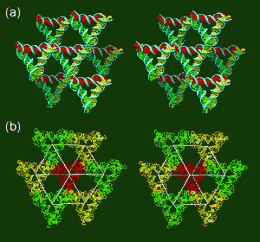
(PhysOrg.com) -- New York University chemists have created three-dimensional DNA structures, a breakthrough bridging the molecular world to the world where we live. The work, reported in the latest issue of the journal Nature, also has a range of potential industrial and pharmaceutical applications, such as the creation of nanoelectronic components and the organization of drug receptor targets to enable illumination of their 3D structures.
While scientists, including those involved in this study, have previously designed and built crystal structures, these compositions have been two-dimensional—that is, their axes are on a single plane— and are not the most complete representation of crystals.
To address this limitation, the research team, headed by NYU Chemistry Professor Nadrian Seeman, sought to design and build three-dimensional DNA crystals—a process that requires significant spatial control of the 3D structure of matter. The project also included researchers from Purdue University's Department of Chemistry and the Argonne National Laboratory in Illinois.
To do this, the researchers created DNA crystals by making synthetic sequences of DNA that have the ability to self-assemble into a series of 3D triangle-like motifs. The creation of the crystals was dependent on putting "sticky ends"—small cohesive sequences on each end of the motif—that attach to other molecules and place them in a set order and orientation. The make-up of these sticky ends allows the motifs to attach to each other in a programmed fashion.
Seeman and his colleagues had previously created crystals using this process. However, because these crystals self-assembled on the same plane, they were two-dimensional in composition. In the work reported in Nature, the researchers expanded on the earlier efforts by taking advantage of DNA's double-helix structure to create 3D crystals. The 2D crystals are very small—about 1/1000th of a millimeter—but the 3D crystals are between 1/4 and 1 millimeter, visible to the naked eye.
DNA's double helices form when single strands of DNA—each containing four molecular components called bases, attached to backbone—self-assemble by matching up their bases. The researchers added sticky ends to these double helices, forming single-stranded overhangs to each double helix. Where these overhanging sticky ends were complementary, they bind together to link two double helices. This is a common technique used by genetic engineers, who apply it on a much larger scale. By linking together multiple helices through single-stranded sticky ends, the researchers were able to form a lattice-like structure that extends in six different directions, thereby yielding a 3D crystal.
"With this technique we can organize more matter and work with it in many more ways than we could with 2D crystals," Seeman observed.
A promising avenue for the application of this approach is in nanoelectronics, using components no bigger than single molecules. Currently, such products are built with 2D components. Given the enhanced flexibility that 3D components would yield, manufacturers could build parts that are smaller and closer together as well as more sophisticated in design.
The scientists also expect that they can organize biological macromolecules by attaching them to these crystals. This can help in the development of drugs because macromolecules arranged in crystals can be visualized by a technique known as X-ray crystallography. By adding drugs to these crystals, their interactions with these biological components can be visualized.
X-ray diffraction data were collected from DNA crystals and their iodinated derivatives on beamlines X6A and X25 at the National Synchrotron Light Source (NSLS) at Brookhaven National Laboratory in Upton, New York and on beamline ID19 at the Structural Biology Center at Advanced Photon Source in Argonne, Illinois.
Bob Sweet, a biophysicist and the leader of the group who run NSLS beamline X25, observed, "This is one of the neatest structures I've seen in years. It really connects biotechnology to nanotechnology. We've been helping these folks for over a dozen years, and they really hit the ball out of the park. It's beautiful!"
Source: New York University (news : web)


