No strain for Andromeda: Galaxy is cosmic cannibal (w/ Video)
September 2, 2009
No strain for Andromeda: Galaxy is cosmic cannibal (AP)

Enlarge

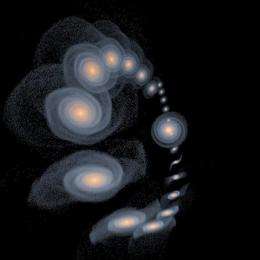
This undated artist's rendering provided by the University of Cambridge, England, shows the spiral galaxy of Andromeda, center right, over a period of about three billion years as repeated, but modified views of the dwarf galaxy Triangulum, move away from it, clockwise towards Earth, then back towards it, where Triangulum will be ultimately devoured by the Andromeda galaxy says astronomer John Dubinski. (AP Photo/Illustration by John Dubinski and Larry Widrow)

(PhysOrg.com) -- A huge galaxy neighbouring our own Milky Way appears to have expanded by "digesting" smaller galaxies nearby, a new study has shown.

The survey of the Andromeda Galaxy, which lies approximately 2.5million light years away, has revealed what seems to be evidence of the cosmic formation process absorbing some of its nearest neighbours.

An international team of astronomers, including scholars from the University of Cambridge, made the observations during an ongoing survey of Andromeda using the Canada-France-Hawaii telescope and its MegaCam/MegaPrime digital camera.

The study, which is the biggest of its kind, took in an area with a diameter equivalent to one million light years, enabling scientists to produce the broadest and deepest panoramic image of a galaxy ever made. The results will be published in the journal Nature on September 3rd.

This video is not supported by your browser at this time.

Watch a movie simulation of the Triangulum Galaxy orbiting the Andromeda Galaxy.

Theory holds that galaxies evolve and grow by absorbing smaller galaxies over time. One way to test this is to find the leftovers from this process. Finding these faint structures is difficult, since it involves looking over an area hundreds of time larger than the main "disc" at the galaxy's centre.

The new study found streams and structures on the fringes of Andromeda which appear to be the leftovers from exactly this sort of process. It suggests that Andromeda has expanded by cannibalising other galaxies nearby, and that the process is still under way.

"This is a startling visual demonstration of the truly vast scale of galaxies," Dr Mike Irwin, from the University of Cambridge's Institute of Astronomy and one of the report's lead authors, said. "The survey has produced an unrivalled panorama of galaxy structure which reveals that galaxies are the result of an ongoing process of accretion and interaction with their neighbours."

Andromeda is the nearest large galaxy visible to the naked eye from the Northern Hemisphere. The researchers charted the unexplored outskirts of the galaxy for the first time, detecting stars and giant structures in the process.

Although these now form part of its furthest reaches, many of these stars could not have formed within Andromeda itself because the density of gas so far from the galaxy's core would have been too low to allow formation to take place. Therefore, the team reason that they are almost certainly the remnants of other, smaller galaxies which have been absorbed by Andromeda - and that Andromeda itself is still in a state of expansion.

On a similar basis, the paper argues that the larger-scale substructures identified on the galaxy's fringes are probably the "undigested" remains of previously accreted dwarf galaxies. In all likelihood, they originally belonged to dwarf galaxies or other, proto-galactic fragments.

The results also indicate that Andromeda is presently interacting with a nearby region called the Triangulum Galaxy, which is also visible in the Northern Hemisphere using a small telescope. "Ultimately, these two galaxies may end up merging completely," Dr Scott Chapman, Reader in Astrophysics at the Institute of Astronomy, University of Cambridge, said. "Ironically, galaxy formation and galaxy destruction seem to go hand in hand."

Provided by University of Cambridge

4.6 /5 (9 votes)  

Filter


Move the slider to adjust rank threshold, so that you can hide some of the comments.


Display comments: newest first

yyz
Sep 02, 2009

Rank: 5 / 5 (2)
An e-print of the paper as well as a short movie of the interaction of M 33 with M 31 can be found here: http://arxiv.org/abs/0909.0398 .
yyz
Sep 02, 2009

Rank: 5 / 5 (1)
Additional evidence for a past interaction between M 33 and M 31 was the discovery of an HI bridge between the two galaxies. The 2008 paper can be found here: http://arxiv.org/abs/0807.1161 .
Rank 4.6 /5 (9 votes)
Related Stories
Relevant PhysicsForums posts
  • Titan's lack of impact craters
    created17 hours ago
  • Real pictures of black hole eating a star?
    createdFeb 08, 2012
  • Hypothetical way to travel faster than light, but not technically exceed lightspeed
    createdFeb 06, 2012
  • How do scientists monitor the Sun's activity?
    createdFeb 05, 2012
  • Search patterns in observational studies
    createdFeb 05, 2012
  • Derivation of Pogson's law
    createdFeb 03, 2012
  • More from Physics Forums - General Astronomy

More news stories

New views show old NASA Mars landers

(PhysOrg.com) -- The High Resolution Imaging Science Experiment (HiRISE) camera on NASA's Mars Reconnaissance Orbiter recorded a scene on Jan. 29, 2012, that includes the first color image from orbit showing ...

Space & Earth / Space Exploration

created 20 hours ago | popularity 4.9 / 5 (7) | comments 8 | with audio podcast

Deconstructing a mystery: What caused Snowmaggedon?

In the quiet after the storms, streets and cars had all but disappeared under piles of snow. The U.S. Postal Service suspended service for the first time in 30 years. Snow plows struggled to push the evidence ...

Space & Earth / Earth Sciences

created 12 hours ago | popularity 4.7 / 5 (3) | comments 1 | with audio podcast

Black holes and star formation

(PhysOrg.com) -- It has long been recognized that galaxy mergers or even close interactions can play a vital role in shaping the morphology of galaxies. One way they can do so, it is thought, is by triggering ...

Space & Earth / Astronomy

created 19 hours ago | popularity 4.1 / 5 (7) | comments 5 | with audio podcast

Ocean microbe communities changing, but long-term environmental impact is unclear

As oceans warm due to climate change, water layers will mix less and affect the microbes and plankton that pump carbon out of the atmosphere – but researchers say it's still unclear whether these processes ...

Space & Earth / Earth Sciences

created 14 hours ago | popularity 5 / 5 (2) | comments 2 | with audio podcast

Researchers create 3-D laser maps that show how earthquake changes landscape

Geologists have a new tool to study how earthquakes change the landscape down to a few inches, and it's giving them insight into how earthquake faults behave. In the Feb. 10 issue of the journal Science, a team ...

Space & Earth / Earth Sciences

created 14 hours ago | popularity 5 / 5 (4) | comments 0 | with audio podcast


'Dark plasmons' transmit energy

Microscopic channels of gold nanoparticles have the ability to transmit electromagnetic energy that starts as light and propagates via "dark plasmons," according to researchers at Rice University.

FDA-approved drug rapidly clears amyloid from the brain, reverses Alzheimer's symptoms in mice

Neuroscientists at Case Western Reserve University School of Medicine have made a dramatic breakthrough in their efforts to find a cure for Alzheimer's disease. The researchers' findings, published in the journal Science, show t ...

Hydrogen from acidic water: Researchers develop potential low cost alternative to platinum for splitting water

A technique for creating a new molecule that structurally and chemically replicates the active part of the widely used industrial catalyst molybdenite has been developed by researchers with the Lawrence Berkeley ...

Ultraviolet protection molecule in plants yields its secrets

Lying around in the sun all day is hazardous not just for humans but also for plants, which have no means of escape. Ultraviolet (UV) radiation from the sun can damage proteins and DNA inside cells, leading ...

Soraa LED light may dim 50-watt halogen rivals

(PhysOrg.com) -- Soraa, a Fremont, California company founded in 2008, this week launched its first product, a light that uses LEDS (light emitting diodes). The "Soraa LED MR16 lamp" is the "perfect" replacement ...

Anyone can learn to be more inventive, cognitive researcher says

There will always be a wild and unpredictable quality to creativity and invention, says Anthony McCaffrey, a cognitive psychology researcher at the University of Massachusetts Amherst, because an "Aha moment" is rare and ...