Researcher uses 100,000 degree heat to study plasma
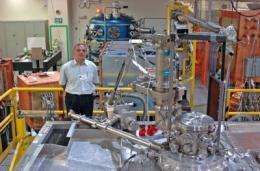
Using one of the greatest sources of radiation energy created by man, University of Nevada, Reno researcher and faculty member Roberto Mancini is studying ultra-high temperature and non-equilibrium plasmas to mimic what happens to matter in accretion disks around black holes.
Physics department professor and chair Mancini has received a $690,000 grant from the U.S. Department of Energy to continue his research in high energy density plasma; plasmas are considered to be the fourth state of matter. He will serve as principal investigator for a project titled "Experiments and Modeling of Photo-ionized Plasmas at Z."
"Receiving awards such as this exemplifies the academic caliber and national importance of the work in our Physics Department," Jeff Thompson, dean of the College of Science said. "We're proud of the team of researchers here working on cutting-edge science."
Mancini has been studying the atomic and radiation properties of high-energy density plasmas for more than 15 years, and this new grant will allow him to further explore what happens to matter when it is subjected to extreme conditions of temperature and radiation - similar to what happens to many astrophysical objects in the universe.
The research will enable astrophysicists to better understand what happens around black holes and in active galactic nuclei. Scientists will also better understand the application of high-energy density plasmas to energy production, such as controlled nuclear fusion (produced in the laboratory), and production of X-ray sources for a variety of applications.
"Using theories and tools created here at the University to design and analyze experiments, we then go to the only national facility that has the capacity to deliver the high-intensity flux of X-rays required to perform and measure these experiments," Mancini said. "We custom build instrumentation in our machine shop that meets the high standard set by the national facility so that it will fit onto the target chamber of the pulsed-power Z-machine, enabling us to conduct this unique experiment."
The pulsed-power machine at the Sandia National Laboratories in New Mexico (similar in concept but larger than the University's Nevada Terawatt Facility Zebra accelerator) is the most powerful source of X-rays on earth, Mancini said.
"We subject a very small cell - a 1-inch by ½-inch cube - filled with a gas, such as neon, to this tremendous, short burst of X-ray energy," he said. "It's about 10 nanoseconds of the most intense power on earth - creating conditions of hundreds of thousands of degrees and millions of atmospheres in pressure - in the form of X-rays."
The researchers can then compare their extensive computer modeling and calculations with the measurements so they can study and explain the extreme state of matter (plasma) created during those 10 nanoseconds, which mimics the majority of matter found throughout the universe.
"We are using a unique imaging X-ray spectrometer to measure the intensity distribution of radiation as a function of wavelength, which tells us what happens with the plasma," Mancini said. From detailed analysis of the data, Mancini can extract the plasma's density, ionization and temperature.
He said the plasma reaches extreme conditions, very unlike the low-energy plasma found in a neon light or a plasma television screen, with light 1,000 times more energetic than visible light, temperature as high as 100,000 degrees Fahrenheit, and ionization mainly driven by the action of the X-ray flux going through the plasma.
The University of Nevada, Reno Physics Department has a team of about 20 scientists, faculty and research associates working on a variety of projects in the field of High Energy Density Plasma Physics Research. Mancini emphasized that having strong research programs is critical for the quality of education and training that the University can provide to students.
Source: University of Nevada, Reno


