Fungal map of mutations key to increasing enzyme production for bioenergy use
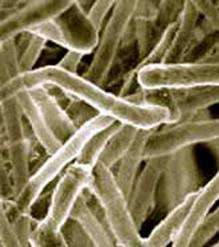
(PhysOrg.com) -- In half a century, one fungus has gone from being the bane of the Army quartermasters' existence in the Pacific to industry staple and someday, as part of the U.S. Department of Energy's mission to promote national energy security through clean, renewable energy development, a biofuel producers' best friend.
Trichoderma reesei's makeover is due in part to scientific explorations that led to the development of mutant fungal strains that produce large quantities of biomass-degrading enzymes.
Now an international team of researchers led by scientists at the DOE Joint Genome Institute (JGI), the French applied research center IFP-- particularly concerned with renewable resources and energies -- and the Vienna University of Technology (TU Vienna) provides the first genome-wide look at what these mutations are in order to understand just how cellulase production was first improved, and how it can be boosted even further.
"We want to understand the path that we've taken to high enzyme production because it isn't exactly known what was done to these strains," said Scott Baker, a DOE JGI scientist at Pacific Northwest National Laboratory who, along with Christian Kubicek of TU Vienna and Antoine Margeot of IFP, is a senior author of the paper published online the week of August 31 in the journal Proceedings of the National Academy of Sciences Online Early Edition. "There were three mutations characterized previously that gave us some clues, but that just touched the tip of the iceberg. There's over 200 mutations we found in the T. reesei genome across 60 genes. We now have a blueprint on which we can do future studies to see which genes are related to the enzymes. If you can produce more enzyme more efficiently, that makes your process -- in this case the production of biofuel -- more economical."
During World War II, T. reesei frustrated American Army quartermasters in the South Pacific by speeding up the rate at which canvas supplies wore out. Now the same fungus is a key producer of industrial enzymes that are used, among other applications, to break down biomass for biofuel production.
Part of the makeover can be attributed to scientists who developed high cellulase-producing strains of the fungus through several rounds of treating the fungus with a variety of mutagens and then screening the resulting mutant strains to select those in which cellulase production had been increased.
To create these high cellulase producing fungal strains, researchers exposed the original strain to two rounds of mutagenesis to create the high-producing strain NG14 and an additional 3rd round to generate RUT C30," said DOE JGI scientist and study co-first author Wendy Schackwitz. "It is not known which of the many induced mutations are responsible for this increased production. With information from this study, you can begin to understand which mutations are involved in boosting cellulase production and which are just baggage."
Schackwitz, her fellow co-first author Stéphane Le Crom from the French institute École Normale Supérieure and their colleagues mapped the mutations found on two hyperproducing strains of T. reesei, performing "massively parallel sequencing" on an isolate of the strain NG14 and two isolates of its direct descendant RUT C30.
The current study complements last year's publication of the T. reesei genome, which was sequenced at the DOE JGI. The authors looked at the sequence of the reference strain named for the Army quartermasters, QM6a, noted Baker. "Now we're looking at strains such as RUT C30, which is a parent strain for many cellulase producing lines used in industry, to figure out how cellulase production might be further boosted without affecting the health of the strain," he added.
Study co-author Randy Berka, a director at the Davis, Calif.-based office of the Danish bioinnovation company Novozymes, one of the largest producers of industrial enzymes, confirmed T. reesei's importance for biotechnical applications. "Most, if not all of the T. reesei strains that are used to produce cellulases today for industrial applications were derived from the ancestral QM6a isolate and its progeny," he said. "Companies have devised ways to generate improved strains from the QM6a pedigree that produce cellulase enzyme products more economically. Along with genome modifications that have improved cellulase production, these methods may introduce negative changes in the genome that affect the organism's robustness."
Using Illumina next generation sequencing technology, Le Crom and his French colleagues did single end reads on the RUT C30 and NG14 isolates while Schackwitz and her DOE JGI colleagues did paired ends reads on the other RUT C30 isolate. Paired end reads consist of short DNA sequences on either end of an unsequenced DNA fragment of known size and serve as a way to narrow down possible regions where the reads can be placed. This additional information allows placement of many reads that are otherwise difficult to align, and using them allowed the DOE JGI team to pick out very short DNA sequences that had been inserted or deleted.
Researchers identified several kinds of novel mutations in the sequences: 223 single nucleotide variants, 15 small insertions or deletions called indels and 18 larger deletions. When the isolates' sequences were compared against the reference strain's sequence, the researchers noted that as a result of boosting cellulase production, the NG14 and RUT C30 strains had lowered amino acid growth rates and reduced use of the lactose pathway.
With the mutation map in hand, researchers can now go through each mutation to identify its effect on the T. reesei strain. The completed mapping project means that researchers will be able to study the mutations and their effects in more detail, said Schackwitz.
"By identifying the changes that are responsible for the improvements and the effects of the negative changes, we can learn a great deal about the components within T. reesei cells that might be further tweaked to make strains with higher productivities which translates into better economy. This could be critical in developing T. reesei strains that produce enzymes cheaply enough for demanding applications such as cellulosic ethanol," added Novozymes staff scientist and study co-author Michael Rey.
This fruitful collaboration began when Pr. Christian P. Kubicek from TU Vienna realized both DOE JGI and the two French laboratories IFP and École Normale Supérieure, which were working together, were sequencing genomes from different T. reesei strains, and that they would get even more relevant information by sharing data and uniting. With the help of all involved institutes, the work was further coordinated, data analyzed and results compiled by Antoine Margeot at the Biotechnology department of IFP.
Aside from the international research collaborations that resulted in the paper, Baker also credited the collaboration between DOE offices with making the project possible. "This project spans basic research to what ends up being an applied research topic," he said. "Parts of DOE that traditionally fund very basic science, offices that fund more applied research and sections that support international collaboration all come together to support that work and make a major contribution to this paper."
Source: DOE/Joint Genome Institute (news : web)


