New graphene-based nanomaterial with magnetic properties designed
September 2, 2009 Researchers design new graphene-based, nano-material with magnetic properties

Enlarge

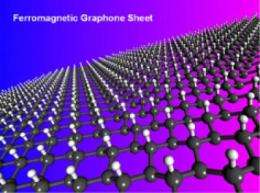
This is a ferromagnetic graphone sheet. Credit: Image courtesy of Puru Jena/VCU

An international team of researchers has designed a new graphite-based, magnetic nano-material that acts as a semiconductor and could help material scientists create the next generation of electronic devices like microchips.

The team of researchers from Virginia Commonwealth University; Peking University in Beijing, China; the Chinese Academy of Science in Shanghai, China; and Tohoku University in Sedai, Japan; used theoretical computer modeling to design the new material they called graphone, which is derived from an existing material known as graphene.

Graphene, created by scientists five years ago, is 200 times stronger than steel, its electrons are highly mobile and it has unique optical and transport properties. Some experts believe that graphene may be more versatile than carbon nanotubes, and the ability to make graphene magnetic adds to its potential for novel applications in spintronics. Spintronics is a process using electron spin to synthesize new devices for memory and data processing.

Although graphene's properties can be significantly modified by introducing defects and by saturating with hydrogen, it has been very difficult for scientists to manipulate the structure to make it magnetic.

"The new material we are predicting - graphone - makes graphene magnetic simply by controlling the amount of hydrogen coverage - basically, how much hydrogen is put on graphene. It avoids previous difficulties associated with the synthesis of magnetic graphene," said Puru Jena, Ph.D., distinguished professor in the VCU Department of Physics.

"There are many possibilities for engineering new functional materials simply by changing their composition and structure. Our findings may guide researchers in the future to discover this material in the laboratory and to explore its potential technological applications," said Jena.

"One of the important impacts of this research is that semi-hydrogenation provides us a very unique way to tailor magnetism. The resulting ferromagnetic graphone sheet will have unprecedented possibilities for the applications of graphene-based materials," said Qiang Sun, Ph.D., research associate professor with the VCU team.

More information: The study appeared online Aug. 31 in the journal , a publication of the American Chemical Society. Read the article abstract at http://pubs.acs.org/doi/abs/10.1021/nl9020733

Source: Virginia Commonwealth University (news : web)


print this article email this article download pdf blog this article bookmark this article     Stumble it Digg this share on Facebook retweet share on Reddit add to delicious
Rate this story - 3.1 /5 (18 votes)

Rank Filter

Move the slider to adjust rank threshold, so that you can hide some of the comments.


Display comments: newest first

  • Sina - Sep 03, 2009
    • Rank: not rated yet
    The authors of the letter deal with the semi-hydrogenation of Graphene. This had been discussed in the arxiv preprint 0905.2812, which the authors were completely aware of, and is unfortunately uncited in their letter. Furthermore, they had obtained the correct tight-binding data from the authors of preprint to verify their calculations.
  • rgw - Sep 03, 2009
    • Rank: not rated yet
    Or as the Chinese rulers would say, "Twas Brillig, and the slithy toves did gyre an gimble in the wabe:

    Fight that in a court of law!
  • Mr_Man - Sep 03, 2009
    • Rank: not rated yet
    The authors of the letter deal with the semi-hydrogenation of Graphene. This had been discussed in the arxiv preprint 0905.2812, which the authors were completely aware of, and is unfortunately uncited in their letter. Furthermore, they had obtained the correct tight-binding data from the authors of preprint to verify their calculations.


    That's ca-razy!!!
  • rincewind - Sep 03, 2009
    • Rank: not rated yet
    Does nobody read the arxiv preprint 0905.2812 anymore?

September 2, 2009 all stories

Comments: 4

3.1 /5 (18 votes)
  • Stumble this up

  • Digg this

  • share this

  • hide
  • Related Stories

  • Scientists discover ground-breaking material: Graphane
    created Jan 30, 2009 | popularity not rated yet | comments 0
  • A new type of spin valve that uses graphene
    created Jul 09, 2007 | popularity not rated yet | comments 0
  • Light-speed nanotech: Controlling the nature of graphene
    created Jan 21, 2009 | popularity not rated yet | comments 0
  • From graphene to graphane, now the possibilities are endless
    created Jul 31, 2009 | popularity not rated yet | comments 0
  • New material could speed development of hydrogen powered vehicles
    created Oct 06, 2008 | popularity not rated yet | comments 0


  • hide
  • Relevant PhysicsForums posts

Other News

Nanoparticles used in common household items caused genetic damage in mice

Nanotechnology / Bio & Medicine

created Nov 16, 2009 | popularity 4.7 / 5 (22) | comments 11

Titanium dioxide (TiO2) nanoparticles, found in everything from cosmetics to sunscreen to paint to vitamins, caused systemic genetic damage in mice, according to a comprehensive study conducted by researchers at UCLA's Jonsson ...


Using superconducting probes to get a picture of what it's like inside CNTs

Nanotechnology / Nanophysics

created Nov 20, 2009 | popularity 4.9 / 5 (7) | comments 0

(PhysOrg.com) -- "Carbon nanotubes are exciting for fundamental physics, and for potential technological applications," Nadya Mason tells PhysOrg.com. "However, we are generally limited in the way that we can study them. ...


Nanotube defects equal better energy and storage systems

Nanotube defects equal better energy and storage systems

Nanotechnology / Nanomaterials

created Nov 19, 2009 | popularity 4.4 / 5 (9) | comments 2

(PhysOrg.com) -- Most people would like to be able to charge their cell phones and other personal electronics quickly and not too often. A recent discovery made by UC San Diego engineers could lead to carbon ...


When It Comes to Drug Delivery, Size Matters

Nanotechnology / Bio & Medicine

created Nov 20, 2009 | popularity 5 / 5 (1) | comments 0

(PhysOrg.com) -- One of the great promises of nanotechnologies lies in its ability to create drug-containing nanoparticles decorated with targeting molecules that recognize and bind to cancer cells, providing drug delivery ...


Scientists synthesize graphene-like material: Polymer with honeycomb structure

Scientists synthesize graphene-like material: Polymer with honeycomb structure

Nanotechnology / Nanomaterials

created Nov 19, 2009 | popularity 4.5 / 5 (6) | comments 1

Two-dimensional carbon layers, so-called graphenes, are regarded as a possible substitute for silicon in the semiconductor industry. The electronic properties of these layers can be varied by "building in" ...