Researcher regenerates brain tissue in traumatic injuries
September 2, 2009 Researcher regenerates brain tissue in traumatic injuries

Enlarge

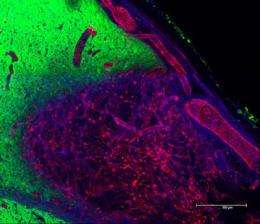
Four weeks after a TBI lesion on a rat's brain with hydrogel treatment. This is a mosaic image reconstruction of the lesion. A well-structured vasculature network was rebuilt at the lesion filled with the hydrogel. Green is neurofilament staining for neurites, and red is Reca-1 staining for blood vessels. Credit: Clemson University

An injectable biomaterial gel may help brain tissue grow at the site of a traumatic brain injury, according to findings by a Clemson University bioengineer.

Research by assistant professor of bioengineering Ning Zhang shows that the biomaterial gel made up of both synthetic and natural sources has the potential to spur the growth of a patient's own in the body, structurally repairing the brain injury site. In previous lab studies, Zhang has demonstrated the reconstruction of a complete vascular network at the injury site as an initial step toward brain tissue regeneration.

Zhang presented her findings Wednesday, Sept. 2, at the Military Research Forum in Kansas City. The conference is geared toward improving the overall health and welfare of the U.S. armed forces, their families, veterans and the American public.

"We have seen an increase in brain injuries due to combat, but our strategy can also potentially be applied to head injuries caused by car accidents, falls and gunshot wounds," said Zhang. "These results that we are seeing in adult lab rats are the first of its kind and show a sustained functional recovery in the of TBI (traumatic brain injury). It also represents one of very few in the traumatic brain injury field that attempts structural repair of the lesion cavity using a tissue-engineering approach."

Zhang predicts the procedure may be ready for human testing in about three years.

The researcher says current approaches to traumatic have been focused on managing the primary injury using hypothermia or neuroprotection with pharmacological agents, all with limited success. With this new procedure, the is injected into the lesion site to direct the response of neural stem cells in the brain to regenerate normal at the lesion site.

Source: Clemson University (news : web)


print this article email this article download pdf blog this article bookmark this article     Stumble it Digg this share on Facebook retweet share on Reddit add to delicious
Rate this story - 4 /5 (1 vote)

Rank Filter

Move the slider to adjust rank threshold, so that you can hide some of the comments.


Display comments: newest first

  • el_gramador - Sep 03, 2009
    • Rank: not rated yet
    The real questions is whether it can bring back the dead? Answer: No, the buildup of toxic chemicals after death would prevent it. Unless they could account for those chemicals before death.

September 2, 2009 all stories

Comments: 1

4 /5 (1 vote)
  • Stumble this up

  • Digg this

  • share this

  • hide
  • Related Stories

  • Traumatic brain injury to delinquent teens associated with mental problems
    created Sep 25, 2008 | popularity not rated yet | comments 0
  • Pill ingredient could prevent brain damage after head injury
    created Apr 30, 2008 | popularity not rated yet | comments 0
  • Researchers take first steps towards spinal cord reconstruction following injury
    created Nov 12, 2007 | popularity not rated yet | comments 0
  • Nanotechnology brings brain recovery in sight
    created Mar 14, 2006 | popularity not rated yet | comments 0
  • A simple therapy for brain injury
    created Jun 27, 2008 | popularity not rated yet | comments 0


  • hide
  • Relevant PhysicsForums posts

  • What is transpulmonary pressure?
    created Nov 24, 2009
  • Is there a gay gene?
    created Nov 23, 2009
  • Super quick question about Starling forces?
    created Nov 22, 2009
  • Questions about diffusion
    created Nov 22, 2009
  • More from Physics Forums - Biology

Other News

Sustainable Corn Production Supports Advanced Biofuel Feedstocks

Sustainable Corn Production Supports Advanced Biofuel Feedstocks

Biology / Biotechnology

created 11 minutes ago | popularity not rated yet | comments 0

(PhysOrg.com) -- Researchers worldwide are trying to economically convert cellulosic biomass such as corn stover into "cellulosic ethanol." But Agricultural Research Service (ARS) scientists have found that ...


Redback spiders were first spotted in Japan in 1995

Venomous Aussie redback spiders invading Japan

Biology / Ecology

created 3 hours ago | popularity not rated yet | comments 0

Australia's venomous redback spiders are on the march in Japan, where they are believed to have arrived years ago as stowaways on cargo ships, a wildlife expert warned Wednesday.


Study explores violent world of raptors

Biology / Plants & Animals

created 3 hours ago | popularity not rated yet | comments 0

A journey that started with a box of bird feet carried three Montana State University graduate students into the gruesome world of raptors and led to their findings being published in a prominent journal.


Asian carp may have breached barrier protecting Lake Michigan

Biology / Ecology

created 11 hours ago | popularity 5 / 5 (4) | comments 0

Two feared species of Asian carp have zoomed beyond the $9 million electric barriers built to keep them out of Lake Michigan. Now, the only thing left between the carp and the Great Lakes is a lock and dam in southern Chicago.


Got a pain? -- Have a cup of Brazilian mint

Biology / Plants & Animals

created 13 hours ago | popularity 4.6 / 5 (7) | comments 0

For thousands of years it has been prescribed by traditional healers in Brazil to treat a range of ailments from headaches and stomach pain to fever and flu.