Researchers uncover genetic origins of rice fragrance
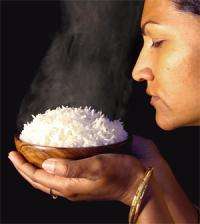
(PhysOrg.com) -- A new Cornell study reports that the gene that gives rice its highly valued fragrance stems from an ancestor of basmati rice and dispels other long-held assumptions about the origins of basmati.
Rice is classified into two major varietal groups: Japonica and Indica, both of which were grown in China some 8,000 years ago and are believed to have originated from there. The new study, published Aug. 25 in the Proceedings of the National Academy of Sciences, confirms that basmati rice, long assumed to be an Indica variety, is actually more closely related genetically to Japonica rice.
Basmati, which is endemic to northern India, Pakistan and Iran, has been falsely assumed to be in the Indica group due to its characteristic long, thin grains and because it is grown in India, where Indica varieties are widespread. Japonica varieties, which include sushi rice, are widely grown in East and Southeast Asia and tend to have shorter, stickier grains.
When the gene, called BADH2, loses its function through the natural process of mutation, rice becomes fragrant. This study reports eight novel mutations in BADH2 associated with fragrance and found that a previously discovered mutation, or allele, is shared by the vast majority of fragrant rice varieties today, including the fragrant Japonica varieties known as basmati and the fragrant Indica variety known as Thai jasmine.
Through genetic analysis of the DNA flanking BADH2, the researchers determined that the major fragrance allele originated in a Japonica-ancestor of basmati rice and was later transferred to Indica varieties, including Thai jasmine rice.
"People think that all rice [varieties] in India are from the Indica varietal group, but that's not true," said Susan McCouch, professor of plant breeding and genetics and the paper's senior author. Michael Kovach, a doctoral student in McCouch's lab, is the paper's first author.
The new study supports findings from a 2005 paper by McCouch that showed the close genetic relationship of basmati rice to the Japonica varietal group.
"India has both Indica and Japonica rice," McCouch added. "Basmati is a unique type of rice but it is genetically more closely related to sushi rice from Japan than to many of the long grained Indica rices grown elsewhere in India. It is intriguing to think about what these relationships tell us about human migration and cultural exchange."
The findings have important implications for claims of ownership of rice varieties and traits, said Kovach. Rice fragrance is one of the most highly valued traits of rice, and it can command higher prices on the global market.
Thai scientists recently patented the use of a genetic engineering strategy to knock out the BADH2 gene while claiming the fragrance trait was part of their national heritage -- through Thai jasmine rice -- and "belonged to the Thai people," Kovach said.
"They would like to use this approach to impart this characteristic fragrance on other crops like wheat and maize," Kovach added. "There was no proof that the common BADH2 allele causing fragrance in Thai jasmine rice actually did not originate in jasmine varieties, until this study."
"The results suggest something profound and interesting about human culture, and that is, we are all hybrids," said McCouch. "Claims of ownership of rice are important for national identity, but people's concepts of national identity are often over-simplified. Humans continuously exchange ideas, technology and everything that is valuable, and in the exchange, they become something new. The lesson is that while each culture and each rice variety represents something unique, much of what we value most is shared by all."
Provided by Cornell University (news : web)


