What's Smelly But Can Fuel a Car?
September 2, 2009 by Samantha Kinhan
What's Smelly But Can Fuel a Car?

Enlarge

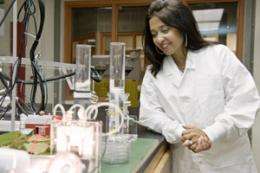
Driving home from a seminar on fuel cell technology, Gerardine Botte was struck with a notion. Her idea was based on water electrolysis, a process used to produce hydrogen energy from water. Botte, an associate professor of chemical and biomolecular engineering in the Russ College of Engineering and Technology, took the concept to the next level: Instead of clean water, what if it were possible to use wastewater?

“You could remove the from wastewater, convert it to hydrogen energy, and it would be better, because you’d be remediating and producing clean energy,” says Botte.

What resulted was a first-of-its-kind fuel cell technology, known as the “ammonia electrolytic cell,” that allows hydrogen to be produced on demand. It’s an efficient and environmentally sound process; compared to water , ammonia electrolysis consumes 95 percent less energy and produces more hydrogen.

The ammonia itself comes from a renewable supply. Botte estimates more than 5 million tons of ammonia enter the waste stream as human and animal each year in the United States.

If it seems like an unlikely , Botte will do her best to convince you otherwise. “I think ammonia is our future fuel,” she says. “It’s green, renewable, and we know how to transport it and work with it.”

Since its inception, Botte’s idea of ammonia electrolysis has blossomed into several projects. At Ohio University, she enlists the help of five graduate students who each cover specific branches of ammonia electrolysis research, including potential automobile and residential applications.

In November, Botte’s Electrochemical Engineering Research Laboratory received a $2.23 million federal grant to adapt the concept for military use. Under the “Silent Camp Initiative,” she’ll work with the U.S. Army Engineer Research and Development Center’s Construction, Engineering Research Laboratory to provide backup power for training facilities and soldier camps at night.

The system could cut long-term costs for fuel and decrease susceptibility to attacks against fuel supply lines.

If successful, there could be promising potential for the commercialization of the ammonia electrolytic cell.

Botte takes pride in the fact that the cell had its beginnings at Ohio University. “It was born here and is unique to this university,” she says.

Provided by Ohio University (news : web)

4.6 /5 (18 votes)  

Filter


Move the slider to adjust rank threshold, so that you can hide some of the comments.


Display comments: newest first

Birger
Sep 02, 2009

Rank: 3.5 / 5 (4)
"electrolysis, a process used to produce hydrogen energy from water." No, it only separates hydrogen from water, it does not produce energy. Apart from that, it is a good article.
otto1923
Sep 02, 2009

Rank: 5 / 5 (1)
She's been busy:
http://www.physor...803.html
-same researcher-
el_gramador
Sep 03, 2009

Rank: 5 / 5 (2)
electrolysis - base words = "electro-" which means having or pertaining to electricity. And "-lysis" which means the breakdown of. Cells do lyzing in vacuoles of highly powerful chemicals that can break down foreign matter. Electrolysis is hardly limited to water. So please don't get caught up in the definition. Anything can be broken down with the right mix of methods and materials. Ammonia already is by nitrogen-fixing bacteria under the ground. That they were able to replicate that for batteries is the amazing part though. Given the high number of hydrogen groups attached to the nitrogen atoms, this is highly efficient, and a much better process and than breaking down water. If anything, it's better. All you'd have to do is just go to the bathroom. The converter would break down the hydrogen, the nitrogen could be collected for other things, and you could be on your merry way with your car fueled. :P
Sean_W
Sep 03, 2009

Rank: 5 / 5 (2)
I suppose you would want to get most of the water out if you are using it for transportation. Might just having a home fuel cell in the basement connected to dedicated urine plumbing and an electric car be more practical? No shuffling pee canisters and you can buy electricity and use other sources like solar if you don't have enough pee on hand ;-)
Sean_W
Sep 03, 2009

Rank: not rated yet
She's been busy:

http://www.physor...803.html

-same researcher-


It looks like the two processes could be compatible. The catalyst works on the urea and the electrolysis converts the ammonia.
WhiteJim
Sep 03, 2009

Rank: not rated yet
I guess we can all piss on this. Piss off will now refer to the act of filling your cars fuel tank. Can't wait to add a orafice to the seat of my car? No more stopping for a leak durring drives in the country. Great stuff. Lets make sure the oil companies and related interests don't snuff this technology. If it takes 95% less energy to produce hydrogen it should be a self contained process. Just pee and start the electrolysis with a battery and the energy from the hydrogen fuel cell can power the production of its own hydrogen. Nitrogen in this case can be used as the liquid fuel pumped into the tank at a filling station.
DozerIAm
Sep 03, 2009

Rank: not rated yet
I'd prefer stuffing junk into a "Mr. Fusion" over stuffing my junk into some orifice in the car designed to take my pee and store it for onboard conversion.
RayCherry
Sep 03, 2009

Rank: 5 / 5 (1)
Peetrolium? ;-)

Hope this really goes somewhere. Could help to resolve two problems at the same time: fuel/climate and human waste polution.
david_42
Sep 03, 2009

Rank: not rated yet
5 million tons sounds huge, but it is only a few days oil consumption for the US.
GlenM
Sep 03, 2009

Rank: not rated yet
If it's yellow let it mellow.
If it's brown flush it down.


Kind of takes on a new meaning.
degojoey
Sep 03, 2009

Rank: not rated yet
If it's yellow let it mellow.

If it's brown flush it down.


Kind of takes on a new meaning.

.....wow.....
danman5000
Sep 03, 2009

Rank: not rated yet
"...ammonia electrolysis consumes 95 percent less energy and produces more hydrogen..."

Anyone else notice that many articles you see nowadays make claims like this? Look at our new process! Its 3000% more efficient and uses 99.9% less electricity! If all these advances are as amazing as they sound, why don't people jump on them and start produccing products? Seems to me that a lot of the time they are either greatly exaggerating, or fail to mention some fatal flaw/difficulty in the system. I'd just have to say be careful what you read.

Not that I'm saying this technology is bad, I just see this pattern of incredibly high numbers among unrelated articles. On the contrary, I'd love to see this work - it sounds like a great technology, and it would indeed produce more hydrogen than water. I can't wait for my pee-powered car :)

Btw, I got a good laugh out of the "Peetrolium" comment. Nice one!
aufever
Sep 06, 2009

Rank: not rated yet
This process could be used to take the ammonia out of treated sewage water, ie, the effluent of the Sacramento,Ca. sewage plant and clean up the water that is released into the Delta. This along with a Constructed Wetland could make water reusable for agriculture.
gideon
Sep 06, 2009

Rank: not rated yet
I think it sounds great but scalability makes me think that for every person who want to get around in a vehicle - there would have to be enough "material" produced to get them where they had to go. I only go average twice a day and I doubt I could get enough energy from that to get me down the block let alone to work and back every day. Maybe in a city with public transport it could sustainably work for buses but individuals with cars would still need another source in addition to whatever energy this provided.
Nik_2213
Sep 06, 2009

Rank: not rated yet
So, we'll see solar panels and wind generators on top of eg pig-farms' sheds, supplying fuel to site equipment and local community ??

Better than the endless battle against run-off, with nitration of aquifers causing 'blue babies' and algal overgrowth of waterways...

Sounds like a 'two for one'...
KBK
Sep 08, 2009

Rank: 1 / 5 (2)
"electrolysis, a process used to produce hydrogen energy from water." No, it only separates hydrogen from water, it does not produce energy. Apart from that, it is a good article.


Interestingly enough, the exact process that is done to create "rhodes gas" or "brown's gas"..also known as HHO..DOES produces a very seriously anomalous level of energy. The Canadian department of atomic energy HAS tested this gas out on it's claim of 'reducing radioactive emissions by +98% in radioactive substances'.

This test was done and it is on tape and the video of the official government test IS ON THE INTERNET.

Go look for it. You will find it. And that, ladies and germs is the tip of the iceberg on this particular technology.

How fast can you say 'one thousand fundamental patents in my name', due to the new understandings it brings you?

It is out there for you to discover.
Rank 4.6 /5 (18 votes)
Related Stories
Relevant PhysicsForums posts
  • Need help reading 3-D
    created17 hours ago
  • A way to send and receive wireless data
    created23 hours ago
  • Calling function with no input argument
    createdFeb 10, 2012
  • Force free body diagram problem on gym equipment
    createdFeb 10, 2012
  • Empirical data regarding shower heads and water
    createdFeb 10, 2012
  • feed hold button on CNC lathe
    createdFeb 09, 2012
  • More from Physics Forums - General Engineering

More news stories

Google might launch Drive for cloud storage soon

(PhysOrg.com) -- Google's next big move, according to the Wall Street Journal, is a cloud storage service called Drive. Hardly first to the plate, Google is simply catching up to introducing its cloud reposi ...

Technology / Internet

created 5 hours ago | popularity 4.7 / 5 (3) | comments 3 | with audio podcast report

Love a click away in Indonesia's Twitter Republic

He was a geeky kid from Yogyakarta, she a glamorous city girl in Jakarta. In a country with one of the world's most vibrant social networking scenes they fell in love on Twitter.

Technology / Internet

created 6 hours ago | popularity 4 / 5 (1) | comments 0

Europeans protest controversial Internet pact

Tens of thousands of people marched in protests in more than a dozen European cities Saturday against a controversial anti-online piracy pact that critics say could curtail Internet freedom.

Technology / Internet

created 22 hours ago | popularity 4.6 / 5 (9) | comments 1

Walney offshore wind farm is world's biggest (for now)

(PhysOrg.com) -- The Walney wind farm on the Irish Sea--characterized by high tides, waves and windy weather--officially opened this week. The farm is treated in the press as a very big deal as the Walney ...

Technology / Energy & Green Tech

created Feb 11, 2012 | popularity 4 / 5 (11) | comments 34 | with audio podcast weblog

Navy to begin tests on electromagnetic railgun prototype launcher

The Office of Naval Research (ONR)'s Electromagnetic (EM) Railgun program will take an important step forward in the coming weeks when the first industry railgun prototype launcher is tested at a facility ...

Technology / Engineering

created Feb 06, 2012 | popularity 4.7 / 5 (16) | comments 93 | with audio podcast


Injured boomers beware: Know when to see doctor

(AP) -- It happened to nurse Jane Byron years after an in-line skating fall, business owner Haralee Weintraub while doing "men's" push-ups, and avid cyclist Gene Wilberg while lifting a heavy box.

Latin America mining boom clashes with conservation

Latin America is experiencing a mining boom as prices rise fuelled by a hike in global demand, but the region is also being hit by a wave of violent protests, strikes and rallies by environmentalists.

Explained: Sigma

It's a question that arises with virtually every major new finding in science or medicine: What makes a result reliable enough to be taken seriously? The answer has to do with statistical significance -- but ...

Political leaders play key role in how worried Americans are by climate change: study

More than extreme weather events and the work of scientists, it is national political leaders who influence how much Americans worry about the threat of climate change, new research finds.

NASA budget will axe Mars deal with Europe: scientists

US President Barack Obama's budget proposal to be submitted next week for 2013 will cut NASA's budget by 20 percent and eliminate a major partnership with Europe on Mars exploration, scientists said Thursday.

New power source discovered

(PhysOrg.com) -- Researchers at the Massachusetts Institute of Technology (MIT) and RMIT University have made a breakthrough in energy storage and power generation.