Chimpanzees develop 'specialized tool kits' to catch army ants
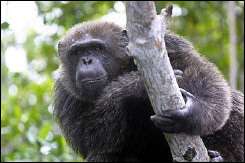
Chimpanzees in the Congo have developed specialised 'tool kits' to forage for army ants, reveals new research published today in the American Journal of Primatology. This not only provides the first direct evidence of multiple tool use in this context, but suggests that chimpanzees have developed a 'sustainable' way of harvesting food.
A team from the Goualougo Triangle Ape Project, led by Dr Crickette Sanz, studied several communities of chimpanzee throughout the Nouabalé-Ndoki national park in the Republic of Congo. After spending a collective 111 months in the Goualougo Triangle, the team recovered 1,060 tools and collected 25 video recordings of chimpanzees using them to forage for army ants.
"The use of tool sets is rare and has most often been observed in great apes," said Sanz. "Until now there have been no reports of regular use of more than one type of tool to prey upon army ants."
It is already known that chimpanzees use tools when foraging for honey or collecting termites. However the variation in techniques and the relationship between the ants and the chimpanzees has perplexed scientists for decades.
"In other studies, based across Africa, chimpanzees have been seen to prey on army ants both with and without tools," said Sanz, "and it was inexplicable why some chimpanzees used different techniques to gather the same prey."
The average number of tools recovered by the team at each site was 3.37, while 36% of recovered tools sets contained two types of tools, nest perforating tools and ant-dipping probes. Ant-dipping probes are the most commonly observed method of catching army ants. The chimpanzee inserts a probe into a nest or column of ants and gathers the individuals who stream up the tool. The perforating tools on the other hand are used to open nests so the chimpanzee can gather the ants within.
While the tools sets observed during this study were similar to other recorded tools, this research suggests that chimpanzees are selecting tools depending on the characteristics of the ant species they are foraging. There are several varying species of ants found throughout the triangle, but their characteristics can be divided into two categories, 'epigaeic' or 'intermediate'.
Epigaeic ants have longer legs so can run faster and can inflict a more painful bite. They forage on the ground and in the vegetation and when attacked the workers counter-attack in large swarms. Intermediate species forage only in the leaf litter and withdraw into underground tunnels or into the leaf litter when attacked.
Chimpanzees that harvest ants simply by raking a nest open with their hands cause a massive counter-attack from the ants. This results not only in bites but the attack may provoke the ants to migrate and build a new nest at a different location.
However, by using the perforation tools the chimps can entice the ants out and can allow the insertion of the second tool for dipping. This not only reduces the ant's aggressive behaviour but may also be a 'sustainable harvesting' technique as the ants will stay in that location allowing the chimpanzees to revisit this renewable source of food.
It also appears that chimpanzees practise recycling by recognising tool forms and re-using tools which have been discarded by other individuals during previous visits.
"It has only recently been discovered that these particular chimpanzees use several different types of tool sets which could be their cultural signature of sorts," concluded co-author Dr. David Morgan. "There is an urgency to learn about these behaviours as the existence of the apes in the Congo Basin is threatened by commercial logging, bushmeat hunting, and emerging diseases."


