When it comes to hurricanes, what's in a name?
September 3, 2009 by Sara Hussein The practice of naming storms was popularized by meteorologist Clement Wragge in the 19th century

Enlarge

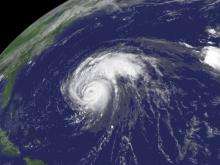
A satellite image shows Hurricane Bill, on August 21. Assigning names to tropical depressions, storms and hurricanes has been common practice for hundreds of years, in part because it made it easier for coastal stations and ships to identify and transmit information about weather systems.

With three months left in the 2009 Atlantic hurricane season, storm watchers can be sure that there will not be another Hurricane Katrina, or Rita, or Wilma this year, or ever again.

The names of these devastating hurricanes and other destructive storms have been "retired," never to reemerge, so that new monikers can be assigned to the systems that develop each .

The task of striking and replacing names falls to the World Meteorological Organization's Hurricane Committee, which devotes part of its annual meeting to the process of voting to remove names and devising new ones.

Assigning names to tropical depressions, storms and hurricanes has been common practice for hundreds of years, in part because it made it easier for coastal stations and ships to identify and transmit information about weather systems.

In the 1800s, storms that developed in the West Indies were commonly named after the saint's day on which they occurred, such as the ferocious Hurricane Santa Ana, which killed hundreds when it hit Puerto Rico in 1825.

The practice of naming storms was popularized by meteorologist Clement Wragge in the 19th century and formally adopted by the Miami-based National Hurricane Center in 1953, when six lists of female names were compiled -- each containing one name for all but five letters in the alphabet.

"There's five letters that we do not have in there -- q is one of them, and then u, x, y, z. And the reason for that is there are not enough names... that we'd be able to put them in the list and have enough to replace them," said National Weather Service spokesman Dennis Feltgen.

In 1978, meteorologists began to assign men's names to storms forming in the Eastern North Pacific and the practice widened the following year to include Atlantic and Gulf of Mexico weather systems.

The six lists are used in rotation, so the names that survive from this year's hurricane list will next be up for usage again in 2015.

Only once since reliable records began in 1944 has an Atlantic season produced more storms than names on a list and forced the use of a backup option -- the Greek alphabet.

The 2005 season, which included the devastating , produced a record 27 named storms, ending with Delta, Epsilon and Zeta. Unsurprisingly, a record five names -- Dennis, Katrina, Rita, Stan and Wilma -- were retired that year.

In all, more than 70 names have been retired for the Atlantic Ocean, Caribbean Sea and the Gulf of Mexico region, Feltgen said, and the process of devising new names is usually a low key process that attracts little attention.

But in 2001, the Committee found it had created an uproar by adding, among others, the names "Israel" and "Adolph" to the Eastern North Pacific storm list.

Jewish leaders expressed outrage at the decision, and though officials noted that Israel and Adolph, spelled with a "ph" unlike Adolf Hitler, were common boy's names, they retired the names at the end of the season.

(c) 2009 AFP


print this article email this article download pdf blog this article bookmark this article     Stumble it Digg this share on Facebook retweet share on Reddit add to delicious
Rate this story - not rated yet


September 3, 2009 all stories

Comments: 0

not rated yet
  • Stumble this up

  • Digg this

  • share this

  • hide
  • Related Stories

  • Storm names can boost insurance costs
    created Nov 30, 2007 | popularity not rated yet | comments 0
  • UN agency takes deadly storm names off list
    created May 06, 2009 | popularity not rated yet | comments 0
  • Researchers Say Outlook Indicates Active 2008 Hurricane Season
    created Apr 09, 2008 | popularity not rated yet | comments 0
  • Busy Atlantic storm season predicted
    created Aug 02, 2005 | popularity not rated yet | comments 0
  • El Nino may calm 2006 hurricane season
    created Sep 07, 2006 | popularity not rated yet | comments 0


  • hide
  • Relevant PhysicsForums posts

  • The IPCC and the term "most"
    created Nov 23, 2009
  • Is global warming a fact?
    created Nov 23, 2009
  • Random variability of wind patterns
    created Nov 23, 2009
  • Record precipitation in the UK
    created Nov 22, 2009
  • More from Physics Forums - Earth

Other News

Monster Waves on the Sun are Real

Monster Waves on the Sun are Real (w/ Video)

Space & Earth / Astronomy

created 12 hours ago | popularity 4.8 / 5 (12) | comments 1

Sometimes you really can believe your eyes. That's what NASA's STEREO (Solar Terrestrial Relations Observatory) spacecraft are telling researchers about a controversial phenomenon on the sun known as the "solar ...


Cosmic 'dig' reveals vestiges of the Milky Way's building blocks

Cosmic 'Dig' Reveals Vestiges of the Milky Way's Building Blocks

Space & Earth / Astronomy

created 16 hours ago | popularity 4.9 / 5 (15) | comments 1

(PhysOrg.com) -- Peering through the thick dust clouds of our galaxy's "bulge" (the myriads of stars surrounding its center), a team of astronomers has unveiled an unusual mix of stars in the stellar grouping ...


Climate experts debate strategies for reducing atmospheric carbon and future warming

Climate experts debate strategies for reducing atmospheric carbon and future warming

Space & Earth / Environment

created 12 hours ago | popularity 2.6 / 5 (7) | comments 10

(PhysOrg.com) -- Reducing carbon dioxide to safe levels may require extracting carbon from the air, says Cornell climate researcher.


No Wheel Stall in Diagnostic Drive

Spirit Mars Rover: No Wheel Stall in Diagnostic Drive

Space & Earth / Space Exploration

created 12 hours ago | popularity 4.7 / 5 (3) | comments 0

(PhysOrg.com) -- On Sol 2095 (Tuesday, Nov. 24), Spirit performed a set of diagnostic actions related to a stall of the right-rear wheel on the previous drive, three days earlier.


Cutting greenhouse pollutants could directly save millions of lives worldwide

Space & Earth / Environment

created 18 hours ago | popularity 2.2 / 5 (10) | comments 6

Tackling climate change by reducing carbon dioxide and other greenhouse emissions will have major direct health benefits in addition to reducing the risk of climate change, especially in low-income countries, according to ...