Atoms don't dance the 'Bose Nova'
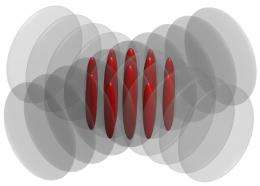
(PhysOrg.com) -- Hanns-Christoph Naegerl's research group at the Institute for Experimental Physics, Austria, has investigated how ultracold quantum gases behave in lower spatial dimensions. They successfully realized an exotic state, where, due to the laws of quantum mechanics, atoms align along a one-dimensional structure. A stable many-body phase with new quantum mechanical states is thereby produced even though the atoms are usually strongly attracted which would cause the system to collapse. The scientists report on their findings in the leading scientific journal Science.
Interactions are considerably more drastic in low-dimensional systems than in three-dimensional ones. Thus, physicists take a special interest in these systems. In physics zero-dimensional quantum dots, two-dimensional quantum wells and also one-dimensional quantum wires are known. The latter are spatial potential structures, where carriers can move only one-dimensionally.
Whereas quantum dots and wells can be realized and analyzed relatively easily, it is much harder to investigate quantum wires in solid-state bodies. Hanns-Christoph Naegerl’s research group of the Institute for Experimental Physics of the University of Innsbruck has now tried something totally different: In a cloud of ultracold atoms they realized one-dimensional structures and thoroughly analyzed their properties.
Surprising observation
In a vacuum chamber the physicists produced a Bose-Einstein condensate with approx. 40,000 ultracold cesium atoms. With two laser beams they generated an optical lattice, where the atoms were confined to vertical one-dimensional structures with up to 15 atoms aligned in each tube. The laser beams prevent the atoms from breaking ranks or changing place with each other.
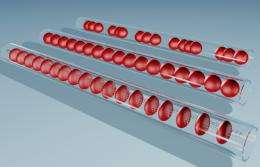
Using a magnetic field, the scientists could tune the interaction between the atoms: “By increasing the interaction energy between the atoms (attraction interaction), the atoms start coming together and the structure quickly decays,“ Naegerl explains what is called among experts the "Bosenova" effect.
"By minimizing the interaction energy, the atoms repel each other (repulsive interaction), align vertically and regularly along a one-dimensional structure and the system is stable." If the interactions are switched from strongly repulsive to strongly attractive, a surprising effect can be observed. "We thereby achieve an exotic, gas-like phase, where the atoms are excited and correlated but do not come together and a 'Bosenova' effect is absent," Naegerl says. The phase was diagnosed by compressing the quantum gas and measuring its stiffness. "However, this excited many-body phase can only be realized by a detour via repulsive interaction. This phase was predicted four years ago and we have now been able to realize it experimentally for the first time," Elmar Haller says. He is first author of the research paper, which is now published in the renowned scientific journal Science. Currently, research on low-dimensional structures receives a lot of attention internationally and it may help to better understand the functioning of high-temperature superconductors.
Cold atoms as an ideal field of experimentation
"Ultracold quantum gases offer a big advantage: They can be isolated against the environment quite well," Naegerl explains. "Moreover, in our experiment we can practically rule out defects we often find in solid-state bodies." With this successful experiment the Innsbruck quantum physicists found an ideal experimental setup to further study the properties of quantum wires. Naegerl’s team of scientists clearly benefits from the long standing and successful research on ultracold atoms and molecules by another Innsbruck group of physicists: the research group led by Wittgenstein laureate Prof. Rudolf Grimm, which has already assumed a leading role internationally.
In addition to producing the first Bose-Einstein condensates using cesium atoms and molecules, the scientists also observed exotic states such as the Efimov-state and repulsive quantum pairs experimentally for the first time worldwide. "The research work of Hanns-Christoph Naegerl and his team once more underlines the international significance of our research projects," Rudolf Grimm says.
The experimental physicists of the research project on quantum wires also benefited from a very close cooperation with the theoretical physicists of the quantum physics stronghold in Innsbruck. The project of START-awardee Hanns-Christoph Naegerl is funded by the Austrian Science Funds and the European Union.
More information: Realization of an Excited, Strongly-Correlated Quantum Gas Phase. Haller E, Gustavsson M, Mark MJ, Danzl JG, Hart R, Pupillo G, Nägerl HC. Science 4. September 2009 (DOI:10.1126/science.1175850)
Provided by University of Innsbruck


