Spare gene is fodder for fishes' evolution
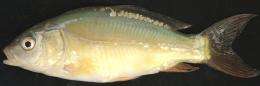
Scientists have suspected that spare parts in the genome—extra copies of functional genes that arise when genes or whole genomes get duplicated -- might sometimes provide the raw materials for the evolution of new traits. Now, researchers report in a study published online on September 3rd in Current Biology, that they have discovered a prime example of this in fish.
The researchers show that a duplicate copy of a gene involved in embryonic development has taken up a newer and decidedly less essential role in the development of fish scales. Zebrafish carrying a mutant version of that extra fibroblast growth factor receptor 1 (fgfr1) gene show decreases in their scale formation. What's more, the spare fgfr1 gene is at the root of similar scale loss seen in domesticated carp, which have been selectively bred by humans for the last 2,000 years.
"Our finding is an excellent case for [gene] duplication supporting diverse forms," said Matthew Harris of the Max Planck Institute for Developmental Biology.
"By 'tweaking' the use of one of the two copies of the fish fgfr1, the teleost order that contains zebrafish and carp have a specialized 'toolbox' gene that now controls adult-specific variation in form," added Nicolas Rohner, also of the Max Planck Institute.
Fish species outnumber all other vertebrates combined and include many with spectacular features to match the diverse environments in which they live, Harris and Rohner said. Teleost fish in particular represent the largest assemblage of vertebrates, comprising over 26,000 species with astonishing diversity in their form and physiology. Although little is known about the genetic basis of that diversity, it is clear that gene duplication is commonplace within teleost groups, providing a source of genetic raw material for selection.
To further explore in the new study, the researchers first examined mutant strains of zebrafish in search of those with changes to their fins, skulls, or scales, all structures that tend to vary among species. They focused their attention on one with fewer scales and in an unusual pattern—an abnormality they traced to fgfr1.
"We were surprised to find severe coding mutations in such an important developmental gene to cause an adult-specific and viable phenotype," Harris said, adding that the zebrafish mutant had no obvious deficiencies when compared to normal zebrafish.
Further study showed the reason why: zebrafish maintain two copies of fgfr1 that function redundantly during embryonic development. One of those two genes is also required for the formation of the scales in juveniles.
But could the findings in zebrafish tell us something about variation in other fish? The answer is yes, at least in the case of the domesticated carp.
"Carps experienced their heyday during the Middle Ages, when they were bred by monks as a substitute for meat during Lent," Rohner said. That's when the "mirror carp" under study, with its characteristic scale reduction, likely arose. The researchers now show that changes to the fgfr1 gene are responsible for that scale pattern, which was apparently selected for and maintained by breeders in the domestication of the species.
The findings in the domesticated carp will likely have relevance for understanding the evolution of other fish species in nature, the researchers say.
"The instance of morphological change that we have documented is the result of artificial selection during domestication—which is rather different from natural selection," they write. "However, it is not unlikely that the same genes might account for similar phenotypic changes that occurred during natural evolution. Indeed, loss of scales is not uncommon in fish: within the Cypriniformes (the order containing zebrafish and carps), scale reduction and/or loss have occurred independently in natural populations at least thirteen times in six different families."
More information: Nicolas Rohner, Miklós Bercsényi, László Orbán, Maria E. Kolanczyk, Dirk Linke, Michael Brand, Christiane Nüsslein-Volhard, Matthew P. Harris; Duplication of fgfr1 permits Fgf signaling to serve as a target for selection during domestication; Current Biology, October 13, 2009, advance online publication September 3, 2009; doi: 10.1016/j.cub.2009.07.065
Source: Cell Press (news : web)


