XMM-Newton uncovers a celestial Rosetta stone
September 3, 2009
XMM-Newton uncovers a celestial Rosetta stone

Enlarge

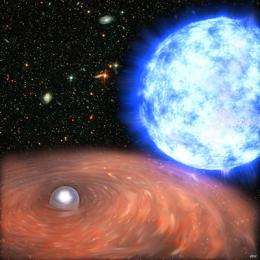
Illustration of the white dwarf and its companion HD49798. If it was possible to look at the system up-close, it would look something like this. Credits: Francesco Mereghetti, background image: NASA, ESA and T.M. Brown (STScI)

(PhysOrg.com) -- ESA's XMM-Newton orbiting X-ray telescope has uncovered a celestial Rosetta stone: the first close-up of a white dwarf star, circling a companion star, that could explode into a particular kind of supernova in a few million years. These supernovae are used as beacons to measure cosmic distances and ultimately understand the expansion of our Universe.

Astronomers have been on the trail of this mysterious object since 1997 when they discovered that something was giving off X-rays near the bright star HD 49798. Now, thanks to ’s superior sensitivity, the mysterious object has been tracked along its orbit. The observation has shown it to be a white dwarf, the dead heart of a star, shining X-rays into space.

Sandro Mereghetti, INAF-IASF Milan, Italy, and collaborators also discovered that this is no ordinary white dwarf. They measured its mass and found it to be more than twice what they were expecting. Most pack 0.6 solar masses into an object the size of Earth. This particular white dwarf contains at least double that mass but has a diameter just half that of Earth. It also rotates once every 13 seconds, the fastest of any known white dwarf.

The mass determination is reliable because the XMM-Newton tracking data allowed the astronomers to use the most robust method for ‘weighing’ a star, one that uses the devised by Isaac Newton in the 17th century. Most likely, the white dwarf has grown to its unusual mass by stealing gas from its , a process known as accretion. At 1.3 solar masses, the white dwarf is now close to a dangerous limit.

When it grows larger than 1.4 solar masses, a white dwarf is thought to either explode, or collapse to form an even more compact object called a neutron star. The explosion of a white dwarf is the leading explanation for type Ia supernovae, bright events that are used as standard beacons by astronomers to measure the expansion of the . Until now, astronomers have not been able to find an accreting white dwarf in a binary system where the mass could be determined so accurately.

“This is the Rosetta stone of white dwarfs in binary systems. Our precise determination of the masses of the two is crucial. We can now study it further and try to reconstruct its past, so that we can calculate its future,” says Mereghetti.


That future is a spectacular one. The star is likely to explode in a few million years’ time. Although it is far enough to pose no danger to Earth, it is close enough to become an extraordinarily spectacular celestial sight. Calculations suggest that it will blaze initially with the intensity of the full moon and be so bright that it will be seen in the daytime sky with the naked eye.

Our descendants are in for quite a show. Thanks to XMM-Newton, we can already start looking forward to it.

More information: 'An ultra massive fast-spinning white dwarf in a peculiar binary system' by S Mereghetti, A Tiengo, P Esposito, N La Palombara, GL Israel, L. Stella will be published in Science on 4 September 2009.

Provided by European Space Agency (news : web)

4.9 /5 (16 votes)  

Filter


Move the slider to adjust rank threshold, so that you can hide some of the comments.


Display comments: newest first

brant
Sep 03, 2009

Rank: 1 / 5 (1)
"Calculations suggest that it will blaze initially with the intensity of the full moon and be so bright that it will be seen in the daytime sky with the naked eye."

But what do think will really happen???
omatumr
Sep 04, 2009

Rank: 2.7 / 5 (3)
CONGRATULATIONS!

What an intriguing story!

What could be hiding inside this 1.2 solar mass white dwarf with a diameter just half that of Earth that allows it to rotate once every 13 seconds?

With kind regards,
Oliver K. Manuel
http://www.omatumr.com
poi
Sep 04, 2009

Rank: not rated yet
That future is a spectacular one. The star is likely to explode in a few million years’ time.
xxx xxx
Our descendants are in for quite a show. Thanks to XMM-Newton, we can already start looking forward to it.


lol! oh yeah! i can't wait to see it!
Archivis
Sep 04, 2009

Rank: 4.3 / 5 (3)
@omatumr - I would imagine that it's higher than usual solar mass likely has something to do with a super dense core, else it would have no chance at becoming a neutron star, as the article says is one of the two most likely outcomes. Though without being able to study it from a bit closer we may never know exactly what's going on in this little dwarf.
omatumr
Sep 04, 2009

Rank: 2 / 5 (4)
A NEUTRON STAR HIDING INSIDE?

@omatumr - I would imagine that it's higher than usual solar mass likely has something to do with a super dense core, else it would have no chance at becoming a neutron star, as the article says is one of the two most likely outcomes. Though without being able to study it from a bit closer we may never know exactly what's going on in this little dwarf.


Intriguing!

We are a bit closer to the Sun.

Are you absolutely certain that there isn't a neutron star hiding there?

See: "Fingerprints of a local supernova," in SPACE EXPLORATION RESEARCH (Nova Science Publishers, Inc., Hauppauge, NY, in press, 38 pp, 2009)
http://arxiv.org/pdf/0905.0684

With kind regards,
OLiver K. Manuel
http://www.omatumr.com
rwinners
Sep 11, 2009

Rank: not rated yet
CONGRATULATIONS!


What an intriguing story!


What could be hiding inside this 1.2 solar mass white dwarf with a diameter just half that of Earth that allows it to rotate once every 13 seconds?


With kind regards,

Oliver K. Manuel

http://www.omatumr.com


The ghosts of christmas past, perhaps?
omatumr
Sep 12, 2009

Rank: 1 / 5 (1)
READ: "HEAVEN and EARTH" by PROFESSOR IAN PLIMER

This new book, "Heaven and Earth: Global warming - the missing science" (Taylor Trade Tublishing, New York, 2009) by Professor Ian Plimer, Australia's best known geologist, confronts solar dogma with experimental data.

A new copy of this 504 page soft-back book from Amazon.com cost $14.93

With kind regards,
Oliver K. Manuel
http://www.omatumr.com
Rank 4.9 /5 (16 votes)
Relevant PhysicsForums posts
  • Scale of the Universe
    created10 hours ago
  • Titan's lack of impact craters
    createdFeb 09, 2012
  • Real pictures of black hole eating a star?
    createdFeb 08, 2012
  • Hypothetical way to travel faster than light, but not technically exceed lightspeed
    createdFeb 06, 2012
  • How do scientists monitor the Sun's activity?
    createdFeb 05, 2012
  • Search patterns in observational studies
    createdFeb 05, 2012
  • More from Physics Forums - General Astronomy

More news stories

Humans may have helped the decline of African rainforests 3000 years ago

(PhysOrg.com) -- Large areas of rainforests in Central Africa mysteriously disappeared over three thousand years ago, to be replaced by savannas. The prevailing theory has been that the cause was a change ...

Space & Earth / Environment

created 21 hours ago | popularity 4.3 / 5 (12) | comments 12 | with audio podcast report

Could Venus be shifting gear?

(PhysOrg.com) -- ESA’s Venus Express spacecraft has discovered that our cloud-covered neighbour spins a little slower than previously measured. Peering through the dense atmosphere in the infrared, the ...

Space & Earth / Space Exploration

created 17 hours ago | popularity 5 / 5 (7) | comments 7 | with audio podcast

NASA budget will axe Mars deal with Europe: scientists

US President Barack Obama's budget proposal to be submitted next week for 2013 will cut NASA's budget by 20 percent and eliminate a major partnership with Europe on Mars exploration, scientists said Thursday.

Space & Earth / Space Exploration

created 20 hours ago | popularity 5 / 5 (2) | comments 18

Two new moons for Jupiter

Advances in technology have lead to the discovery of new planets outside of our Solar System, and now even new moons in our own backyard.

Space & Earth / Space Exploration

created 17 hours ago | popularity 4 / 5 (1) | comments 7

Mars Science Laboratory computer issue resolved

(PhysOrg.com) -- Engineers have found the root cause of a computer reset that occurred two months ago on NASA's Mars Science Laboratory and have determined how to correct it.

Space & Earth / Space Exploration

created 18 hours ago | popularity 4.7 / 5 (6) | comments 3 | with audio podcast


Anonymous knocks CIA website offline (Update)

The website of the Central Intelligence Agency was inaccessible on Friday after the hacker group Anonymous claimed to have knocked it offline.

New error-correcting codes guarantee the fastest possible rate of data transmission

Error-correcting codes are one of the triumphs of the digital age. They’re a way of encoding information so that it can be transmitted across a communication channel — such as an optical fiber o ...

Google users warned of threat to smartphone wallets

Users of Google smartphone wallets were being warned on Friday that there is a way to crack pass codes intended to thwart thieves from going on illicit shopping sprees.

New power source discovered

(PhysOrg.com) -- Researchers at the Massachusetts Institute of Technology (MIT) and RMIT University have made a breakthrough in energy storage and power generation.

The power of estrogen -- male snakes attract other males

A new study has shown that boosting the estrogen levels of male garter snakes causes them to secrete the same pheromones that females use to attract suitors, and turned the males into just about the sexiest ...

Small modular reactor design could be a 'SUPERSTAR'

(PhysOrg.com) -- Though most of today's nuclear reactors are cooled by water, we've long known that there are alternatives; in fact, the world's first nuclear-powered electricity in 1951 came from a reactor ...