First-ever calculation performed on optical quantum computer chip
September 3, 2009 First-ever calculation performed on optical quantum computer chip

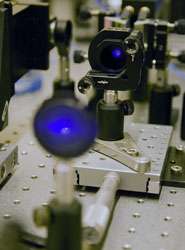
A quantum photonic experiment. Photo by Jonathan Matthews

(PhysOrg.com) -- A primitive quantum computer that uses single particles of light (photons) whizzing through a silicon chip has performed its first mathematical calculation. This is the first time a calculation has been performed on a photonic chip and it is major step forward in the quest to realise a super-powerful quantum computer.

The chip takes four photons that carry the input for the calculation, it then implements a quantum programme (Shor’s algorithm) to find the prime factors of 15, and outputs the answer - 3 and 5. The results are reported by a team of physicists and engineers from the University of Bristol in today’s issue of Science.

“This task could be done much faster by any school kid,” said PhD student, Alberto Politi, who, together with fellow PhD student Jonathan Matthews performed the experiment, “but this is a really important proof-of-principle demonstration.”

Finding prime factors may seem like a mathematical abstraction, but it lies at the heart of modern encryption schemes, including those used for secure internet communication. The ability of quantum computers to simulate quantum systems may also prove to be a powerful tool in the development of new materials or pharmaceuticals.

The team from the University of Bristol’s newly established Centre for Nanoscience and have spent several years developing devices where photons propagate in silica waveguides — much like in optical fibres — micro-fabricated on a .

“This approach results in miniature, high-performance and scalable devices,” said Professor Jeremy O’Brien, Director of the Centre for Quantum Photonics, who led the research. “The realisation of a quantum algorithm on a chip is an extremely important step towards an all-optical quantum computer”

“Despite recent advances, the ability to perform even small-scale quantum algorithms has largely been missing,” said Matthews. “For the last few years, researchers at the Centre for Quantum Photonics have been working towards building fully functional quantum circuits on a chip to solve this issue,” added O’Brien.
First-ever calculation performed on optical quantum computer chip

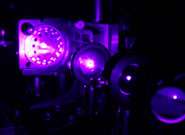
The generation and detection of single photons. Photo by Carmel King

The team coupled four photons into and out of the chip using optical fibres. On the chip the photons traveled through silica waveguides that were brought together to form a sequence of quantum logic gates. The output was determined by which waveguides the photons exited the chip in. By detecting the photons at the output of the device they confirmed high-performance operation of the quantum algorithm.

“As well as and quantum metrology, ‘on-chip’ photonic quantum circuits could have important applications in quantum communication, since they can be easily integrated with optical fibres to send photons between remote locations,” said Politi.

O’Brien concurred and added: “The really exciting thing about this result is that it will enable the development of large scale quantum circuits for photons. This opens up all kinds of possibilities”.

More information: Shor’s Quantum Factoring Algorithm on a Photonic Chip by Alberto Politi, Jonathan C. F. Matthews and Jeremy L. O'Brien. Science, 4 September 2009.


Join PhysOrg.com on Facebook!
Follow PhysOrg.com on Twitter!
Provided by University of Bristol (news : web)


print this article email this article download pdf blog this article bookmark this article     Stumble it Digg this share on Facebook retweet share on Reddit add to delicious
Rate this story - 4.6 /5 (34 votes)

Rank Filter

Move the slider to adjust rank threshold, so that you can hide some of the comments.


Display comments: newest first

  • Fazer - Sep 03, 2009
    • Rank: not rated yet
    Very nice and clean, no 'messy' particles lying around in cages. Just set up the problem, fire photons through and read the result, or something along those lines.
  • El_Nose - Sep 03, 2009
    • Rank: not rated yet
    i know this is __ first attempt and all -- but I am kinda curious as to what was the speed fo the clock that synchronized all of the operations necessary. While miss leading if you don;t understand that the speed will increase on a parabolic curve as you add registers to the chip I would like to know what the base speed measurement is. -- but it would add little value to the article
  • Allaytros - Sep 03, 2009
    • Rank: not rated yet
    Now someone will spend billions perfecting the computer. In 20 years we'll all have one and take it for granted.
  • sender - Sep 03, 2009
    • Rank: not rated yet
    Surprised non-blinking waveguides haven't been made standard for optical computing yet.
  • Kedas - Sep 04, 2009
    • Rank: not rated yet
    “This task could be done much faster by any school kid,”

    OK, that it can't do much complex thinks yet is understandable BUT it is also slow??
    I think I'm starting to miss the point of why they doing it. Isn't speed the one and only reason.

    I'm just going to assume that the time needed for a big complex calculation will be about the same.
  • Shaffer - Sep 04, 2009
    • Rank: not rated yet
    i know this is __ first attempt and all -- but I am kinda curious as to what was the speed fo the clock that synchronized all of the operations necessary. While miss leading if you don;t understand that the speed will increase on a parabolic curve as you add registers to the chip I would like to know what the base speed measurement is. -- but it would add little value to the article


    I believe C=approximately 299,792,458 metres per second. Although, the photon separation gap would be the "clock speed" so to speak.
  • toyo - Sep 04, 2009
    • Rank: not rated yet

    I believe C=approximately 299,792,458 metres per second. Although, the photon separation gap would be the "clock speed" so to speak.


    I assume by C you're trying to quote the speed of light. If so you figure's out by the index of refraction of the medium, which for optical fibers is approx. 1.48.
    This means the speed of light in a fiber would be around 200,000 Km/s.
    See: http://en.wikiped...l_fiber.

    :)
  • tomliotta - Sep 06, 2009
    • Rank: not rated yet
    [I think I'm starting to miss the point of why they doing it. Isn't speed the one and only reason.]

    It's slow relative to the 2-digit number, '15'. What seems reasonable is that the eventual result might be that prime factors of much larger numbers would be determined in the same amount of time.
  • Velanarris - Sep 07, 2009
    • Rank: not rated yet
    The reason for quantum computing is to increase the number of parallel computations, not the speed at which we can perform single calculations.
  • DesmondMurse - Sep 09, 2009
    • Rank: not rated yet
    I thought we looked into quantum computing to develop more badass video games...

September 3, 2009 all stories

Comments: 10

4.6 /5 (34 votes)
  • Stumble this up

  • Digg this

  • share this

  • hide
  • Related Stories

  • Silicon chips for optical quantum technologies
    created Mar 27, 2008 | popularity not rated yet | comments 0
  • Manipulating light on a chip for quantum technologies
    created Jun 05, 2009 | popularity not rated yet | comments 0
  • Photonic quantum technologies could be only light years away
    created Aug 30, 2007 | popularity not rated yet | comments 0
  • Quantum technologies move a step closer with the demonstration of an 'entanglement' filter
    created Jan 22, 2009 | popularity not rated yet | comments 0
  • Quantum computing: No turning back
    created Mar 15, 2005 | popularity not rated yet | comments 0


Other News

Restored machine to explore mysteries of Big Bang (AP)

Restored machine to explore mysteries of Big Bang

Physics / General Physics

created 21 hours ago | popularity 4.5 / 5 (15) | comments 10

(AP) -- Scientists are preparing the world's largest atom smasher to explore the depths of matter after successfully restarting the $10 billion machine following more than a year of repairs.


nuclear power plant

Doubts raised on nuclear industry viability

Physics / General Physics

created Nov 19, 2009 | popularity 3.1 / 5 (20) | comments 19

(PhysOrg.com) -- The investment in nuclear power has been growing around the world over the last few years, being viewed as a means for countries to control their energy security, avoid the price fluctuations ...


Researchers Find Innate Correlations Among Different Power Law Phenomena

Researchers Find Innate Correlations Among Different Power Law Phenomena

Physics / General Physics

created Nov 17, 2009 | popularity 4.3 / 5 (15) | comments 14

(PhysOrg.com) -- Studying the patterns that emerge in natural and social phenomena is a popular area of research, although usually individual phenomena are studied separately from each other. In a recent study, ...


Scientists demonstrate 'universal' programmable quantum processor

Scientists demonstrate 'universal' programmable quantum processor

Physics / Quantum Physics

created Nov 15, 2009 | popularity 4.6 / 5 (21) | comments 11

Physicists at the National Institute of Standards and Technology have demonstrated the first "universal" programmable quantum information processor able to run any program allowed by quantum mechanics -- th ...


Proton's party pals may alter its internal structure

Proton's party pals may alter its internal structure

Physics / General Physics

created Nov 18, 2009 | popularity 4.6 / 5 (20) | comments 9

A recent experiment at the DOE's Thomas Jefferson National Accelerator Facility has found that a proton's nearest neighbors in the nucleus of the atom may modify the proton's internal structure.