Are tigers 'brainier' than lions?
September 3, 2009 Are tigers ‘brainier’ than lions?

Enlarge

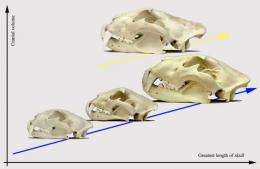
Comparison between greatest length of skull and cranial volume amongst leopard (left on the lower line), jaguar (centre on the lower line), lion (right on the lower line), and tiger (on the upper line).

(PhysOrg.com) -- A wide-ranging study of big cat skulls, led by Oxford University scientists, has shown that tigers have bigger brains, relative to their body size, than lions, leopards or jaguars.

The team investigated the relationship between the skull size - the longest length between the front and back parts of the skull - of a large sample of tigers, lions, leopards and jaguars and the volume inside the cats’ respective craniums. The researchers report their findings in this month’s Biological Journal of the Linnean Society.

'What we had not expected is that the tiger has clearly much bigger relative than do the other three species, which all have similar relative brain sizes,’ said Dr Nobby Yamaguchi of Oxford University’s Wildlife Conservation Research Unit (WildCRU), an author of the report with WildCRU Director Professor David Macdonald.

‘When we compare the two biggest species, on average the has a bigger skull than the tiger based on the greatest length of the skull. However, the tiger has bigger cranial volume than the lion. It is truly amazing that tiny female Balinese tiger skulls have cranial volumes as large as those of huge male southern African lion skulls.’

It has sometimes been assumed that social species, such as lions, should have larger brains than solitary species, such as tigers, because of the need to handle a more complex social life within groups or prides. However, despite a few studies suggesting a relationship between big brains and sociality in mammals, evidence for the link is far from clear.

Dr Nobby Yamaguchi said: ‘Our results strongly suggest that there is no detectable positive relationship between relative brain size and sociality amongst these four big cat species, which shared a common ancestor around 3.7 million years ago.’

The team also looked at the popular idea that tigers are ‘bigger’ than lions (which could mean that the tiger’s relatively bigger brain size simply reflects its bigger body). However, careful re-evaluation of original field data and relatively well-documented hunting records does not support this idea.

So the team concluded that the tigers have a relatively bigger brain (around 16 per cent larger) than lions, given their very similar average body sizes.

Professor Macdonald said: ‘Two general lessons emerge from our findings: first, how much remains to be discovered about even these most familiar of big cats, and second how important museum collections can be as a source of unexpected insights.’

The next step for the researchers is to try to answer whether such a difference can be explained by intrageneric variation or merely by chance. If not by chance, then it raises the question why the tiger evolved a relatively bigger brain (or why other species evolved smaller brains) after the tiger’s ancestor split from the common ancestor to the other three species.

The answers to both these questions may lie in analysing comparative brain anatomy amongst these species (for instance, which parts of the ’s brain are bigger than the lion’s) and similar data from extinct relatives of these big cats as well as smaller living relatives such as the snow leopard and clouded leopard.

Provided by Oxford University (news : web)


print this article email this article download pdf blog this article bookmark this article     Stumble it Digg this share on Facebook retweet share on Reddit add to delicious
Rate this story - 5 /5 (3 votes)


September 3, 2009 all stories

Comments: 0

5 /5 (3 votes)
  • Stumble this up

  • Digg this

  • share this

  • hide
  • Related Stories

  • Evolution of skull and mandible shape in cats
    created Jul 30, 2008 | popularity not rated yet | comments 0
  • Scientists reveal family tree of 'super-sized lions'
    created Mar 31, 2009 | popularity not rated yet | comments 0
  • Wild tigers need cat food
    created Dec 13, 2006 | popularity not rated yet | comments 0
  • Viable tiger populations, tiger trade incompatible
    created Jun 05, 2007 | popularity not rated yet | comments 0
  • First Far Eastern Leopard Captured in Southeast Russia
    created Nov 14, 2006 | popularity not rated yet | comments 0


  • hide
  • Relevant PhysicsForums posts

  • Super quick question about Starling forces?
    created 7 hours ago
  • Questions about diffusion
    created 12 hours ago
  • Human Leukocyte Antigen (HLA) typing
    created 19 hours ago
  • Breeding program
    created Nov 20, 2009
  • More from Physics Forums - Biology

Other News

Beyond sunlight: Explorers census 17,650 ocean species between edge of darkness and black abyss

Beyond sunlight: Explorers census 17,650 ocean species between edge of darkness and black abyss (w/ Video)

Biology / Plants & Animals

created 25 minutes ago | popularity 5 / 5 (2) | comments 0

Census of Marine Life scientists have inventoried an astonishing abundance, diversity and distribution of deep sea species that have never known sunlight - creatures that somehow manage a living in a frigid ...


The Monarchs' annual migration ritual has yet to be scientifically explained

Tree-eating bugs threaten Monarch butterfly in Mexico

Biology / Ecology

created 20 hours ago | popularity 4 / 5 (1) | comments 0

The mysterious Monarch butterfly, which migrates en masse annually between Canada and Mexico, is now facing a new peril: another insect thriving in Western Mexican forests.


Bigger not necessarily better, when it comes to brains

Bigger not necessarily better, when it comes to brains

Biology / Plants & Animals

created Nov 17, 2009 | popularity 4.5 / 5 (18) | comments 11

(PhysOrg.com) -- Tiny insects could be as intelligent as much bigger animals, despite only having a brain the size of a pinhead, say scientists at Queen Mary, University of London.


Extinct goat Myotragus balearicus

Extinct goat was cold-blooded

Biology / Plants & Animals

created Nov 18, 2009 | popularity 4.9 / 5 (33) | comments 10

(PhysOrg.com) -- An extinct goat that lived on a barren Mediterranean island survived for millions of years by reducing in size and by becoming cold-blooded, which has never before been discovered in mammals.


Right-handed chimpanzees provide clues to the origin of human language

Biology / Plants & Animals

created Nov 16, 2009 | popularity 3 / 5 (1) | comments 7

Most of the linguistic functions in humans are controlled by the left cerebral hemisphere. A study of captive chimpanzees at the Yerkes National Primate Research Center (Atlanta, Georgia), reported in the January 2010 issue ...