The war against wildlife comes to an end in Southern Europe
September 4, 2009
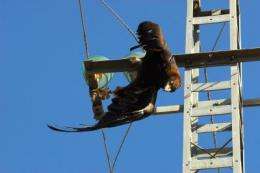
This is an electrocuted bird. Credit: Photo: Juan Antonio Gómez/ Center of Recovery of Wild Fauna ' La Granja of El Saler '/ SINC
This is the conclusion of a study which has analyzed the persecution of birds as a result of hunting in Spain over 14 years. The decrease in this activity and the fall in the number of animals admitted to recovery centres (by a yearly 10%) are the reasons why the "war", in the sense of direct persecution, is drawing to a close in southern Europe.
Researchers from the Mediterranean Institute for Advanced Studies (IMEDEA-CSIC) focussed on the period from 1994 to 2007 to study the persecution of the ten species of birds most often admitted to the recovery centres. The abandonment of rural life and the decrease in hunting are the reasons for the end to the war against wildlife.
Alejandro Martínez-Abraín is the main author and a researcher at the IMEDEA. "The concentration of the human population in large cities means that we no longer perceive countryside animals as enemies; the hunting of birds has also fallen as a result of the increase in awareness of the urban population through the media", he indicated to SINC.
In the study, recently published in the Zoological Society of London's Animal Conservation, 1,050 birds admitted to the La Granja de El Saler rehabilitation centre in Valencia were analyzed (55% diurnal birds of prey, 25% nocturnal birds of prey and 20% aquatic birds) in order to verify whether there has been a fall in the number of animals admitted as a result of direct persecution. The centre is dependent on the Regional Government of Valencia and is one of the largest in Spain.
This phenomenon is directly connected to the decrease in hunting. "The number of licences has fallen by 33% between 1991 and 2000 in the Autonomous Community of Valencia and the markedly downward trend is continuing", indicated Daniel Gold, who has also participated in the study.
According to Martínez-Abraín, "this is a historic moment, as the whole history of humanity has been a history of a fight against nature to survive". The separation between industrialized human beings and nature, due to urban development, means that we no longer perceive wildlife as a problem.
New threats appear
Nevertheless, in spite of the fact that the fight against animals is reaching its end in southern Europe, "we still affect wildlife in a significant manner. The fauna continues to suffer, in equal or greater measure, the indirect consequences of economic development. The collateral damage now causes more harm than the objectives of war themselves, as the metaphor goes", declared the researcher.
As for direct persecution, the illegal use of poison has increased in recent years in some autonomous communities. "But economic development is the latest and main threat to animals", declared Martínez-Abraín. Collisions and electrocutions on electricity cables, animals getting killed in wind turbines and run over on roads and the tremendous development of infrastructures fragment the territory, with serious demographic consequences in the mid and long terms.
According to Martínez-Abraín, in order to reduce the negative impact on wild animals, it is necessary "to continue increasing our ethical valuation of the conservation of biodiversity. There still remains a lot to do, and it must be done soon because we are losing our genetic heritage (the result of millions of years of evolution along an unrepeatable course) at breakneck speed", concluded the scientist.
More information: Martínez-Abraín, A.; Crespo, J.; Jiménez, J.; Gómez, J.A.; Oro, D. "Is the historical war against wildlife over in southern Europe?" Animal Conservation 12(3): 204-208 junio de 2009.
Source: FECYT - Spanish Foundation for Science and Technology
-
Red List overlooks island species
Jul 24, 2009 |
not rated yet |
0
-
CPAP treatment linked to lower mortality in stroke patients with OSA
Jun 25, 2009 |
not rated yet |
0
-
The minerals on Mars influence the measuring of its temperature
Jul 14, 2009 |
not rated yet |
0
-
Spanish scientists develop echolocation in humans
Jun 30, 2009 |
not rated yet |
0
-
Study on origin of mutation that causes fatal familiar insomnia
Jan 07, 2009 |
not rated yet |
0
-
Engineers build first sub-10-nm carbon nanotube transistor
Feb 01, 2012 |
4.9 / 5 (33) |
30
-
Something old, something new: Evolution and the structural divergence of duplicate genes
Jan 31, 2012 |
4.6 / 5 (7) |
1
-
The hidden nanoworld of ice crystals: Revealing the dynamic behavior of quasi-liquid layers
Jan 30, 2012 |
5 / 5 (4) |
1
-
Stock market network reveals investor clustering
Jan 27, 2012 |
3.9 / 5 (23) |
8
-
Of microchemistry and molecules: Electronic microfluidic device synthesizes biocompatible probes
Jan 26, 2012 |
5 / 5 (2) |
0
-
Factors affecting beet root cell membrane
10 hours ago
-
Stem cell question.
Feb 10, 2012
-
Protease cleavage
Feb 10, 2012
-
Pertubance in a model
Feb 10, 2012
-
Cancer drugs and Alzheimer's, Oh my!
Feb 09, 2012
-
Squishing cells
Feb 09, 2012
- More from Physics Forums - Biology
More news stories
A mitosis mystery solved: How chromosomes align perfectly in a dividing cell
Although the process of mitotic cell division has been studied intensely for more than 50 years, Whitehead Institute researchers have only now solved the mystery of how cells correctly align their chromosomes during symmetric ...
5 hours ago |
4.5 / 5 (8) |
0
|
Researchers find extensive RNA editing in human transcriptome
In a new study published online in Nature Biotechnology, researchers from BGI, the world's largest genomics organization, reported the evidence of extensive RNA editing in a human cell line by analysis of RNA-seq data, demons ...
5 hours ago |
5 / 5 (4) |
0
|
The proteins ensuring genome protection
Researchers from the University of Geneva (UNIGE), Switzerland, have discovered the crucial role of two proteins in developing a cell 'anti-enzyme shield'. This protection system, which operates at the level of molecular ...
5 hours ago |
5 / 5 (3) |
0
|
Entire genome of extinct human decoded from fossil
(PhysOrg.com) -- In 2010, Svante Pääbo and his colleagues presented a draft version of the genome from a small fragment of a human finger bone discovered in Denisova Cave in southern Siberia. The ...
Feb 07, 2012 |
4.7 / 5 (59) |
48
|
Why are there so few fish in the Earth's oceans?
(PhysOrg.com) -- A Stony Brook University researcher has found that, contrary to popular belief, there are not plenty of fish in the sea.
Feb 08, 2012 |
4.2 / 5 (18) |
27
|
Declining health-care productivity in England: Who says so?
Reports that the National Health Service in England has been declining in productivity in the last decade appear to have been accepted as fact. However, a Viewpoint published Online First by The Lancet disputes this. The Vi ...
Scientists discover molecular secrets of 2,000-year-old Chinese herbal remedy
For roughly two thousand years, Chinese herbalists have treated Malaria using a root extract, commonly known as Chang Shan, from a type of hydrangea that grows in Tibet and Nepal. More recent studies suggest that halofuginone, ...
New method to examine batteries -- MRI from the inside
There is an ever-increasing need for advanced batteries for portable electronics, such as phones, cameras, and music players, but also to power electric vehicles and to facilitate the distribution and storage of energy derived ...
Overeating may double risk of memory loss
New research suggests that consuming between 2,100 and 6,000 calories per day may double the risk of memory loss, or mild cognitive impairment (MCI), among people age 70 and older. The study was released today and will be ...
Lab study raises questions over nano-particle impact
Tests involving chickens have raised questions about the impact on health from engineered nano-particles, the ultra-fine grains commonly used in drugs and processed foods, scientists said on Sunday.
Starve a virus, feed a cure? Findings show how some cells protect themselves against HIV
A protein that protects some of our immune cells from the most common and virulent form of HIV works by starving the virus of the molecular building blocks that it needs to replicate, according to research published online ...