Scientists move closer to a safer anthrax vaccine
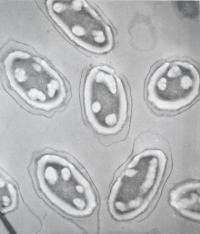
Researchers at Albert Einstein College of Medicine of Yeshiva University have identified two small protein fragments that could be developed into an anthrax vaccine that may cause fewer side effects than the current vaccine.
The research is significant because anthrax is considered a major bioterrorism threat. The current anthrax vaccine is intended mainly for members of the armed forces serving in areas considered high risk and for individuals involved in homeland biosecurity.
"Our research was motivated by the fact that the current anthrax vaccine has significant limitations and there is great need for a better one," says lead author Nareen Abboud, Ph.D., an Einstein postdoctoral fellow and lead author of the study, which appears in the current issue of The Journal of Biological Chemistry. The study's senior author is Arturo Casadevall, M.D., Ph.D., Leo and Julia Forchheimer Professor and chairman of microbiology & immunology.
Anthrax, a disease caused by the bacterial species Bacillus anthracis, occurs when anthrax spores (the microbe's dormant stage) are inhaled, ingested or enter the body through an open wound. Anthrax is a common disease among grazing animals such as cows, goats, and sheep but can also result from bioterrorism.
Eighty to 90 percent of people infected through inhalation will die if not treated, according to the U.S. Department of Health and Human Services. In 2001, five people died after inhaling anthrax spores contained in envelopes mailed to U.S. lawmakers and media personnel. Typical treatment post-exposure includes the antibiotics ciprofloxacin, doxycycline and penicillin.
Anthrax results in part from toxic proteins, or toxins, that the multiplying bacteria secrete. The current anthrax vaccine employs one of these proteins, which elicits protective antibodies when injected into people.
While this 40-year-old vaccine can prevent disease, it has significant drawbacks. Immunity is temporary, and five injections over the course of 18 months are needed to sustain it. One in five vaccine recipients develop redness, swelling or pain at the injection site, and a small number develop severe allergic reactions. A recent article in the journal Clinical Infectious Diseases states that nearly seven million doses of the anthrax vaccine were administered to more than 1.8 million Americans between 1998 and 2008.
In their study, the Einstein scientists focused on the protein toxin used in the current vaccine, looking for the smallest protein sections (known as peptides) that could trigger the production of protective antibodies when injected into animals.
The researchers injected the current vaccine into mice and recovered six different "pure" strains of antibodies known as monoclonal antibodies. They then mixed each type of antibody with the 145 peptides formed by chopping up the vaccine protein. The researchers looked for peptides that were "recognized by" (became bound to) an antibody — an indication that those particular peptides might themselves be able to stimulate the production of protective antibodies on their own.
Ultimately, the researchers found that two of the 145 peptides fit the bill: Each peptide elicited antibodies when injected into mice, and these antibodies protected macrophages from death that would normally have occurred when the macrophages were exposed to anthrax toxin. (Macrophages are protective white blood cells involved in the body's immune response to foreign invaders.) The next step in the Einstein research will be to inject the peptides into an animal model to see if the peptides can protect against anthrax infection.
"An ideal anthrax vaccine contains only the proteins needed to provide protection against disease, and none of the extraneous protein material that triggers the adverse reactions caused by the current vaccine," says Dr. Abboud. "We're hopeful that the two peptides that we have identified in this study can offer these benefits."
The simple structure of these peptides — one is only five amino acids in length, the other six — means it should be easy to synthesize the peptides and inexpensive to produce a vaccine containing them, Dr. Abboud notes.
Einstein will be applying for a patent for the use of the two peptides in an anthrax vaccine.
More information: The paper, "Identification of Linear Epitopes in Bacillus anthracis Protective Antigen Bound by Neutralizing Antibodies," appears in the September 4 online edition of The Journal of Biological Chemistry.
Source: Albert Einstein College of Medicine (news : web)


