The first DNA barcodes of commonly traded bushmeat are published
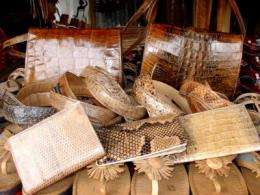
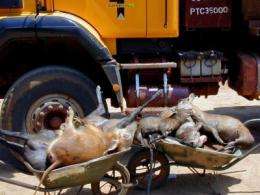
Leather handbags and chunks of red meat: when wildlife specialists find these items in shipping containers, luggage, or local markets, they can now use newly published genetic sequences known as "DNA barcodes" to pinpoint the species of origin. Experts hope that this simple technique will track the harvesting of bushmeat (or wildlife hunted largely in Asia, South and Central America, and Africa) and will ultimately crack down on the widespread and growing international trade in bushmeat, a market estimated to be worth as much as $15 billion in 2008.
According to a paper published in the early online edition of Conservation Genetics (DOI 10.1007/s10592-009-9967-0), barcodes can ably and quickly distinguish among a large number of commercially traded species, so that a handbag is identified as caiman or Nile crocodile, and the meat as duiker or mangabey.
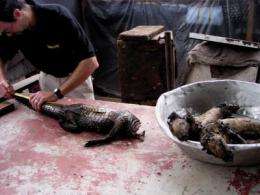
"The species in our study are among the most commercially harvested species in South America and Africa. They are often partially prepared by the time they get to urban markets, which can make the species identification impossible," says one of the authors, Mitchell Eaton, who led the research as part of his doctoral research at the University of Colorado. "In this study, we tested the usefulness of molecular barcodes for monitoring bushmeat harvest and trafficking in wildlife products. We have shown that the method effectively and unambiguously identifies a large number of species."
A genetic barcode is a relatively short region of a gene in the mitochondrion, a structure present outside of the nucleus in cells of all multicellular animals. Over the years, scientists have searched for an appropriate region of the genome that mutates quickly enough to distinguish closely related species but also slowly enough so that individuals within a species have similar barcodes. A 645 base pair region of the COX1 gene (cyotochrome c oxidase subunit 1) has been agreed-upon by researchers as appropriate for barcoding, given that it is both highly variable and very specific. Barcoding has been used to distinguish shark species, to check the labeling of caviar and red snapper, and to identify the presence of endangered whales in Asian markets.
"There is consensus on using the same fragment of DNA, COX1, to construct a library of life," says co-author George Amato, Director of the Sackler Institute for Comparative Genomics at the American Museum of Natural History. "This is an example of where new genetic technology can be transformative to society, by using barcodes to catalog the diversity of ecosystems, to monitor invasive species, to search for pathogens in the food supply, and to observe wildlife trafficking for the pet trade and other commercial markets."
In the current study, Eaton, Amato, and colleagues sequenced the barcode region in 204 samples that represent as many as 25 commonly traded mammals and reptiles. Samples came from blood and tissue collected in Central Africa, museum specimens, and leather products confiscated by the U.S. Fish and Wildlife Service. Although not all are currently endangered, many are embargoed from international trade. These species, which include duikers, spiral-horned antelope, red river hogs, old world monkeys, alligators and crocodiles, represent a large swath of some of the more commonly traded animals in tropical Africa and America. Sequences generated from this study will be added to the Barcode of Life Data Systems, an online, open-access database of barcodes.
As expected, the barcode region accurately identified each species; the variability of the genetic region was low within species but differed by an average of 9.8% among closely related species. The findings, however, point to the need for additional genetic research. African Nile crocodile sequences confirmed previous suggestions of an eastern and western species, and this study determined that the species divide lies between sampling sites in Gabon and the Republic of Congo. Peter's duiker, a cryptic forest antelope, revealed a large amount of hidden genetic diversity within what is now considered a single species; more genetic analysis could refine the taxonomy. Finally, generating barcodes from leather products proved challenging due to the degradation of DNA in these processed skins. The authors of this study hope to develop methods to sequence shorter DNA barcode fragments to focus on identification of older and highly processed material.
"We hope biologists all over the world could—in addition to the work they are already doing—generate barcodes for the species they are working on," says Amato. "This would help the huge international endeavor to develop an encyclopedia of barcodes for all species."
Source: American Museum of Natural History


