For peat's sake: Alternative growing media
September 4, 2009
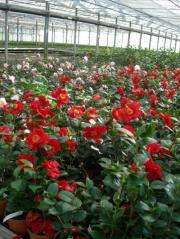
These are colorful camellias which were used in the study. Credit: Photo by Federica Larcher
Peat, or semi-decayed vegetation matter, has been used by commercial growers and amateur gardeners since the middle of the 20th century. Peat is added to potting soil to help retain moisture and provide additional nutrients. As the demand for peat grew, acres of peat bogs were being drained and destroyed. Now, concerns about the environmental impact of extracting peat from wetlands are mounting. And as peat supplies are reduced, the cost naturally increases. Diminishing supplies and environmental and economical concerns are encouraging researchers to find viable alternatives to this popular growing medium.
A recent research study led by Federica Larcher and Valentina Scariot of the University of Turin's Department of Agronomy evaluated five materials as partial peat substitutes. The results, published in HortScience, show these alternatives have potential.
The study focused on growing camellia, a woody plant that prefers acidic soils and is often grown in containers for decorative purposes. Three varieties of camellia ('Charles Cobb's', 'Nuccio's Pearl', and 'Dr. Burnside' ) were tested using a combination of peat and the following peat alternatives: green compost such as grass clippings and leaves, pumice, coconut husks broken down into fibers, composted coconut "peat", and pine bark. Each variety was also grown using the standard commercial Sphagnum peat as a control.
Plant growth and the ornamental quality of each plant was evaluated during each phase of cultivation, potting, before repotting, before and after branching and at the end of the experiment. "The alternative growing media tested…performed as well or better than the standard substrate," the study reports. However, green compost was the exception. Plants grown in green compost had the lowest evaluations in all categories. Green compost also increased pH levels with negative effects on plants.
The impact of the different growing media seemed to be most notable during the first 2 months. After that time, no relevant differences were noticed. "Overall, coconut fibers and pine bark resulted in being the most suitable partial peat substitutes," stated Larcher, adding that none of the plants grown in any mixture showed signs of malnutrition or toxicity at any point during the study.
Coconut fibers are recommended as the best option considering technical and economic factors. The study recommends that adjusting fertilization and irrigation practices to make the most of coconut fiber and peat mixtures will help reduce the costs and losses for nurseries.
More information: The complete study and abstract are available on the ASHS Hortscience electronic journal web site: http://hortsci.ash … act/44/2/312
Source: American Society for Horticultural Science
-
Peatlands disappearance of concern
Nov 10, 2006 |
not rated yet |
0
-
Global warming predicted to hasten carbon release from peat bogs
Nov 06, 2008 |
not rated yet |
0
-
Nitrogen rain makes bogs contribute to climate change
Dec 11, 2006 |
not rated yet |
0
-
Ancient bodies found in Irish bog
Jan 12, 2006 |
not rated yet |
0
-
Alternatives to pine bark and peatmoss identified for commercial, home gardens
Mar 26, 2009 |
not rated yet |
0
-
Engineers build first sub-10-nm carbon nanotube transistor
Feb 01, 2012 |
4.9 / 5 (32) |
30
-
Something old, something new: Evolution and the structural divergence of duplicate genes
Jan 31, 2012 |
4.6 / 5 (7) |
1
-
The hidden nanoworld of ice crystals: Revealing the dynamic behavior of quasi-liquid layers
Jan 30, 2012 |
5 / 5 (4) |
1
-
Stock market network reveals investor clustering
Jan 27, 2012 |
3.9 / 5 (23) |
8
-
Of microchemistry and molecules: Electronic microfluidic device synthesizes biocompatible probes
Jan 26, 2012 |
5 / 5 (2) |
0
-
Factors affecting beet root cell membrane
5 hours ago
-
Stem cell question.
Feb 10, 2012
-
Protease cleavage
Feb 10, 2012
-
Pertubance in a model
Feb 10, 2012
-
Cancer drugs and Alzheimer's, Oh my!
Feb 09, 2012
-
Squishing cells
Feb 09, 2012
- More from Physics Forums - Biology
More news stories
A mitosis mystery solved: How chromosomes align perfectly in a dividing cell
Although the process of mitotic cell division has been studied intensely for more than 50 years, Whitehead Institute researchers have only now solved the mystery of how cells correctly align their chromosomes during symmetric ...
1 hour ago |
5 / 5 (2) |
0
|
The proteins ensuring genome protection
Researchers from the University of Geneva (UNIGE), Switzerland, have discovered the crucial role of two proteins in developing a cell 'anti-enzyme shield'. This protection system, which operates at the level of molecular ...
1 hour ago |
5 / 5 (2) |
0
|
Researchers find extensive RNA editing in human transcriptome
In a new study published online in Nature Biotechnology, researchers from BGI, the world's largest genomics organization, reported the evidence of extensive RNA editing in a human cell line by analysis of RNA-seq data, demons ...
1 hour ago |
5 / 5 (3) |
0
|
Entire genome of extinct human decoded from fossil
(PhysOrg.com) -- In 2010, Svante Pääbo and his colleagues presented a draft version of the genome from a small fragment of a human finger bone discovered in Denisova Cave in southern Siberia. The ...
Feb 07, 2012 |
4.7 / 5 (58) |
48
|
Why are there so few fish in the Earth's oceans?
(PhysOrg.com) -- A Stony Brook University researcher has found that, contrary to popular belief, there are not plenty of fish in the sea.
Feb 08, 2012 |
4.3 / 5 (17) |
27
|
Lab study raises questions over nano-particle impact
Tests involving chickens have raised questions about the impact on health from engineered nano-particles, the ultra-fine grains commonly used in drugs and processed foods, scientists said on Sunday.
Iran blocks email, restricts net access: reports
Iran has further restricted access to the Internet and blocked popular email services for the past few days, in a move a top lawmaker said could "cost the regime dearly," media reports said on Sunday.
Salvage workers begin pumping fuel from Italian shipwreck
Salvage workers Sunday began pumping fuel from the shipwrecked Italian cruise liner Costa Concordia, a day ahead of schedule, officials said.
Scientists discover molecular secrets of 2,000-year-old Chinese herbal remedy
For roughly two thousand years, Chinese herbalists have treated Malaria using a root extract, commonly known as Chang Shan, from a type of hydrangea that grows in Tibet and Nepal. More recent studies suggest that halofuginone, ...
New method to examine batteries -- MRI from the inside
There is an ever-increasing need for advanced batteries for portable electronics, such as phones, cameras, and music players, but also to power electric vehicles and to facilitate the distribution and storage of energy derived ...
Starve a virus, feed a cure? Findings show how some cells protect themselves against HIV
A protein that protects some of our immune cells from the most common and virulent form of HIV works by starving the virus of the molecular building blocks that it needs to replicate, according to research published online ...