Humans spread out of Africa later
September 4, 2009 Humans spread out of Africa later

Enlarge

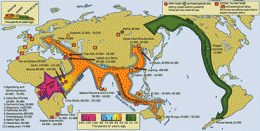
Detailed world map showing directions and times of major migration of modern humans. New research shows they spread out of Africa 20,000 years later than previously thought at around 55-60,000 years ago. © Trends in Ecology & Evolution

Modern humans spread out of Africa 20,000 years later than previously thought, according to new genetic research just published.

Scientists, including the Natural History Museum’s origins expert Professor Chris Stringer, re-examined how scientists get dates for key events in human evolutionary history. They did this by finding new ways to analyse the data obtained from mitochondrial (mtDNA).

Mitochondria are the tiny structures in each human cell that produce the cell’s power. They contain their own DNA and this is inherited through the mother.

‘We tried alternative ways to date recent episodes in , such as our split from , and we found these events occurred more recently in time,’ says Prof Stringer.

The new analysis revealed modern humans separated from Neanderthals around 300-400,000 years ago rather than previous estimates of 500-600,000 years.

The research suggested that modern humans migrated out of Africa between 55-60,000 years ago rather than the previous dates of 70-80,000 years.

They also got more recent dates for other crucial events such as the age of our African ancestral mother, known as mitochondrial Eve, from who all recent humans (Homo sapiens) descended. She was found to have lived around 110-130,000 years ago, rather than previous estimates of 150,000-200,000 years ago.

‘The new dates are consistent with the most recent fossil and archaeological data for Neanderthal evolution, our exit from Africa and our arrival in Asia, Australia, Europe and the Americas,’ says Prof Stringer.

‘And they also cast doubt on ideas of an early exit from towards China and Australia.’

More information: Chris Stringer, Phillip Endicott, Simon Y.W. Ho, and Mait Metspalu's Evaluating the Mitochondrial Timescale of Human Evolution paper is published in the journal Trends in Ecology and Evolution.

Source: American Museum of Natural History (news : web)


print this article email this article download pdf blog this article bookmark this article     Stumble it Digg this share on Facebook retweet share on Reddit add to delicious
Rate this story - 4.5 /5 (18 votes)

Rank Filter

Move the slider to adjust rank threshold, so that you can hide some of the comments.


Display comments: newest first

  • rincewind - Sep 04, 2009
    • Rank: 5 / 5 (2)
    Too bad the zoomed-in "Detailed world map showing directions and times of major migration..." is actually not a detailed map but a 180-pixel blur.
  • Caliban - Sep 04, 2009
    • Rank: not rated yet
    No matter- as much contradiction as there is in this whole picture, it will likely be some time before the details are certain enough to map with any clarity.
  • TLO - Sep 04, 2009
    • Rank: not rated yet
    Map is just a tease
  • RayCherry - Sep 07, 2009
    • Rank: not rated yet
    The Creationists will be wearing Devilish smiles when reading this news.

September 4, 2009 all stories

Comments: 4

4.5 /5 (18 votes)
  • Stumble this up

  • Digg this

  • share this

  • hide
  • Related Stories

  • Did modern humans eat Neanderthals?
    created May 18, 2009 | popularity not rated yet | comments 0
  • Neanderthal Lacked Anatomical Competitive Edge: Skeletal Remains Tell the Story
    created Jan 16, 2009 | popularity not rated yet | comments 0
  • Natural Selection and the Human Skull
    created Mar 18, 2008 | popularity not rated yet | comments 0
  • Handsome by Chance
    created Aug 02, 2007 | popularity not rated yet | comments 0
  • Long lost sisters
    created May 15, 2008 | popularity not rated yet | comments 0


  • hide
  • Relevant PhysicsForums posts

  • What is transpulmonary pressure?
    created Nov 24, 2009
  • Is there a gay gene?
    created Nov 23, 2009
  • Super quick question about Starling forces?
    created Nov 22, 2009
  • Questions about diffusion
    created Nov 22, 2009
  • More from Physics Forums - Biology

Other News

Explained: The Discrete Fourier Transform

Explained: The Discrete Fourier Transform

Other Sciences / Mathematics

created 17 hours ago | popularity 4.2 / 5 (22) | comments 8

(PhysOrg.com) -- In 1811, Joseph Fourier, the 43-year-old prefect of the French district of Isčre, entered a competition in heat research sponsored by the French Academy of Sciences. The paper he submitted ...


Ancient Greek Temple

Houses of the rising sun: Research sheds new light on Ancient Greeks

Other Sciences / Archaeology & Fossils

created 13 hours ago | popularity 5 / 5 (1) | comments 3

New research at the University of Leicester has identified scores of Sicilian temples built to face the rising Sun, shedding light on the practices of the Ancient Greeks.


Biology, training and profit sharing make best traders

Biology, training and profit sharing make best traders

Other Sciences / Mathematics

created 17 hours ago | popularity 5 / 5 (1) | comments 1

(PhysOrg.com) -- Cambridge researchers have identified a group of traders consistently able to outperform the market, even during the credit crisis.


Study: Race, class and gender shape religion's effect on American voters

Other Sciences / Social Sciences

created 9 hours ago | popularity not rated yet | comments 0

(PhysOrg.com) -- How Americans vote is strongly linked to their religious identities, but it is not an independent influence that transcends race, socio-economic class and gender, reports a new Cornell study.


UQ archaeology digs into the life behind Pompeii

Other Sciences / Archaeology & Fossils

created 9 hours ago | popularity 3.3 / 5 (3) | comments 0

(PhysOrg.com) -- Brisbane may be 2000 years and half-a-world away from Pompeii, but it hasn’t stopped a UQ archaeologist from digging up some hidden treasures.