Brown economists measure GDP growth from outer space
September 4, 2009 Brown economists measure GDP growth from outer space

Enlarge

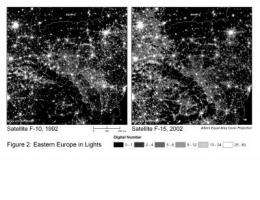
Increased nighttime lighting indicates economic growth in Poland and Eastern Europe between 1992 (left, above) and 2002. Poland is in the top left quarter of each image. Credit: Image and Data processing by NOAA's National Geophysical Data Center. DMSP data collected by the US Air Force Weather Agency.

Outer space offers a new perspective for measuring economic growth, according to new research by three Brown University economists. In a National Bureau of Economic Research working paper, J. Vernon Henderson, Adam Storeygard, and David N. Weil suggest a new framework for estimating a country or region's gross domestic product (GDP) by using satellite images of the area's nighttime lights.

Reliable data on is hard to come by in many parts of the world — particularly in sub-Saharan Africa and other developing countries — and the data is often not calculated at all for cities. The authors cite the Penn World Tables, one of the standard compilations of data on income, which rank countries with grades A through D by the quality of their GDP and price data. While almost all industrialized countries receive a grade of A, nearly all sub-Saharan African countries get a grade of C or D, which is interpreted as roughly 30 or 40 percent margin of error. Several countries do not appear in the table, including Iraq, Myanmar, Somalia, and Liberia.

To improve these estimates, Henderson, Storeygard, and Weil suggest combining measured income data with the changes observed in a country's "night lights" as seen from outer space. Using U.S. Air Force weather satellite picture composites, they look at changes in a region's light density over a 10-year period. "Consumption of nearly all goods in the evening requires lights," they write. "As income rises, so does light usage per person, in both consumption activities and many investment activities."

When the researchers applied the new methodology to countries with low-quality national income data, the new estimates were significantly different. For example, in the Democratic Republic of Congo, lights suggest a 2.4-percent annual growth rate in GDP, while official estimates suggest a negative 2.6-percent growth over the same time period. The Congo appears to be growing faster than official estimates suggest. At the other end, Myanmar has an official growth rate of 8.6 percent a year, but the lights data imply only a 3.4-percent annual growth rate.

Henderson, Storeygard, and Weil say they don't envision the lights density data as a replacement for official numbers, but when added to existing data from agencies like the World Bank, the lights density can provide a better indicator of how these economies really are performing.

"Our hope is that people start using this, either when they don't have actual data on economic growth ... or when the numbers are pretty bad," said Henderson, professor of economics. "This is just a way to get better estimates."

The second portion of the paper establishes the first known causal relationship between local agriculture productivity and an increase in city incomes. The authors examined 541 cities in 18 African countries over a period of nine years, using rainfall as a way to measure "productivity shocks" to the rural areas. The authors conclude that an increase in agricultural output does in fact have substantial effects on local urban economic activity.

Storeygard, a fourth-year graduate student, added that the research was a true collaboration. Weil has written widely on various aspects of economic growth, while Henderson is interested in how to measure growth at a regional or subnational level. Storeygard has experience using geographic and satellite data. "It's the kind of paper that used all three of our areas," said Storeygard. "I don't think any two of us would have been able to do this in quite the same way."

Source: Brown University (news : web)


print this article email this article download pdf blog this article bookmark this article     Stumble it Digg this share on Facebook retweet share on Reddit add to delicious
Rate this story - 4.6 /5 (7 votes)

Rank Filter

Move the slider to adjust rank threshold, so that you can hide some of the comments.


Display comments: newest first

  • srikkanth_kn - Sep 05, 2009
    • Rank: not rated yet
    Are these 'night lights' seen dimmer during these economically turbulent times ?
  • RockyB - Sep 06, 2009
    • Rank: not rated yet
    "The Congo appears to be growing faster than official estimates suggest."

    OR (just MAYBE) this method of evaluating GDP is completely and utterly useless!

September 4, 2009 all stories

Comments: 2

4.6 /5 (7 votes)
  • Stumble this up

  • Digg this

  • share this

  • hide
  • Related Stories

  • As planet warms, poor nations face economic chill
    created Mar 13, 2009 | popularity not rated yet | comments 0
  • Economists: Ancestral history explains roots of income inequality
    created Dec 16, 2008 | popularity not rated yet | comments 0
  • Debunking the 'curse of oil'
    created Jul 07, 2008 | popularity not rated yet | comments 0
  • Study: Healthy living boosts economy
    created Nov 10, 2006 | popularity not rated yet | comments 0
  • Researchers analyze 'Africa effect,' the slow growth of some economies
    created Jun 15, 2007 | popularity not rated yet | comments 0


  • hide
  • Relevant PhysicsForums posts

  • Quantum Economies: Phyisical Modeling of Economic Systems
    created Nov 16, 2009
  • The real purpose of cretenic marketing/commercial propaganda
    created Nov 15, 2009
  • Speculative Attack
    created Nov 13, 2009
  • Animals which attack their "cousins"
    created Nov 07, 2009
  • More from Physics Forums - Social Sciences

Other News

The skyline of Tokyo in Japan, where scientists have criticised the new government for plans to slash research budgets

Japan scientists attack govt research cut plans

Other Sciences / Other

created 32 minutes ago | popularity not rated yet | comments 0

Top Japanese scientists, including four Nobel laureates, have criticised the new government for plans to slash research budgets, warning the country will loose its high-tech edge.


Message gone viral? Blame it on altruistic, yet image-conscious Internet  'e-mavens'

Message gone viral? Blame it on altruistic, yet image-conscious Internet 'e-mavens'

Other Sciences / Economics

created 7 hours ago | popularity 2 / 5 (1) | comments 0

(PhysOrg.com) -- Why do some online ad campaigns go viral while other online marketing messages gather "cyber-dust" on the information superhighway? The key may lie in the motivation of Internet users to email ...


Researcher: Faint writing seen on Shroud of Turin (AP)

Researcher: Faint writing seen on Shroud of Turin (Update)

Other Sciences / Archaeology & Fossils

created Nov 20, 2009 | popularity 2.4 / 5 (30) | comments 42

(AP) -- A Vatican researcher has rekindled the age-old debate over the Shroud of Turin, saying that faint writing on the linen proves it was the burial cloth of Jesus. Experts say the historian may be reading ...


Explained: The Discrete Fourier Transform

Explained: The Discrete Fourier Transform

Other Sciences / Mathematics

created Nov 25, 2009 | popularity 4.3 / 5 (26) | comments 8

(PhysOrg.com) -- In 1811, Joseph Fourier, the 43-year-old prefect of the French district of Isčre, entered a competition in heat research sponsored by the French Academy of Sciences. The paper he submitted ...


Climate change could boost incidence of civil war in Africa

Other Sciences / Social Sciences

created Nov 23, 2009 | popularity 2.4 / 5 (16) | comments 9

Climate change could increase the likelihood of civil war in sub-Saharan Africa by over 50 percent within the next two decades, according to a new study led by a team of researchers at University of California, Berkeley, ...