NY researchers breeding rare native ladybugs
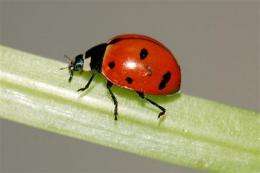
(AP) -- A year after they launched a nationwide search for dwindling native ladybugs, New York researchers are breeding colonies of them from insects found by citizen scientists in Oregon and Colorado.
John Losey, an entomologist at Cornell University, launched the Lost Ladybug Project last year to try to figure out why once-common native ladybug species had all but disappeared across the country. The project, funded by the National Science Foundation, recruits citizen scientists - especially children - to search for ladybugs and send photos of them to Losey and his colleagues.
Of particular interest are the nine-spotted, two-spotted and transverse ladybugs, three native species that have declined dramatically in the last decade, possibly because of the release of non-native species to control crop pests.
"Between 1999 and last year when we started the program, less than 10 individuals of the nine-spot were collected anywhere in the country," Losey said. "That used to be the most dominant species across the U.S. and Canada."
Hundreds of participants across the U.S. and Canada have sent in thousands of photos since the project launched. While some of the photos were of native species, most of the pictures showed the multicolored Asian ladybug and the European seven-spotted ladybug, which were introduced for agricultural pest control and have become widespread as the dominant species.
The big breakthrough came in June, when 6-year-old Alyson Yates and her mom, Kate, started sending in photos of nine-spotted ladybugs from their rural backyard in Lakeview, Ore., in the sagebrush desert east of the Cascades.
"It was really an amazing find," Losey said. "Usually, someone just finds one or two. Alyson and Kate sent in a couple one day, a few more three days later, a couple more a few days after that. It became apparent they had a population out there."
So Losey and a colleague boarded a plane with their collecting nets and came back to Ithaca with 13 nine-spotted and more than 30 transverse ladybugs.
"Aly was thrilled that people would come all the way from New York to go collecting in our yard," said Kate Yates, who got involved in the project when her daughter saw an ad in the National Wildlife Federation's Ranger Rick magazine for children. "She just had a wonderful time looking for ladybugs, and we were ecstatic when we found some of the nine-spots they were looking for."
The researchers got an overnight shipment of 13 more nine-spots from 40-year-old Sheena Beaverson of Champaign, Ill., who sent in more than 200 ladybug photos while she was staying in Boulder, Colo., for a month.
Searching for ladybugs was a lot like looking for seashells on the beach, said Beaverson, who works for the Illinois State Geological Survey. "At first you look at every single one; later on you start looking for something rare or something special."
Since they arrived at Cornell, the beetles have been busily reproducing inside gossamer net cages lined up in Losey's lab, gorging on juicy green pea aphids raised for them on fava bean plants in the university's greenhouse.
Losey plans to conduct a number of studies with the captive populations in hopes of learning why they declined in the wild.
"The leading theory is that the decline had something to do with ladybugs that were imported," Losey said. "That's mostly based on the timing of the decline, which coincides with the introduction of the seven-spot."
"It does do a lot of good in pest control," Losey said. "The question is whether it just replaced the existing ladybugs or added to the diversity."
The Asian multicolored ladybug, which was released by the U.S. Department of Agriculture in the 1970s and '80s to control scale insects on trees, didn't become widely established until after the natives declined, Losey said. The round Asian beetle is famous for swarming by the thousands on homes on warm autumn days.
"Some of the things we'll look at are, do the native species take longer to develop than the imported ones? Do they not eat as much? Are they more susceptible to parasitoids or pathogens? Did they interbreed and take on the appearance of the seven-spot?" Losey said.
Pest management based on natural predators requires knowledge of the life cycle and feeding habits of the predators.
"The different ladybug species forage different parts of the plant, different parts of the field, at different times of day, and seek different prey," Losey said. "If you want the most effective suppression of pests, you need a whole variety of ladybugs because then they work together and cover different parts of the environment."
Ladybugs eat a wide range of plant-damaging pests, including aphids, mealybugs, scale, and the eggs and young larvae of European corn borers and eastern tent caterpillars.
At some point, field studies will be conducted with the ladybugs being bred in Losey's lab. But it's not a captive breeding program aimed at re-establishing the natives in the wild, he said.
"It could evolve into one, but for now, we're just trying to determine why they declined and what the implications are."
---
On the Net:
©2009 The Associated Press. All rights reserved. This material may not be published, broadcast, rewritten or redistributed.


