Discovery astronauts ready for final spacewalk
September 5, 2009
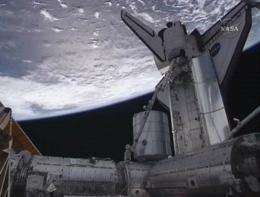
Image from NASA video shows the International Space Station September 3 during the spacewalk by Disvovery astronauts Danny Olivas and Christer Fuglesang of Sweden. Astronauts will venture again into outer space Saturday on a third and final spacewalk
Astronauts of the US space shuttle Discovery will venture again into outer space Saturday on a third and final spacewalk of their mission designed to help complete the International Space Station.
The walk, which will be conducted by mission specialists Danny Olivas and Christer Fuglesang, is scheduled to begin at 4:49 pm (2049 GMT), the National Aeronautics and Space Administration (NASA) announced.
After reviewing procedures, Olivas and Fuglesang are spending the night in the Quest airlock to prepare themselves for work in outer space.
On Friday, Fuglesang, of Sweden, and Olivas installed a liquid ammonia tank to keep the space station cool and completed several other tasks, including bolting portable foot restraints on the orbiter's truss.
The pair returned to the decompression chamber after six hours and 39 minutes in space, NASA said, after bolting the 1,760-pound (800-kilogram) tank into place and linking up electrical and fluid lines.
It was the second of three spacewalks for the space shuttle Discovery's mission at the ISS.
The veteran spacewalkers also moved a spent ammonia tank, which was removed Wednesday, into the shuttle's cargo bay to be taken back to Earth.
The ammonia helps move excess heat from inside the ISS to the radiators outside the station.
Earlier, a large piece of space debris drifted toward the ISS, but NASA said it would not affect the mission's spacewalks.
"We got sufficient data to tell us that the debris was no longer a threat to the space station," ISS Flight Director Heather Rarick told reporters during a post-spacewalk briefing.
She said the combined crew of 13 astronauts aboard the ISS and the shuttle were completing the transfer of supplies from Discovery to the orbiter.
The shuttle had brought 7.5 tons of supplies, including new station crew quarters, a freezer, two research racks and a treadmill named after popular US talkshow comedian Stephen Colbert, to the station.
The freezer will store samples of blood, urine and other materials that will eventually be brought back to Earth for study on the effects of zero-gravity.
Mission Control was keeping a close watch on the remains of the three-year-old Ariane 5, a European space rocket, that were moving in an oval-shaped orbit.
The piece, which is some 200 square feet (19 square meters) in size, was expected to pass almost two miles (three kilometers) from the outpost on Friday, NASA said.
Officials have developed a contingency plan to potentially "reboost" the station-shuttle complex if the space junk posed a threat.
The linked spacecraft are currently orbiting 220 miles (354 kilometers) above the Earth.
The duo also fetched US and European equipment from the orbiting station's Columbus laboratory that will be brought back to scientists on Earth.
Discovery's mission is the fourth of five planned for the shuttle program this year. The last is scheduled for November.
The shuttle will remain docked at the ISS for a total of nine days ending Tuesday and is due to return to Earth on September 10.
Once the mission is complete, just six more shuttle flights remain before NASA's three shuttles are retired in September 2010.
(c) 2009 AFP
-
Spacewalk performed despite approaching space junk
Sep 03, 2009 |
not rated yet |
0
-
NASA delays shuttle Discovery launch
Aug 27, 2009 |
not rated yet |
0
-
Space shuttle Endeavour readies return to Earth
Jul 28, 2009 |
not rated yet |
0
-
NASA analyzing junk that could threaten astronauts
Sep 02, 2009 |
not rated yet |
0
-
NASA gets ready for another space mission
Mar 31, 2008 |
not rated yet |
0
-
Engineers build first sub-10-nm carbon nanotube transistor
Feb 01, 2012 |
4.9 / 5 (31) |
30
-
Something old, something new: Evolution and the structural divergence of duplicate genes
Jan 31, 2012 |
4.6 / 5 (7) |
1
-
The hidden nanoworld of ice crystals: Revealing the dynamic behavior of quasi-liquid layers
Jan 30, 2012 |
5 / 5 (3) |
1
-
Stock market network reveals investor clustering
Jan 27, 2012 |
3.9 / 5 (23) |
8
-
Of microchemistry and molecules: Electronic microfluidic device synthesizes biocompatible probes
Jan 26, 2012 |
5 / 5 (1) |
0
-
Never ending outer space.....
12 hours ago
-
Neutron Star fragments?
14 hours ago
-
stationary or not?
18 hours ago
-
Scale of the Universe
Feb 10, 2012
-
Titan's lack of impact craters
Feb 09, 2012
-
Real pictures of black hole eating a star?
Feb 08, 2012
- More from Physics Forums - General Astronomy
More news stories
Latin America mining boom clashes with conservation
Latin America is experiencing a mining boom as prices rise fuelled by a hike in global demand, but the region is also being hit by a wave of violent protests, strikes and rallies by environmentalists.
6 hours ago |
not rated yet |
0
Political leaders play key role in how worried Americans are by climate change: study
More than extreme weather events and the work of scientists, it is national political leaders who influence how much Americans worry about the threat of climate change, new research finds.
Feb 06, 2012 |
5 / 5 (6) |
72
NASA budget will axe Mars deal with Europe: scientists
US President Barack Obama's budget proposal to be submitted next week for 2013 will cut NASA's budget by 20 percent and eliminate a major partnership with Europe on Mars exploration, scientists said Thursday.
Space & Earth / Space Exploration
Feb 10, 2012 |
5 / 5 (3) |
55
Humans may have helped the decline of African rainforests 3000 years ago
(PhysOrg.com) -- Large areas of rainforests in Central Africa mysteriously disappeared over three thousand years ago, to be replaced by savannas. The prevailing theory has been that the cause was a change ...
Study shows global glaciers, ice caps, shedding billions of tons of mass annually
Earth's glaciers and ice caps outside of the regions of Greenland and Antarctica are shedding roughly 150 billion tons of ice annually, according to a new study led by the University of Colorado Boulder.
Space & Earth / Earth Sciences
Feb 08, 2012 |
4.4 / 5 (9) |
14
|
Google might launch Drive for cloud storage soon
(PhysOrg.com) -- Google's next big move, according to the Wall Street Journal, is a cloud storage service called Drive. Hardly first to the plate, Google is simply catching up to introducing its cloud reposi ...
Love a click away in Indonesia's Twitter Republic
He was a geeky kid from Yogyakarta, she a glamorous city girl in Jakarta. In a country with one of the world's most vibrant social networking scenes they fell in love on Twitter.
Europeans protest controversial Internet pact
Tens of thousands of people marched in protests in more than a dozen European cities Saturday against a controversial anti-online piracy pact that critics say could curtail Internet freedom.
Walney offshore wind farm is world's biggest (for now)
(PhysOrg.com) -- The Walney wind farm on the Irish Sea--characterized by high tides, waves and windy weather--officially opened this week. The farm is treated in the press as a very big deal as the Walney ...
Navy to begin tests on electromagnetic railgun prototype launcher
The Office of Naval Research (ONR)'s Electromagnetic (EM) Railgun program will take an important step forward in the coming weeks when the first industry railgun prototype launcher is tested at a facility ...
Explained: Sigma
It's a question that arises with virtually every major new finding in science or medicine: What makes a result reliable enough to be taken seriously? The answer has to do with statistical significance -- but ...