Ozone: Climate change boosts ultraviolet risk for high latitudes
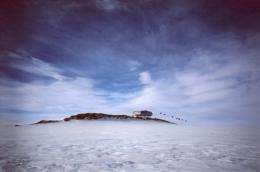
September 6, 2009 Belgium's Princess Elisabeth base in Antartica

Enlarge

This undated photo, released by the International Polar Foundation, shows Belgium's Princess Elisabeth base in Antartica. By century's end, UV levels in Antarctica could rise by up to 20 percent at seasonal peaks while average exposure in northern Scandinavia, Siberia and northern Canada could fall by almost a tenth.

(PhysOrg.com) -- Physicists at the University of Toronto have discovered that changes in the Earth's ozone layer due to climate change will reduce the amount of ultraviolet (UV) radiation in northern high latitude regions such as Siberia, Scandinavia and northern Canada. Other regions of the Earth, such as the tropics and Antarctica, will instead face increasing levels of UV radiation.

"Climate change is an established fact, but scientists are only just beginning to understand its regional manifestations," says Michaela Hegglin, a postdoctoral fellow in the Department of Physics, and the lead author of the study published this month in Nature Geoscience.

Using a sophisticated computer model, Hegglin and U of T physicist Theodore Shepherd determined that 21st-century climate change will alter atmospheric circulation, increasing the flux of ozone from the upper to the lower atmosphere and shifting the distribution of ozone within the upper atmosphere. The result will be a change in the amount of UV radiation reaching the Earth's surface which varies dramatically between regions: e.g. up to a 20 per cent increase in UV radiation over southern high latitudes during spring and summer, and a nine per cent decrease in UV radiation over northern high latitudes, by the end of the century.

While the effects of increased UV have been widely studied because of the problem of ozone depletion, decreased UV could have adverse effects too, e.g. on vitamin D production for people in regions with limited sunlight such as the northern high latitudes.

"Both human and ecosystem health are affected by air quality and by UV radiation," says Shepherd. "While there has been much research on the impact of climate change on air quality, our work shows that this research needs to include the effect of changes in stratospheric ozone. And while there has been much research on the impact of ozone depletion on UV radiation and its impacts on human and ecosystem health, the notion that climate change could also affect UV radiation has not previously been considered. This adds to the list of potential impacts of climate change, and is especially important for Canada as northern high latitudes are particularly affected."

Provided by University of Toronto


print this article email this article download pdf blog this article bookmark this article     Stumble it Digg this share on Facebook retweet share on Reddit add to delicious
Rate this story - 2.2 /5 (13 votes)

Rank Filter

Move the slider to adjust rank threshold, so that you can hide some of the comments.


Display comments: newest first

  • dachpyarvile - Sep 06, 2009
    • Rank: 5 / 5 (1)
    No, the chemicals we have shot up into the atmosphere will be responsible for the loss of Ozone as these chemicals have been up there for a while a take a long time to break down. They damage Ozone until they break down.
  • LariAnn - Sep 06, 2009
    • Rank: 3 / 5 (2)
    "changes in convention?" Someone needs to check their spelling. I think it should be "change in convection".

    LOL
  • Velanarris - Sep 07, 2009
    • Rank: 5 / 5 (2)
    By century's end, UV levels in Antarctica could rise by up to 20 percent at seasonal peaks while average exposure in northern Scandinavia, Siberia and northern Canada could fall by almost a tenth.

    The shift could have worrying impacts on human health, as high exposure to UV is linked to cancer, cataracts and crop damage just as low exposure causes vitamin D insufficiency.

    Those poor antarticans.....

    As an aside, most people nowadays cannot produce vit d from UV and require dietary supplementation in any event.

    My question would be how will there be an increase in UV at the tropical regions if they are the main ozone generator? Are we expecting a decrease in creation or an increase in wind currents? If it's the latter, under what scenario would global warming have any effect on wind currents if it is in fact "global" warming?

    The abstract leaves much to be answered.
  • AlexCoe - Sep 08, 2009
    • Rank: 5 / 5 (1)
    Can someone please explain to me how...
    A) CFC's a huge, heavy molecule, could kill ozone in the upper atomosphere? That is why we outlawed them. Why aren't there ozone holes over areas where CFC's are released?
    B) How can O3 travel upward in the convection currents and sustain itself without degrading to O2?
    C) As I understand the process, O3 in the upper atmosphere is actually created there by ionizing radiation.
    D) We have no clue what "normal" is for the ozone layer. Since we have little study of it over a short period of time, by the standards involved in climate work.
    E) Isn't this simply more hype to support the IPCC and the gorebal warming crowd in support of the carbon trading scam by Congress?
  • dachpyarvile - Sep 08, 2009
    • Rank: not rated yet
    No, the CFC problem was real. Several ozone holes did begin to form over several large cities in the form of ozone thinning. I remember those days well. You may be too young to remember the days before the ban.

    The process for ozone breakdown via CFCs is relatively well known. The problem was not in the existence of the chemicals but in their breakdown in the stratosphere.

    They would break down and release free chlorine ions, which would knock an oxygen atom off the ozone, which would re-release the chrorine ions, which would contact more ozone and break it down, etc.

    This process still is taking place and will take place until all the CFCs are broken down and the chlorine ions remain bound with something else. Luckily, the action of the CFCs is lessening over time and will do so as long as we continue to prevent their escape into the atmosphere.

    Air convection and currents are what spread it around once released into the atmosphere. Another part of the problem was HCFCs as well as CBrCs like Halon, which also was banned.

    Most of the ozone thinning forming over the various cities closed up but the chemicals migrated with the air currents to the poles. They assist with the formation of the Antarctic Ozone Hole in combination with normally occurring factors.

September 6, 2009 all stories

Comments: 5

2.2 /5 (13 votes)
  • Stumble this up

  • Digg this

  • share this

  • hide
  • Related Stories

  • Record cold winter may increase ozone hole over North Europe
    created Jan 31, 2005 | popularity not rated yet | comments 0
  • Patch of thin ozone layer in New Zealand
    created Sep 24, 2006 | popularity not rated yet | comments 0
  • Antarctic ozone - not a hole lot worse or better
    created Nov 10, 2005 | popularity not rated yet | comments 0
  • Ozone recovering, but unlikely to stabilize at pre-1980 levels
    created May 03, 2006 | popularity not rated yet | comments 0
  • Study Finds Clock Ticking Slower On Ozone Hole Recovery
    created Jun 30, 2006 | popularity not rated yet | comments 0


  • hide
  • Relevant PhysicsForums posts

  • The IPCC and the term "most"
    created Nov 23, 2009
  • Is global warming a fact?
    created Nov 23, 2009
  • Random variability of wind patterns
    created Nov 23, 2009
  • Record precipitation in the UK
    created Nov 22, 2009
  • More from Physics Forums - Earth

Other News

No Wheel Stall in Diagnostic Drive

Spirit Mars Rover: No Wheel Stall in Diagnostic Drive

Space & Earth / Space Exploration

created 3 hours ago | popularity 5 / 5 (1) | comments 0

(PhysOrg.com) -- On Sol 2095 (Tuesday, Nov. 24), Spirit performed a set of diagnostic actions related to a stall of the right-rear wheel on the previous drive, three days earlier.


Monster Waves on the Sun are Real

Monster Waves on the Sun are Real (w/ Video)

Space & Earth / Astronomy

created 3 hours ago | popularity 5 / 5 (6) | comments 0

Sometimes you really can believe your eyes. That's what NASA's STEREO (Solar Terrestrial Relations Observatory) spacecraft are telling researchers about a controversial phenomenon on the sun known as the "solar ...


Cosmic 'dig' reveals vestiges of the Milky Way's building blocks

Cosmic 'Dig' Reveals Vestiges of the Milky Way's Building Blocks

Space & Earth / Astronomy

created 8 hours ago | popularity 4.9 / 5 (12) | comments 1

(PhysOrg.com) -- Peering through the thick dust clouds of our galaxy's "bulge" (the myriads of stars surrounding its center), a team of astronomers has unveiled an unusual mix of stars in the stellar grouping ...


Oceanic crust formation is dynamic after all

Oceanic crust formation is dynamic after all

Space & Earth / Earth Sciences

created 7 hours ago | popularity 4.3 / 5 (3) | comments 0

Imagine the Earth's crust as the planet's skin: Some areas are old and wrinkled while others have a fresher, more youthful sheen, as if they had been regularly lathered with lotion.


Climate experts debate strategies for reducing atmospheric carbon and future warming

Climate experts debate strategies for reducing atmospheric carbon and future warming

Space & Earth / Environment

created 3 hours ago | popularity 3 / 5 (4) | comments 3

(PhysOrg.com) -- Reducing carbon dioxide to safe levels may require extracting carbon from the air, says Cornell climate researcher.