Analysis confirms that nano-related research has strong multidisciplinary roots
The burgeoning research fields of nanoscience and nanotechnology are commonly thought to be highly multidisciplinary because they draw on many areas of science and technology to make important advances.
Research reported in the September issue of the journal Nature Nanotechnology finds that nanoscience and nanotechnology indeed are highly multidisciplinary - but not much more so than other modern disciplines such as medicine or electrical engineering that also draw on multiple areas of science and technology.
With $1.6 billion scheduled to be invested in nano-related research during 2010, assessing the multidisciplinary nature of the field could be important to policy-makers, research managers, technology-transfer officers and others responsible for managing the investment and creating a supportive environment for it.
"Research in nanoscience and nanotechnology is not just a collection of isolated 'stove pipes' drawing knowledge from one narrow discipline, but rather is quite interdisciplinary," said Alan Porter, co-author of the paper and a professor emeritus in the Schools of Industrial and Systems Engineering and Public Policy at the Georgia Institute of Technology. "We found that research in any one category of nanoscience and nanotechnology tends to cite research in many other categories."
The study was sponsored by the National Science Foundation through the Center for Nanotechnology in Society at Arizona State University.
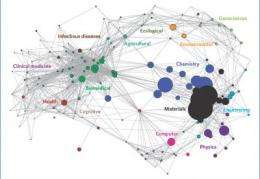
Porter and collaborator Jan Youtie, manager of policy services in Georgia Tech's Enterprise Innovation Institute, analyzed abstracts from more than 30,000 papers with "nano" themes that were published between January and July of 2008. They found that although materials science and chemistry dominated the papers, fields as diverse as clinical medicine, biomedical sciences and physics also contributed.
These "nanopapers" studied by the researchers appeared in more than 6,000 journals that were part of a database known as the Science Citation Index (SCI). The researchers found nanopapers in 151 of SCI's 175 subject categories, with 52 of the categories containing more than 100 such papers.
To explore how well knowledge was integrated across the disciplines, the researchers also studied the journal articles that were cited in the nanopapers. They found more than one million cited references, a mean of 33 per paper.
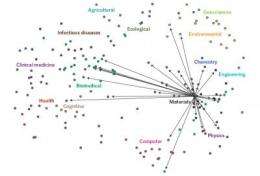
Using text mining techniques to extract sources from the cited references, they further found that 45 subject categories were cited by five percent or more of the nanopapers - and 98 categories that were cited by at least one percent of the papers. The text mining was done using VantagePoint software developed by Georgia Tech and Search Technology Inc.
Six subject categories dominated both the original nanopapers and the cited references. Each of the six contained 10 percent or more of the original nanopapers and was cited by 39 percent or more of the references. They are:
- Materials science, multidisciplinary
- Physics, applied
- Chemistry, physical
- Physics, condensed matter
- Nanoscience and nanotechnology
- Chemistry, multidisciplinary
This representation continued even outside the top six categories. The 808 nanopapers in electrical engineering cited papers in journals from 138 different subject categories, while the 435 nanopapers in organic chemistry cited papers in journals from 140 different subject categories.
The researchers also used a metric they called an "integration score" to gauge how interdisciplinary nature of a particular paper or set of papers. The integration score ranged from zero for stand-alone disciplines that don't cite work from other disciplines to one for highly-integrated disciplines that heavily cite work from other areas.
Integration scores ranged from 0.65 for nanoscience and nanotechnology to 0.60 for electrical engineering and 0.64 for organic chemistry.
"Our results show the multidisciplinary nature of research in nanoscience and nanotechnology, although the integration scores make it clear that much non-nano research is also comparably interdisciplinary," Porter said. "Much of the nanoresearch is also concentrated in 'macrodisciplines' such as materials science and chemistry, and researchers tend to cite work from neighboring fields more often than work in more distant fields."
Understanding the interdisciplinary nature of nanoscience and nanotechnology could be important to creating the right environment for the field to produce results.
"There is a broad perspective that most scientific breakthroughs occur at the interstices among more established fields," said Youtie. "Nanotechnology R&D is believed to be an area where disciplines converge. If nanotechnology does have a strong multidisciplinary character, attention to communication across disciplines will be an important feature in its emergence."
In the future, Porter and Youtie hope to explore other policy-focused nano topics, including:
- How research and development patterns can forecast likely commercial innovations;
- The societal implications of nanoscience and nanotechnology innovations so that potential negative efforts can be mitigated before they occur;
- How corporations develop their strategies for nanoscience and nanotechnology, and
- Where nanoscience and hotspots for research and development - called "nanodistricts" - exist around the world.
Source: Georgia Institute of Technology


