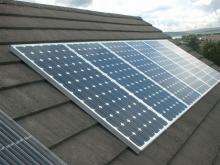
Cheaper Solar Power's Time Has Come
September 7, 2009 by Lin Edwards
(PhysOrg.com) -- Solar power manufacturers in the US are cutting prices to shift their stock, the government is chipping in with tax credits, and innovative leasing or financing arrangements spreading payments over up to 20 years are being introduced. All of which makes solar power much more affordable than before.
A solar system can cut your electricity bill to little or nothing if you live in a sunny area, but the initial costs of as much as $20,000 have been prohibitive for many people. Even for those who can afford the outlay, it takes around a decade or more for the system to pay for itself, depending on your electricity use and the climate where you live.
Now solar panel prices are falling, with high quality crystalline silicon modules dropping to about $2.40 per watt, or about half last year's price, and the cost is likely to drop even further.
Solar panels generally make up less than 50% of the final cost, since you also have to pay for installation, permits and taxes. Most systems also need an inverter to convert the panel array's direct current output to alternating current. Even so, with the price of panels being slashed, the cost of an installed system that retailed for $9-10 per watt last year can now be fully installed and operating for around $7.50 per watt, even before the government subsidies.
Government subsidies come in the form of state rebates and a federal government investment tax credit to the tune of 30 percent of the total system cost. If you're a taxpayer, these subsidies slash thousands off the cost of a solar system.
The initial costs can still be prohibitive, even with the current savings, and so some solar companies are introducing long-term (15-20 year) leasing and purchasing arrangements that have zero or minimal initial costs, and spread the outlay over a long period. Leasing and long-term payment schemes are proving successful with private homeowners, and with businesses such as Wal-Mart, that want solar electricity without the initial outlay.
If you lease the solar panels, you will pay the solar company each month, but savings are immediate, and can cut your electricity bills by 10-15 percent. If you lock in the rate, over time savings are much greater as electricity prices go up, but the price you pay doesn't.
Resourceful communities are also banding together to buy solar panels in volume, and this can bring the cost of a system down to just over $6 per watt, even before rebates and tax credits. A company called One Block Off the Grid, for example, is organizing homeowners around the US into groups of over 100 to ensure the solar companies give them the best discounts. Signing up is free, and without obligation.
Solar installers will estimate the payback time and savings you will make, but you can do your own estimation at sites such as findsolar.com. Plug in your details in their free solar calculator and they calculate the costs, savings, return on investment (ROI) over 25 years, and the break-even time.
Whether you pay for your solar system upfront, lease it, have a long-term purchase arrangement, or join a community solar group, massive savings are assured. And there's never been a better time to start.
© 2009 PhysOrg.com


I guess I'll have to send a link to this article so he can see how it will make a difference in his costs.
That 1000 watt figure is moronic. I live in an apartment and I use more than that. Someone living in a reasonably sized house would be sucking down many times that much on average. My electricity bill rarely tops 40 dollars a month (and 35 of that is basic monthly hookup fee:P). If I'm constantly using more than 1000 watts, how much do you think those people with 500 dollar monthly bills are using?
But even if the average house did use 1000 watts on *average*, you have to look at peek usage, not average usage. Peek is usually several times what the average is (average includes nearly null-energy times like 2 in the morning, so it isn't of particular concern).
You're also assuming that the manufacture of PV panels is pollution free. I assure you, it isn't. It is a truly nasty process. If everyone switched to PV (if that were practically possibly), we'd all be hooked up to oxygen masks, drinking distilled water, and eating our own reprocessed waste, because there would be nothing left living outside due to the side effects from PV production:P.
Are there any incentives for them to try more efficient panels and productions methods? I mean besides sales pitches of "New and (slightly) Improved".
Yea, it's called more money.
I think NanoSolar might be of interest to you. They claim between 10-16.4% efficiency for their CIGS roll to roll PV. That makes this much more comparable with Si PV in efficiency but their pricing is far lower.
Other Si PV vendors who already are having a tough time in this market are forced to dump on the market near $1/W at a loss.
I wouldn't mind buying up some of the stock now and build the rest myself, but Boston weather just sucks for 6 months.
My numbers from my electric bill for outer Boston. Family size 5, avg house size, annual use 5900 kWh, so continuous rate is 1KW for 16*365h/yr. Heat is by gas. Power includes modest AC, CFLs, couple of PCs, old TV and usual stuff. We aren't trying that hard but maybe I should at 15c/kWh or $74/month almost flat year round. The base is about 10c plus 5c extra for whatever. The mix is half coal.
We are not sucking down many times 1000W, heck we haven't got a plasma TV yet. If people have $500 monthly bills they must be living pretty rich too or heating electric too or blasting the AC max with bad insulation.
My quad core + 2 24" LCDs is ~200W on the Kill a Watt meter. Maybe your 500W includes a wicked game card.
As for peak, if I ever did solar PV I'd not worry about peak at all, leave the kitchen, laundry and other peak loads, future EV on the grid. I'd add extra AC and 12V DC wiring for the base load, move electronics to 12V where possible to skip AC-DC-AC losses.
JJ
The problem that I have is with nuts who think that they can slap a PV panel on their roof and then disconnect themselves from the electric grid. Ok, that's cool I guess. They're wrong, but they're not hurting anyon... oh look! There they are protesting against a new nuclear plant. There they are protesting against a new hydroelectric dam. There they are protesting against geothermal too... no one can figure out why, but they are. They hate anything that isn't solar. They're zealots of the worst type.
Also, the difference between kW/h and kW - the former is a measure of ENERGY, the latter a measure of POWER.
jfd5xte, those 1000W panels only produce a PEAK of 1000W - the AVERAGE would be closer to 250W (the sun doesn't shine at night, and the panels only produce their peak power for a very short time each day - assuming it is sunny). That's only 25% of what is required for a house that uses an average of 1000W.
http://www.everbr...els.html
http://partsonsal...its.html
A 1.15kW system for your house with a grid-tie system runs $5856 or %5.09/watt
Even the largest system, 16.5kW is $61500 or $3.72/watt, and thats when buying en mass to provide bulk savings.
Solar panels on the roof wont do much if you don't include connections/fusing/charging/inverting systems etc.