Turtle thought to be extinct spotted in Myanmar
September 7, 2009 By MICHAEL CASEY , AP Environmental Writer Turtle thought to be extinct spotted in Myanmar (AP)

Enlarge

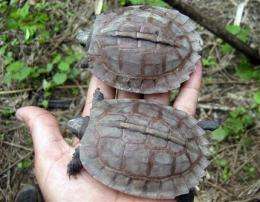
In this 2009 photo released by the Wildlife Conservation Society, juvenile Arakan Forest turtles are observed in the wild in Myanmar by a team of scientists led by the Wildlife Conservation Society. Researchers say they have found a rare turtle thought to be extinct in the wild during a trip to a remote forest in Myanmar, boosting the chances of saving the brown-and-tan spotted reptile. Texas researcher Steven Platt and members of the Wildlife Conservation Society discovered the first of five Arakan Forest turtles in May during a survey of the Rakhine Yoma Elephant Sanctuary wildlife. (AP Photo/Wildlife Conservation Society, Steven Platt)

(AP) -- The rare Arakan forest turtle, once though to be extinct, has been rediscovered in a remote forest in Myanmar, boosting chances of saving the reptile after hunting almost destroyed its population, researchers said Monday.

Texas researcher Steven Platt and staff from the New York-based discovered five of the brown-and-tan-spotted in May during a survey of wildlife in the Rakhine Yoma Elephant Sanctuary.

The sanctuary contains thick stands of impenetrable bamboo forests, with the only trails made by the park's elephants, said Platt, of Sul Ross State University in Alpine, Texas.

Plat said he and his team were able to reach the area only by small boat and endured round-the-clock torrential rains and bands of leeches before finding their first Arakan turtle on May 31.

"At this moment, all of the physical hardships of the trip were forgotten," Platt said in an e-mail interview.

Native to the Arakan hills of western Myanmar, the turtles were believed extinct for close to a century until they started turning up in Asian food markets in the mid-1990s.

The local name for the turtle is "Pyant Cheezar," which translates to "turtle that eats rhinoceros feces." Sumatran rhinos were once found in the area, but vanished half a century ago due to hunting.

Scientists blame the near-disappearance of the turtle on their popularity in Asia as an ingredient in cooking and medicine. Known by its scientific name, Heosemys depressa, it is listed as critically endangered by the International Union for Conservation of Nature and Natural Resources and has proven difficult to breed in captivity.

The discovery in May makes scientists hopeful that the species can survive.

"Throughout Asia, turtles are being wiped out by poachers for the illegal wildlife trade," Colin Poole, the Wildlife Conservation Society's director of Asia programs, said in a statement. "We are delighted and astonished that this extremely rare species is alive and well in . Now we must do what we can to protect the remaining population."

Douglas B. Hendrie, a freshwater turtle expert from Education for Nature-Vietnam who did not take part in the research, said he was not surprised by the discovery because he had heard anecdotes of hunters and guides finding the turtle.

"That said, I think it is good to bring attention to the species," Hendrie said in an e-mail interview, adding that it is an "an important part of furthering the aims of conservation."

Platt and the conservation society recommend that guard posts be set up on roads leading in and out of the park to thwart poaching and that additional data be collected on the species to develop a plan for it.

©2009 The Associated Press. All rights reserved. This material may not be published, broadcast, rewritten or redistributed.


print this article email this article download pdf blog this article bookmark this article     Stumble it Digg this share on Facebook retweet share on Reddit add to delicious
Rate this story - 5 /5 (2 votes)

Rank Filter

Move the slider to adjust rank threshold, so that you can hide some of the comments.


Display comments: newest first


September 7, 2009 all stories

Comments: 1

5 /5 (2 votes)
  • Stumble this up

  • Digg this

  • share this

  • hide
  • Related Stories

  • Relocation of endangered Chinese turtle may save species
    created May 21, 2008 | popularity not rated yet | comments 0
  • Rare soft-shell turtle, nesting ground found in Cambodia
    created May 16, 2007 | popularity not rated yet | comments 0
  • Picture obtained of rare Indonesian rabbit
    created Apr 05, 2007 | popularity not rated yet | comments 0
  • Endangered turtles no longer turned into souvenirs
    created Mar 25, 2009 | popularity not rated yet | comments 0
  • Turtle nesting threatened by logging practices in Gabon, Smithsonian warns
    created Mar 14, 2008 | popularity not rated yet | comments 0


  • hide
  • Relevant PhysicsForums posts

  • What is transpulmonary pressure?
    created 17 hours ago
  • Is there a gay gene?
    created Nov 23, 2009
  • Super quick question about Starling forces?
    created Nov 22, 2009
  • Questions about diffusion
    created Nov 22, 2009
  • More from Physics Forums - Biology

Other News

Asian carp may have breached barrier protecting Lake Michigan

Biology / Ecology

created 4 hours ago | popularity 5 / 5 (3) | comments 0

Two feared species of Asian carp have zoomed beyond the $9 million electric barriers built to keep them out of Lake Michigan. Now, the only thing left between the carp and the Great Lakes is a lock and dam in southern Chicago.


Got a pain? -- Have a cup of Brazilian mint

Biology / Plants & Animals

created 5 hours ago | popularity 4.5 / 5 (6) | comments 0

For thousands of years it has been prescribed by traditional healers in Brazil to treat a range of ailments from headaches and stomach pain to fever and flu.


Opposites attract: Monkeys choose mating partners with different genes

Biology / Evolution

created 5 hours ago | popularity 5 / 5 (1) | comments 0

The world's largest species of monkey 'chooses' mates with genes that are different from their own to guarantee healthy and strong offspring, according to a new research study.


When is a stem cell really a stem cell?

When is a stem cell really a stem cell?

Biology / Biotechnology

created 7 hours ago | popularity 4.7 / 5 (3) | comments 0

(PhysOrg.com) -- Induced pluripotent stem (iPS) cells -- adult cells reprogrammed to look and function like versatile embryonic stem cells -- are of growing interest in medicine. They may provide a way to ...


Ice Cold: Cooler Than Being Cool

Ice Cold: Cooler Than Being Cool

Biology / Cell & Microbiology

created 8 hours ago | popularity 4.2 / 5 (9) | comments 0

(PhysOrg.com) -- Water expands when it freezes. Anyone who has ever left a can of soda or bottle of water in the freezer too long has witnessed this first hand. So how do plants and animals survive severe ...