Solar Roadways Awarded DOT Contract to Pave Roads with Solar Cells
September 7, 2009 by Lisa Zyga
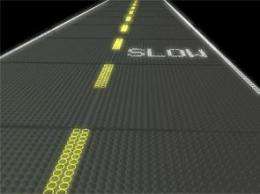
In addition to generating power, the Solar Road Panels contain embedded LED lights that "paint" the road lines from beneath. Image credit: Solar Roadways.
(PhysOrg.com) -- In a first step toward turning highways into energy-generating solar panels, the Sagle, Idaho-based startup Solar Roadways has recently received a $100,000 grant from the US Department of Transportation (DOT). The company will use the money to build a prototype of its Solar Road Panel, made from solar cells and glass, that is meant to replace petroleum-based asphalt on roads and in parking lots.
The 12- x 12-foot panels, which each cost $6,900, are designed to be embedded into roads. When shined upon, each panel generates an estimated 7.6 kilowatt hours of power each day. If this electricity could be pumped into the grid, the company predicts that a four-lane, one-mile stretch of road with panels could generate enough power for 500 homes. Although it would be expensive, covering the entire US interstate highway system with the panels could theoretically fulfill the country's total energy needs. The company estimates that this would take 5 billion panels, but could "produce three times more power than we've ever used as a nation - almost enough to power the entire world."
The Solar Road Panels also contain embedded LED lights that "paint" the road lines from beneath to provide safer nighttime driving. The LEDs could also be programmed to alert drivers of detours or road construction ahead, and can even sense wildlife on the road and warn drivers to slow down. The roads could also contain embedded heating elements in the surface to prevent snow and ice from building up on the road. Further, in the future, fully electric vehicles could recharge along the roadway and in parking lots, making electric cars practical for long trips.
"This feature packed system will become an intelligent highway that will double as a secure, intelligent, decentralized, self-healing power grid which will enable a gradual weaning from fossil fuels," Solar Roadways stated in a recent press release.
More information: www.solarroadways.com
via: Inhabitat
© 2009 PhysOrg.com


It would be far more economical to put a solar panel roof over all the highways, protecting us from rain and snow while vastly extending the life expectancy of the underlying roadway. Slope the roof so snow would slide off and the solar panels would achieve maximum southern exposure. The savings in snow clearing expenses would partially pay for the roof.... sure.... and by mounting cameras on all the support structures, we wouldn't have to pay for the highway patrol because every inch of the nations highways could be seen on TV.
Oh! ...and all those free hours of TV footage of the roads could be watched by all the unemployeed who have nothing better to do.
Is this what they meant by "green jobs"?
Instead of paving roads with these solar panels why not use them as roofing for buildings? If they are durable enough for roads, then they would far exceed the demands as a roof.
Also, paving road would all be done at the taxpayers expense -- why not sell them for a very low fee and get homeowners to help subsidize the cost? Seems like it would be awfully pricey to have to replace these every couple of years from wear and tear on the roadways.
This is just not for collecting power from the sun, but it is meant to replace the aging wooden telephone/electricity poles. The roads would provide electricity, internet, television, phone and light up the roads. The glass that would be used over the solar panels is advanced technology and would sustain the wear and tear of weather and semi trucks for many years. I think he said he wants to have them last at least 21 years before maintenance. It will have at least the same traction as asphalt, if not better.
Asphalt costs a lot of money to maintain and the costs keep rising. Why? Because it's made from oil, of course. On average, roads need repaving every 7 years. Not to mention the cost of filling in pot holes, re-painting lines, snow plows, fixing/replacing telephone poles, etc. We should have something to last longer that doesn't rely on oil.
These solar roadways can break down dirt/dust particles, heat up the road up north during winter months to prevent snow accumulation, and light up dark paths that don't have street lights. You can't put them over the roads as some have suggested because it would be dangerous to have something over your cars and you would still have to pay for the asphalt and the painted lines and power poles. The main problem I see is with hackers since it's networked. Everything will be networked soon, so we'll have to deal with this eventually.
The technology is all there. He's just trying to put the pieces together into a prototype. If that doesn't work, then okay. But if it works, then the problem is just human ignorance. It's convincing pessimistic people who don't do any research. It's been like that for years with science. We need new infrastructure for our power needs, but when people don't like an idea (especially when it has anything to do with solar) ... they shut it down and don't come up with any better solutions themselves. The biggest opposition are people who love to bathe in oil.
I highly recommend people look at the website and watch the video. It's not as crazy as it sounds.
Worth a try.
It also will break down dirt. The glass cleans itself in two stages: the ‘photocatalytic’ stage of the process breaks down the organic dirt on the glass using ultraviolet in sunlight (even on overcast days) and makes the glass hydrophilic (normally glass is hydrophobic). During the following ‘hydrophilic’ state, rain washes away the dirt – leaving almost no streaks, because hydrophilic glass spreads the water evenly over its surface.” In areas where there is not much rain, there may be a need for road cleaners, but it depends on how well the breakdown process works.
And yes, the glass will have traction equal to or greater than asphalt. This is a science site. There is legitimate science to this.
A bunch of angry failed science majors.
lol! Forgive neil. don't take it out on him. he didn't mean to although he does that all the time. he's a mainstay afterall. lol!
I just thought Solar Roads was a great idea and it's a step toward the future, especially since solar panels are getting more efficient each year. Plus, I hate shoveling snow anyway.
Oh wow tell me more about this magical substance that is apparently indestructible.
Glass is already pretty hard by itself I guess. And it can be smooth on a small scale, which might also reduce impact. Note i did not read the article.
My start up squeegee mud flap business should be a success!
Yeah, we'll get right on that.
Well, that's only 35 trillion bucks. I figure Obama and his "constituents" have that much sitting around in unclaimed accounts for which they haven't paid their taxes on yet. Easy fix by my estimate.
I can only really address the stupidity from an EEs point of view. A road engineer would mention a hundred other points of failure such as the road changing its shape through the seasons due to water freezing and melting below the surface a major contributor for potholes and other damage.
Why not fabricate a sheet a this wonder glass first with no electronics in it and try driving over it with a semi year round under all weather conditions. If that can pass the test (it won't I am sure) then think about upgrading with one idea at a time. The problem is that each of these ideas is itself ridiculous. Without long term storage or drawing from the grid the best way to heat a road is to let the sun do it directly. As for self cleaning, I really doubt that it could work even in a window, but if it did, then regular PV and solar heating panels could use it, but I never heard of it.
Semiconductors of all types as designed by engineers such as myself are generally very fragile. It is common for EEs to design electronics for either very low cost to live in the most benign conditions (consumer electronics) or for very high cost rugged industrial use. The cost differences are dramatic, typically 10x for each level of ruggedness. Road use would likely count as being several orders more severe than industrial use, or even space use and that is the most expensive you can get.
Paving the road with any type of PV would require all of the worlds supplies of very limited resources to build even a tiny amount of roadway. The supporters of this wack job of an idea are likely unaware of the impending dire shortages of indium, the expense of polysilicon or even the enormous cost of supercaps and how little energy they can actually store. If you did build a panel from off the shelf parts it could probably withstand repeated use only by toy dinki cars and if it came from a credible oem builder, it would cost millions for each of these panels.
This is the type of engineering I used to read about in popular science mags from the 50s, when we would be flying in space cars to massive domed glass homes filled with sentient ever helpful robot slaves. It is all wishful thinking, but it did push me to become an engineer.
I have read the web site, watched the video that would play, and read the faq page. It is all wishful thinking with no scientific understanding of how the technology can actually be built. I am sure you could build a panel in a lab with all of it features but you sure couldn't deploy it in scale. Just about every aspect of physics and engineering is just glossed over with simple sentences. See the introduction "Imagine a world-wide system where the "lit" half of the world is always powering the "dark" half of the world!", you know there are massive losses involved with transmitting power at world scale distances, but I guess the author doesn't understand those details.
@meeker
Telling somebody you haven't read the faq and that all the questions have been thought out doesn't add any credibility to it. I have read some of Neil's other posts, I think he knows far more about what he is talking about than you or the other fanboys of this dream technology. Your posts seem to have been lifted right off the solarroadways website, perhaps you are the bright spark that had this idea.
I am appalled but hardly surprised the government gave this idea any credence or money, but we all know that most all the politicians are scientifically illiterate.
Hey but what do I know.
Good question... Er, statement.
So you're knocking this thing before they even test the full-scale prototype? Of course there are challenges but what if it actually works the way they say it does?
I'll bet I can name a dozen situations where this would be more cost effective than the alternative. Do some research on how we power military assets in the field: it's VERY costly (lifecycle), VERY labor-intensive and VERY loud to power tent cities, etc. with diesel. If I could drop a few of these in between or around the tents (where they would only be walked on), it would be a no-brainer
Yes absolutely, I go around calling a spade a spade. It is the job of every engineer, scientist, teacher, venture capitalist, to scrutinize and reject dull ideas and not to pamper them. It is called peer review, it actually works most of the time. There isn't even anything sensible to take from the project, all the ideas on the website are just so much hand waving, period. The self cleaning glass looks interesting.
It is the sort of stuff my children come up with, I explain why it can't work and later on they will invent something else. Eventually they may become engineers or maybe just more hand waivers.
As I said, you test the parts in isolation, not as full scale prototypes. The glass road idea will fail first all by itself, then he will give up trying the other stuff. Even with no traffic at all the glass pavement will break as unused roads eventually do.
I already explained why you can't pave the roads with PVs, it is just too expensive even if nobody drives on it. Any competent engineer would say the same thing. I already mentioned the coming shortages in indium needed for the PV contacts.
PVs really only belong in the desert and sunny climes or where conventional energy sources are already expensive and sadly where ridiculous subsidies are available. PVs are really only ever going to be a bit player, there are much better green technologies available running a wide gamut, many are quite low tech and low cost.
Personally I favor the usual list in no particular order, co-generation, massive insulation programs, white roof painting, energy conservation, solar thermal water heating, wind and wave turbines, concentrated PVs (like the mylar balloon), solar thermal towers, troughs, dishes. Also geothermal, and some newer nuclear technologies like the thorium and small fusion projects described at google talks. They all have their detractors but all are more practical than this poor idea, and all are built by engineers and physicists.
You know Edison didn't just waive the lightbulb into existence, it took him and his lab of many technicians untold number of trials to find the right materials before it worked well. Today however too much fluff engineering is done by sticking up a website with grandiose claims or ideas. This belongs on peswiki along with the perpetual motion machines.
I wager we will be flying aircars like the Muller car long before the roads are paved with PV glass and he has been at it for decades. No roads needed at all, no plowing, no cleaning, no signing, no lighting, no heating, no repairing. And some of these flying prototypes have better mileage than many cars, go figure.
It loooks like much $ but what did the interstate system cost in todays dollars? This would be done over decades with the tech improving as it went. Soon vehicles will be driving themselves mostly, with much less wear to road surfaces.
-You retired Chip?
If you wanted PV panels to break as quickly as possible, I couldn't think of a better way than for soldiers to trample on them, and the desert sand will surely grind the glass surface completely frosted.
Wouldn't want to pamper the idea or anything.
I won't take that too seriously, you obviously have no clue about engineering in any field do you?
PV hasn't changed much in decades, it is only getting more efficient at the most expensive end of the technology useful for concentrators and perhaps at the other end for painting roofs with PV paint.
Who cares if vehicles drive themselves, it won't make any difference to road damage, how could they possible change that.
If you think engineers will be replaced by software you gotta be dreaming.
If you think it is such a smart idea why not put your own money into it.
Admiral William Leahy, U.S. Admiral working in the U.S. Atomic Bomb Project, advising President Truman on atomic weaponry, 1944.
There is nothing dull about going to the moon for what it accomplished, I watched it in awe as a kid. You do know that at the time Nasa had relatively an order of magnitude more funding than it does today and todays Nasa is too poorly funded to go back. Gee they barely have any transport anymore.
Nasa had something like hundreds of thousands of people through out the entire US economy working on the moon shot working at many contractors. Today most "dull" people don't care too much about those space programs anymore, they got other things to worry about.
Yeh and I could dig up any no of similar foolish at the time statements about computers from the IBM and DEC CEOs, they all look silly in retrospect.
But if you think this glass road is a good idea, you know where to send your check.
If it powers their HVAC and lights, you can bet the soldiers will probably treat it with the delicate love and kindness of a newborn child.
You speak of a glass road like A) it's made of fine china and B) it will only be used on roads. If Teflon were only used for its original intended purpose, where would we be today? I hope you don't tell your kids broad statements like "Using the sun to power things is a stupid idea", else we'll have some really confused people in the future
I am no glass expert, I reckon almost every glass out there can be shattered with enough force easily found on a highway. To be strong it would have to be thick or laminated or made of something exotic like diamond or transparent aluminum. Thick would surely mean internal reflections, the light wouldn't reach the cell. Laminated, well that means plastic sandwich. Synthetic diamond a little pricey, still breaks. Transparent aluminum only lasts for ns if I could remember that article.
I hear Steve Jobs is also a glass expert, builds patented staircases out of it, a few inches thick for dainty Apple people, not for dull Windows people or trucks.
Chip_engineer means I design micro chips. I don't do that anymore, I got replaced by software or something.
JJ
This applies to everyone, having a degree does not make you all knowing about a field, especially when you are not a part of the newest research. It also doesn't make you a respected poster on the subject if you treat every other poster like they are morons, it just makes you a troll.
There is nothing in my experience that tells me a glass road is any different from a fine china road except for transparency. I don't know of any available wonder glass material, if it existed it surely should not be in front of any PV cell. PVs should be pointed straight at the sun for best energy collection with the least amount of optical interference. As I have said before, thick glass or plastic (uses oil) will surely degrade efficiency probably internal reflections and the like. I don't know why people latch onto crazy schemes.
I thought Teflon was out of vogue these days with modern cooks, (I don't cook).
Using the sun to create energy is a really dumb stupid idea if you do it like this doozy, but..
I listed in a previous post some of my favorites, most every one of them is solar direct or indirect, even gas, coal, oil are solar, it just took eons to get cooked first and has to return millions of years worth of CO2 back to the atmosphere in a few hundred years, which is why we shouldn't be doing that.
The best path to using energy is the one with shortest path between generation and consumption with least number of lossy indirect steps. That means going for local sources at highest density for most efficient electric power generation. That suggests nuclear highest density, then hydrocarbon chemical bonds, then further out in wind and solar, geothermal, wave. The latter are almost infinitely renewable but also somewhat diffused, and that drives up production cost, still we have to deal with that. FWIW I think thorium reactors and some of the small fusion projects could help us get through the next hundred years without the baggage of old fission until the renewables are fully built out.
JJ
http://www.physor...122.html
And I don't cook, either, so I still think Teflon is cool...
It might seem trollish or even childish to you, but if I see articles or press releases with very little meat on them, they need to be called out for what they are, I want physorg to report only the best and real advances, not the kind of nonsense you find on peswiki.
Science is not a democracy, ideas and stuff either work or they don't. Wishful thinking people cannot just vote that something is right. Maybe half or more of the US population doesn't believe in AGW or evolution, they often come to these science boards to deliver their valuable contributions, but if they are plain wrong on something, it needs to be countered with facts. PVs are not even controversial except perhaps in applications. Bad application of a good technology has potentially bad effects, as I mentioned before the natural resources aren't even available to build this glass PV road system.
Many posters with knowledge will simply post a one liner saying it won't work but no detail as to why its a bad idea. Others will leap on that as just trolling, more people cheering on and getting their votes up. When I saw Neil's comment get beaten up, I felt compelled to sign up and post some corrections.
I have been in electronics for more than 30 years and seen thousands of announcements for new technologies, many winners and losers in that list. But never in those years did I see anything as preposterous as this one and taken so seriously. It is tantamount to turning common sense engineering on its head, no new physics to back it up or explain itself. As I said the website is all handwaiving, no real engineering, you either accept it as wondrous or tell it the way it is. If I walk into a room of Phds and deliver something that turns their world upside down, I had better expect to be chewed out or have some shocking new discovery up my sleeve.
JJ
There are some people who find new ideas interesting and want to use their experience in positive ways to comment on them. Then there are those who want to quash innovation and forward thinking, if only for the joy of pushing people around and hearing themselves spout. They suck the life out of companies and make them miserable places to work. I suspect you are one of these people.
Chip your head is bone from ear to ear. I suggest you go to your children whom you mention above and apologize to them for being the treestump that you are.
I think you are both getting the wrong end of the stick here, sigh.
There really are a great number of interesting stealthy companies that are below the radar that I like to keep an eye on. They don't show up here because they don't need to be in the limelight, and VC investors usually don't want that either.
One of my favorites is Unipixel, been following them for a few years. Samsung finally picked up on it too, signed a joint development license for the technology. This could produce a great improvement in LCD panel production, thinner, cheaper, brighter, much simpler, better contrast, much lower power, just overall vastly better than current LCD designs. Maybe enough to sideline OLED displays before they even arrive. Why is that important?, because large Plasma and LCD TVs have now added a huge burden on the utilities, EVs will add more still. If you reduce the power consumption of a large TV panel by a few fold, that shows up on the utilities load, they can redirect that power for future EV use with out having to build more capacity. This is low hanging fruit, make all appliances use less power.
I tell everyone I know about it but since they never claimed anything outrageous, they don't leave a flack trail. It is pretty easy to understand what they have done too, they explain it pretty well on their site.
The way we sort out the wheat from the chaff is to look over the resumes of the founders and the early investors, that gives a pretty good clue about what one can expect. A group of founders with Phds with long business experience in a similar or same field is usually a safe bet. A lone founder even an engineer has a much harder time of it, esp if no relevant past business in that area. In this case we have a lone electrical engineer with experience in putting things together, not of developing any particular fundamental technology at the detail level as far as I could see. Nothing personal here.
I could mention two more interesting companies or sagas that could have fundamental changes in store for us all. EEStor and Brightlight power. The former meet most of my criteria for a sane bet except that the energy storage promised is so scary as to make disbelieving easy. The latter is far more controversial, they just have to rewrite all the physics textbooks for that to work. Will be interesting to see how they pan out. These two companies founders must have the thickest skins given the number of people poring over every tidbit of news.
As for hope, I don't actually hope that anything will or won't work, I do hope people get to understand AGW before it gets trully serious though. I expect Unipixel with Samsung to work, I have an even bet on EEStor, and very low bet on Brightlight.
Cheers
JJ
Engineers worry about grim reality and making things really work (i.e. what goes into the sausage), but these articles are just for fun and entertainment. Mostly they reflect self-promotion, but that's okay, they got to pay the rent.
Since those who read these articles are typically non-engineers, there's really no reason (is there?) why they can't have a good time with "maybe" worlds of neat-o "what if" technology. So what if they lose some investment money? They help run the engine of our economy, as can be seen by the various outrageous growth spurts and burst bubbles in recent decades. It doesn't have to make sense.
However the other points are something I believe are attainable and are in the direction that it should be heading in ~ Embedded led lights in the road would be a huge advancement, it would make night time driving much safer. From what I can gather from it, the roads will be much more accessible from below allowing cables, fibreoptics and whatnot to be easily laid and maintained and if this wonderous glass is a reality then that would reduce road maintenance repairs.
But yes, without the PV nothing what i've mentioned has an impact to generate revenue to repay itself off. But we can dream can't we...
Thanks, here is a small idea I will throw out, don't know if anyone had it before, if it stinks, nothing lost, if its great, well its out in the open.
When I drive at night on unlit roads I usually keep track of the forward traffic tail lights for clues about the roads path. If nothing ahead, it gets quite difficult to predict the road path so one has to drive alot slower.
In the US most roads have wooden poles carrying the infrastructure such as street lighting, power, telephone, cable TV, whatever.
If an unsheathed glass fiber optic cable is added to the cable mix, then at night times, pulse it with a red laser section by section. Fiber might also run vertically up the pole too. If the glass fiber remains clear, then the illumination is just enough to show the driver the projected path of the road to the horizon, and nothing more. Cheap and simple, not much power used. Maybe even change the colors to suggest driving speed between red amber green. Just an idea.
Comments
Wind mills and solar panels are the limp wristed approach pushed by the libs,.. nuclear power is the way to go until fusion becomes practical in 60 years.
What's the problem, that's only $1.9 billion per day for the next 50 years, not counting maintenance, well within a liberal governments ability to spend. :)
Chip_engineer's been bashed most probably because noone has any actual factual counter-arguments to provide, where he has actually provided several, from which the lack of prime materials seems to be the biggest impediment to such a project. Noone has commented on this or refuted this at all, so I assume everyone acknowledges it but hopes it can be wished away.
Moving to the FAQ and the actual website provided..
The 7k$US per solar panel figure. How exactly can they estimate a cost without even having a working prototype ; this just seems like the typical wishful thinking that the whole project seems to be based on. They have no prototype, no usage tests, no considerations for prime material availability, but they do have an estimated cost. This seems more like investor bait to me.
I'm no optics expert, but as far as I know, any "texturing" of the glass surface will alter it's light-conducting properties dramatically. I'm not expecting them to give away their upcoming patent, but at least some scientifical info would be nice here.
"While at the International Workshop on Scientific Challenges for New Functionalities in Glass, I learned of a new technology: self-cleaning glass."
Any small google inquiry will lead you to find the same wikipedia text on several websites that already produce this type of glass for buildings. However while I can see it's practicality for windows, especially somewhere where it actually rains, how would this even remotely work say for example in desert and low-rainfall areas, which are also quite plentiful in dust/sand?
This statement doesn't make me feel any more confident either:
"We have (or can hire) the technical expertise to make the Solar Roadways a reality"
It might be nice to imagine this is going to happen, it might be nice to imagine a scratch-proof glass that cleans itself of bird shit and oil slicks.
However this is called science-fiction, not science.
Science is presenting us with a detailed working model, even if theoretical. This does not qualify.
PS: not meaning to be evil, but listing your wife as a co-inventor although she has absolutely no education or connection to the field whatsoever?
Thanks for the support.
Engineers, scientists always must be skeptical about things, especially the effect of weather on for example O rings. When engineers advice is ignored by managers, we see people die in very public catastrophes like the Shuttle Challenger.
Even in the most benign environments, modern electronics fails in fairly short order esp where cheap batteries and other chemistry based parts are present. There are just so many points of failure in electronics that most people don't understand. The road environment is probably tougher than aerospace and maybe even space in some ways.
The weather is a vicious beast. The auto companies have environment simulators for arctic and tropical weather to find weaknesses. I wouldn't want to put anything cheap through that.
Optimists think it might work.
Pessimists think it won't work.
Sounds right to me. And realists are pessimists in hiding. ;) I just wish there were more suggestions on how to make it work instead of all the reasons why it wouldn't. Don't get me wrong, I'm glad there are people coming up with reasons against it, that's how we get new ideas to fix problems.
One thing I know for sure is that technology will be growing faster and faster with each year, so some things will change sooner than you think. We're getting to the 2010s and how long are we going to use asphalt and power lines/poles? And $100,000 is like the cost of a toilet in Congress, ;) so we'll see what he can do. There will be other ideas out there and this is just one.
Laura
Your arguments are as lopsided as the crap on Fox News. Ever watch Fox News? Its propaganda.It would fry like everything else, including North Korea.
http://www.physor...843.html
Correction, all news.
In any eventuality this actually looks like an interesting idea. I wonder how it matches up with the "kinetic energy" ideas the Japanese are testing.