Star-shaped cells in the brain aid with learning
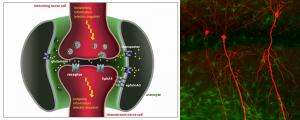
(PhysOrg.com) -- Every movement and every thought requires the passing of specific information between networks of nerve cells. To improve a skill or to learn something new entails more efficient or a greater number of cell contacts. Scientists at the Max Planck Institute of Neurobiology in Martinsried could now show, together with an international team of researchers, that certain cells in the brain, the astrocytes, actively influence this information exchange.
Until now, astrocytes were thought to have their main role in the development and nutrition of the brain's nerve cells. The new findings improve our comprehension of how the brain learns and remembers. They could also aid in the basic research of diseases such as epilepsy and the amyotrophic lateral sclerosis (ALS). (published in Nature Neuroscience, September 7th, 2009)
To live is to learn: Even fruit flies can learn to avoid detrimental odors and also in humans, most abilities are based on what we learn through practice and experience. Thus we are able to perform both fundamental processes such as walking and speaking and also master complex tasks such as logical reasoning and social interactions.
Learning at the cellular level
In order to learn something, i.e. to process new information, nerve cells grow new connections or strengthen existing contact points. At such contact points, the synapses, information is passed from one cell to the next. Once a synapse is created, new information has a means to be passed on and the information is learned. Enhancing an acquired skill through practice is then accomplished by strengthening the synapses involved. Incoming information elicits a much stronger response in the downstream nerve cell when passing through a strengthened synapse, as compared to a "normal" synapse.
At the cellular level, this can be envisioned as follows: At a synapse, the two communicating nerve cells do not come in direct contact but are separated by a small gap. When incoming information reaches the synapse, glutamate is released into the gap. These transmitter molecules cross the gap and bind to special receptors in the downstream nerve cell. This in turn prompts the downstream cell to pass on the information. In a strengthened synapse, the informing cell releases more glutamate into the synaptic gap and/or the informed cell is more efficient at binding the glutamate. As a result, information transmission is significantly enhanced.
Not just passive aid
In the brain, parts of nerve cells and single synapses are often enclosed by star-shaped cells, the astrocytes. So far, astrocytes were mainly thought to aid nerve cells - for example by supporting them or by promoting the maturation of synapses. Scientists of the Max Planck Institute of Neurobiology and an international team of researchers have now shown that astrocytes also have another, much more active role in the brain: They affect the synapses' ability to strengthen, and thus help to facilitate the learning process.
By removing the glutamate transmitter from the synaptic gap via so-called transporters, astrocytes regulate the availability of glutamate. "These transporters are somewhat like small vacuum cleaners", says Ruediger Klein, the supervisor of the study. "They suck surplus glutamate from the gap, which prevents, for example, glutamate spilling over from one synapse to the next." The existence of this "glutamate vacuum cleaner" was already known to science. So far unheard of, and now shown by the scientists, was that the astrocyte and downstream nerve cell communicate with each other and thus regulate the number of glutamate-eliminating transporters.
Signaling pathway with extensive consequences
This communication was found while the neurobiologists were examining the signaling molecule ephrinA3 and its binding partner EphA4 in mice. Ephrins and Eph-receptors are regularly involved when cells recognize or influence each other. Astrocytes, for example, promote synapse maturation via ephrinA3/EphA4 interaction. "Yet it came as a surprise to find an effect working also in the other direction", Ruediger Klein remembers. The scientists found that if a nerve cell is lacking the EphA4-receptor, the neighboring astrocyte increases its transporter numbers. The resulting superabundant transporters eliminate so much glutamate from the synapse that its strengthening becomes impossible, a sure disadvantage for the ability to learn.
The importance of the ephrinA3/EphA4 signaling pathway was further emphasized by the control studies. If the signaling molecule ephrinA3 was absent in an astrocyte, a synaptic strengthening was impaired due to the lack of glutamate - just what happened when EphA4 was missing. In contrast, if ephrinA3 was experimentally increased, the number of astrocyte-transporters decreased. As a result glutamate accumulated in the synaptic gap which in turn quickly led to cell damages and malfunctions of the affected synapses.
Next steps
"We are currently investigating the mechanisms through which ephrinA3/EphA4 affect the transporter production", explains Ruediger Klein. The scientists' aim is to better understand the transporters' function. An important task, as malfunctioning of the astrocyte transporters is known to play a role in neurological and neurodegenerative diseases such as epilepsy and the amyotrophic lateral sclerosis (ALS).
More information: Alessandro Filosa*, Sónia Paixão*, Silke D. Honsek, Maria A. Carmona, Lore Becker, Berend Feddersen, Louise Gaitanos, York Rudhard, Ralf Schoepfer, Thomas Klopstock, Klas Kullander, Christine R. Rose, Elena B. Pasquale, Rüdiger Klein [*equal contribution] Neuro-glia communication via EphA4/ephrinA3 modulates LTP through glial glutamate transport, Nature Neuroscience, September 7th, 2009
Provided by Max Planck Institute


