Recycling Food Scraps into Gardens
September 7, 2009 By Don Comis Recycling Food Scraps into Gardens

ARS scientists are working on ways to reduce losses of methane and ammonia from compost, particularly from food residuals.

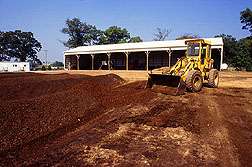
Each weekday, food scraps are collected from the Maryland Food Distribution Authority in Jessup, Md., and from small local food service and marketing establishments. Materials that do not contain metal, glass, or plastic are trucked to the Agricultural Research Service (ARS) Henry A. Wallace Beltsville Agricultural Research Center (BARC) in Beltsville, Md.

There, they are mixed with woodchips, leaves and other organic residuals. Several months later, some of the finished is delivered to the National Mall for use in gardens at the U.S. Department of Agriculture (USDA) Jamie L. Whitten Federal Building.

For Patricia Millner, a microbiologist at the ARS Environmental Microbial and Safety Laboratory at BARC, this is part of research on ways to reduce the release of methane from landfills by diverting food residuals and other organic materials to composting. She conducts this research with microbiologist Walter Mulbry, who works in the ARS Environmental Management and Byproduct Utilization Laboratory at BARC.

In 2009, they are supplying compost to the inaugural “People's Garden,” part of a new program for creating a community garden at each USDA facility worldwide, as well as for landscaping at the U.S. Botanic Garden and the U.S. Capitol.

Millner also makes compost available for other federal “green” projects—such as roof gardens, rain gardens and other landscaping designs—to retain water and reduce runoff at federal sites in the Washington, D.C., metropolitan area.

As part of Millner’s efforts to help the federal government model ways to compost food scraps, she has a Cooperative Research and Development Agreement with RCM, LLC of Maryland to capture ammonia in the final compost to boost its nitrogen content for fertilizer use. She is comparing several types of insulated composting containers for reduction and other cost-benefit characteristics.

Currently, about half of the carbon and nitrogen in composting materials is lost to the air, rather than being captured in the compost.

More information: You can read more about this and other research involving local food production and sustainable agriculture in the September 2009 issue of Agricultural Research magazine.

Provided by Agricultural Research Service


print this article email this article download pdf blog this article bookmark this article     Stumble it Digg this share on Facebook retweet share on Reddit add to delicious
Rate this story - 1 /5 (1 vote)


September 7, 2009 all stories

Comments: 0

1 /5 (1 vote)
  • Stumble this up

  • Digg this

  • share this

  • hide
  • Related Stories

  • Indoor Composting With NatureMill (w/Video)
    created Apr 22, 2009 | popularity not rated yet | comments 0
  • Organic corn: Increasing rotation complexity increases yields
    created May 28, 2008 | popularity not rated yet | comments 0
  • Backyard gardens need good food-safety practices, too
    created Jun 21, 2008 | popularity not rated yet | comments 0
  • Coffee Grounds Perk up Compost Pile With Nitrogen
    created Jul 03, 2008 | popularity not rated yet | comments 0
  • Less trouble at mill, thanks to earthworms
    created Jul 16, 2009 | popularity not rated yet | comments 0


  • hide
  • Relevant PhysicsForums posts

  • The IPCC and the term "most"
    created 10 hours ago
  • Is global warming a fact?
    created 11 hours ago
  • Random variability of wind patterns
    created Nov 23, 2009
  • Record precipitation in the UK
    created Nov 22, 2009
  • More from Physics Forums - Earth

Other News

New computer-developed map shows more extensive valley network on Mars

New computer-developed map shows more extensive valley network on Mars

Space & Earth / Space Exploration

created 10 hours ago | popularity 4.5 / 5 (6) | comments 0

New research adds to the growing body of evidence suggesting the Red Planet once had an ocean.


Supervolcano eruption -- in Sumatra -- deforested India 73,000 years ago

Supervolcano eruption -- in Sumatra -- deforested India 73,000 years ago

Space & Earth / Earth Sciences

created 12 hours ago | popularity 4.3 / 5 (9) | comments 2

A new study provides "incontrovertible evidence" that the volcanic super-eruption of Toba on the island of Sumatra about 73,000 years ago deforested much of central India, some 3,000 miles from the epicenter, ...


Spitzer Telescope Observes Baby Brown Dwarf

Spitzer Telescope Observes Baby Brown Dwarf

Space & Earth / Astronomy

created 9 hours ago | popularity 4.9 / 5 (7) | comments 0

(PhysOrg.com) -- NASA's Spitzer Space Telescope has contributed to the discovery of the youngest brown dwarf ever observed -- a finding that, if confirmed, may solve an astronomical mystery about how these ...


Is global warming unstoppable?

Space & Earth / Environment

created 21 hours ago | popularity 3.8 / 5 (24) | comments 23

In a provocative new study, a University of Utah scientist argues that rising carbon dioxide emissions - the major cause of global warming - cannot be stabilized unless the world's economy collapses or society builds the ...


Scientist: Leak of climate e-mails appalling

Space & Earth / Environment

created 15 hours ago | popularity 3.4 / 5 (9) | comments 8

(AP) -- A leading climate change scientist whose private e-mails are included in thousands of documents that were stolen by hackers and posted online said Sunday the leaks may have been aimed at undermining next month's ...