It's all in the footwork: New research sheds light on parrot intelligence
September 7, 2009 It's all in the footwork: New research sheds light on parrot intelligence

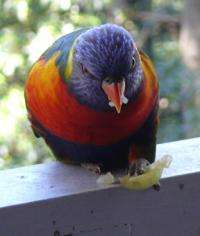
(PhysOrg.com) -- You can tell how smart a parrot is by watching what it does with its feet, according to a new study by Macquarie University researchers.

Favouring one foot over the other - not using a combination of both - when performing a task is an indicator of a parrot’s level of intelligence. The stronger the preference for one side or the other, the higher the level of intelligence, said Dr Culum Brown, Director of Advanced Biology at Macquarie University, and author of new research published last week in the prestigious international journal, Proceedings of the Royal Society.

The research was conducted by Brown and Macquarie University Honours student Maria Magat.

To test the parrots’ problem-solving skills, Brown and Magat chose some parrot species with a left or right side bias, as well as some species that were ambidextrous.

“The parrots with a very strong bias one way or the other tended to me more intelligent and were better able to perform more complex tasks than those that were intermixed,” Brown said.

The research results also suggest an ancient evolutionary purpose associated with having a strong bias to one side or the other and explain why some species are more successful than others.

“With parrots, being intelligent gives them a strong foraging advantage,” Brown said.

“There is a strong connection between preferences for foot use and the hemisphere the parrots are using to analyse information. By strongly favouring one foot over the other, a parrot shows us it is processing specific information in one hemisphere of its without interference from the other hemisphere, much like a dual processor computer,” he said.

The process that takes place in the brain when a parrot favours one foot over the other is called cerebral lateralisation - the partitioning of between the two hemispheres of the brain. The research suggests that one of the benefits of having two brain hemispheres is that it allows us to pay attention to multiple sources of information simultaneously, thereby enhancing our processing capacity.

Cerebral lateralisation was long thought to be a unique human trait because of its close relationship with control of speech and other higher order cognitive functions. However, more recent research has found this it exists in a wide range of animals, both vertebrates and invertebrates.

The study revealed that parrots with strongly lateralised brains showed enhanced discrimination abilities and a greater capacity to solve complex problems.

Provided by Macquarie University


print this article email this article download pdf blog this article bookmark this article     Stumble it Digg this share on Facebook retweet share on Reddit add to delicious
Rate this story - 4.7 /5 (10 votes)

Rank Filter

Move the slider to adjust rank threshold, so that you can hide some of the comments.


Display comments: newest first

  • RayCherry - Sep 08, 2009
    • Rank: not rated yet
    So, a smart multi-core processor should use just one of its cores, and ambidextrous people are indecisive if not just plain dumb ... hmmm.

    Think they might want to study this a little further.

September 7, 2009 all stories

Comments: 1

4.7 /5 (10 votes)
  • Stumble this up

  • Digg this

  • share this

  • hide
  • Related Stories

  • Parrots may block 2nd Australian wind farm
    created Apr 12, 2006 | popularity not rated yet | comments 0
  • New species of parrot and mouse discovered
    created Apr 06, 2006 | popularity not rated yet | comments 0
  • Parrot understands concept akin to zero
    created Jul 09, 2005 | popularity not rated yet | comments 0
  • Scientist exposes threat to backyard bird diversity
    created Oct 29, 2007 | popularity not rated yet | comments 0
  • Extinct parrot resurfaces in Aberdeen
    created Jan 30, 2007 | popularity not rated yet | comments 0


  • hide
  • Relevant PhysicsForums posts

  • What is transpulmonary pressure?
    created Nov 24, 2009
  • Is there a gay gene?
    created Nov 23, 2009
  • Super quick question about Starling forces?
    created Nov 22, 2009
  • Questions about diffusion
    created Nov 22, 2009
  • More from Physics Forums - Biology

Other News

Variable Temperatures Leave Insects wtih a Frosty Reception

Biology / Plants & Animals

created 5 hours ago | popularity not rated yet | comments 0

(PhysOrg.com) -- For the first time, scientists at The University of Western Ontario have shown that insects exposed to repeated periods of cold will trade reproduction for immediate survival.


When camouflage is a plant's best protection

Rare woodland plant uses 'cryptic coloration' to hide from predators

Biology / Plants & Animals

created 7 hours ago | popularity 4.3 / 5 (3) | comments 0

It is well known that some animal species use camouflage to hide from predators. Individuals that are able to blend in to their surroundings and avoid being eaten are able to survive longer, reproduce, and ...


Cells defend themselves from viruses, bacteria with armor of protein errors

Biology / Cell & Microbiology

created 9 hours ago | popularity 5 / 5 (6) | comments 0

When cells are confronted with an invading virus or bacteria or exposed to an irritating chemical, they protect themselves by going off their DNA recipe and inserting the wrong amino acid into new proteins to defend them ...


'Safety valve' protects photosynthesis from too much light

Biology / Cell & Microbiology

created 9 hours ago | popularity 5 / 5 (2) | comments 0

Photosynthetic organisms need to cope with a wide range of light intensities, which can change over timescales of seconds to minutes. Too much light can damage the photosynthetic machinery and cause cell death. Scientists ...


Researchers discover biological basis of 'bacterial immune system'

Biology / Cell & Microbiology

created 10 hours ago | popularity 4.5 / 5 (2) | comments 0

Bacteria don't have easy lives. In addition to mammalian immune systems that besiege the bugs, they have natural enemies called bacteriophages, viruses that kill half the bacteria on Earth every two days.