Genomes reveal bacterial lifestyles
September 7, 2009 New genomic model defines microbes by diet -- provides tool for tracking environmental change

Enlarge

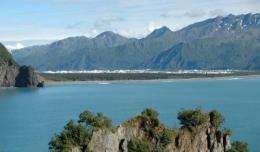
This is the lower half of Alaska's Resurrection Bay, where the bacterium S. alaskensis was isolated. Credit: US Geological Survey/photo by Bruce F. Molnia

Sampling just a few genes can reveal not only the "lifestyle" of marine microbes but of their entire environments, new research suggests.

The finding means researchers may be able to predict the types of that thrive in specific marine environments by sampling the genomes of just a few dominant species, according to research co-author Rick Cavicchioli of the University of New South Wales. As well, it may reveal new insights into the impacts of climate change on biodiversity in the world's oceans.

"It's a bit like using the DNA from a single hair at a crime scene to discover the identity of the perpetrator," says Professor Cavicchioli. "What we've learned here is that a few genes can tell us a much about the nature of the environment that species come from and what influences them to evolve in a specific way."

With other UNSW and US colleagues, Professor Cavicchioli compared the genomes of two common ocean that employ different strategies for living: one lives in nutrient-rich waters and is fast to grow and replicate itself, and another lives in poor-nutrient waters, and grows more slowly. The findings are published in the .

New genomic model defines microbes by diet -- provides tool for tracking environmental change
Enlarge

This 2-D map shows clusters of organisms used in the study. The distance between colors is proportional to how different they are from each other, while the size of each black dot is proportional to the number of genomes occupying a cell in the map. Blue represents organisms that are adapted to extremely nutrient-poor environments while red represents organisms that are adapted to extremely nutrient-rich environments with a range of other colors representing intermediate strategies. Credit: Image generated by Dr. Federico Lauro and Dr. Matthew Z. DeMaere, University of New South Wales.

The comparison revealed genetic differences that reflect the different lifestyles of the two species: the bacteria from the nutrient-rich waters have many selective transporter proteins to quickly absorb plentiful nutrients while those from nutrient-poor waters have a smaller number of highly efficient transporter proteins to extract what little nutrition is available.

Differences in other genes were also identified concerning nutrient and energy usage and resistance to infecting viruses, which reflect the bacteria's adaptations to their environment. Armed with such knowledge from a few key genes, it should be possible to predict what sort of environment an individual species evolved in, says Professor Cavicchioli. Better still, sampling the genomes of a small number of species should enable scientists to gain useful new insights into the dynamics of whole marine ecosystems.

"It's not practical to sample every species in a given area so the model we have described is useful for studying the collective genomes of whole marine microbial communities - or metagenomes - to better understand how they have evolved in specific locations," he says.

"By analysing and comparing the strategies of the dominant organisms we should have an idea of the carbon flux going through the environment which will allow us to monitor the health of the marine ecosystem, including the impact of global warming," he says. "The analysis, for example, may help us predict how marine bacteria will respond to environmental changes caused by climate change, such as oceans becoming warmer or absorbing more carbon dioxide from the atmosphere and becoming more acidic."

Using their new technique to analyse 124 ocean bacteria, the researchers found that bacteria adapted to low nutrients outnumber bacteria adapted to high nutrients in worldwide samples of ocean water. This has led to an under-reporting on what is known about the biodiversity and the physiological properties of the more abundant bacteria - and what secrets they may reveal about life on earth.

Source: University of New South Wales (news : web)


print this article email this article download pdf blog this article bookmark this article     Stumble it Digg this share on Facebook retweet share on Reddit add to delicious
Rate this story - 5 /5 (1 vote)


September 7, 2009 all stories

Comments: 0

5 /5 (1 vote)
  • Stumble this up

  • Digg this

  • share this

  • hide
  • Related Stories


  • hide
  • Relevant PhysicsForums posts

  • What is transpulmonary pressure?
    created Nov 24, 2009
  • Is there a gay gene?
    created Nov 23, 2009
  • Super quick question about Starling forces?
    created Nov 22, 2009
  • Questions about diffusion
    created Nov 22, 2009
  • Human Leukocyte Antigen (HLA) typing
    created Nov 21, 2009
  • Breeding program
    created Nov 20, 2009
  • More from Physics Forums - Biology

Other News

Variable Temperatures Leave Insects wtih a Frosty Reception

Biology / Plants & Animals

created 1hour ago | popularity not rated yet | comments 0

(PhysOrg.com) -- For the first time, scientists at The University of Western Ontario have shown that insects exposed to repeated periods of cold will trade reproduction for immediate survival.


Experts think toxic algae harming endangered fish

Biology / Ecology

created 1hour ago | popularity not rated yet | comments 0

(AP) -- Scientists say they think toxins from a blue-green algae plaguing lakes and rivers around the West are harming an endangered fish in the Klamath Basin, adding another obstacle to restoring species that have forced ...


When camouflage is a plant's best protection

Rare woodland plant uses 'cryptic coloration' to hide from predators

Biology / Plants & Animals

created 3 hours ago | popularity not rated yet | comments 0

It is well known that some animal species use camouflage to hide from predators. Individuals that are able to blend in to their surroundings and avoid being eaten are able to survive longer, reproduce, and ...


Destruction spreads 'like a disease'

Biology / Ecology

created 2 hours ago | popularity not rated yet | comments 0

(PhysOrg.com) -- People have cleared more than a quarter of the world’s forests and half of its grasslands, according to a paper published today in the Proceedings of the Royal Society by researchers from The University of Que ...


'Safety valve' protects photosynthesis from too much light

Biology / Cell & Microbiology

created 5 hours ago | popularity not rated yet | comments 0

Photosynthetic organisms need to cope with a wide range of light intensities, which can change over timescales of seconds to minutes. Too much light can damage the photosynthetic machinery and cause cell death. Scientists ...