Cockroaches advance ASU student’s study of ancient life
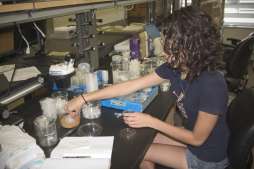
Have you ever seen a three-foot dragonfly? Where such gigantic insects once dominated earth, now only diminutive cousins remain. What created these differences? Elyse Munoz, a junior majoring in biology in the College of Liberal Arts and Sciences, had the rare opportunity to directly investigate this question over the summer, while participating in cutting-edge research in the lab of physiologist Jon Harrison.
"In the lab, research experiences provide an internship-type training that let students actually do research, rather than just read or hear about it," says Harrison, a professor in the School of Life Sciences. "They learn practical techniques, as well as ways of thinking critically about the research process. They get to interact on a personal level with faculty, post-doctoral fellows and graduate students, which helps them decide whether this is something they wish to do as a career."
Munoz connected with Harrison through the summer Undergraduate Research Experience program (REU) offered by the School of Life Sciences. The program is just one of a number of undergraduate research programs in the school. Such opportunities are one reason that Munoz, a native of San Antonio, Texas, came to Arizona State University with an award from the Hispanic Scholarship Fund.
“This research program has given me a truly invaluable experience,” Munoz says, “and an amazing opportunity to improve on myself and explore avenues of science that I didn’t even know existed.”
A Barrett Honors College student fueled by a penchant for genetics and a desire to become a surgeon, Munoz discovered the life sciences research program while taking Harrison’s undergraduate course in anatomy and physiology; attending graduate students mentioned there was a summer research opening in the Harrison lab to do research with insects.
Munoz says that while she wasn’t exactly sure what the research entailed, she had enjoyed Harrison’s course. She applied and was accepted.
The summer undergraduate research program links students with mentors and existing grants from the National Science Foundation (NSF). Students receive fellowships and are paid while they learn first hand what research is all about.
The NSF grant on which Munoz works was developed by John VandenBrooks, a post-doctoral fellow in the Harrison laboratory. Jennifer Hale, another life sciences undergraduate, is also working on this project. The goal of VandenBrook’s research is to understand how oxygen affects the body size of insects related to those that existed in the Paleozoic era. A second goal is to determine whether the dimensions of insect tracheae (breathing tubes) can be used to estimate oxygen levels of the prehistoric earth.
Why the link between oxygen and size? Models developed by scientists have suggested that levels of oxygen in earth’s atmosphere have undergone some major shifts over time. For example, oxygen is believed to have reached 31 percent during the Paleozoic era (today it is 21 percent), followed by a massive decline to as low as 13 percent in the Mesozoic era. The gigantic insects occurred at the same time as the oxygen peak, suggesting that changes in atmospheric oxygen enabled and then eliminated these giants.
How can one measure the oxygen in prehistoric atmospheres? The idea that Munoz, Hale, VandenBrooks and Harrison pursue is that the dimensions of insect’s tracheae can provide a key. They are measuring the effect of different oxygen levels on the dimensions of the bodies and tracheal tubes of German roaches. The reason the cockroach is interesting is that the species have lived for such a long time and existed during time periods of both high and low oxygen and persist still today. To study them, Munoz and Hale spent this summer rearing cockroaches in tanks that contained different oxygen levels. They measured the insects’ growth, and then took them to the Argonne National laboratory in Chicago, which operates an X-ray Synchrotron. There, Munoz, Hale and VandenBrooks peered inside the cockroaches and collected images that will enable them to document the effect of oxygen level on the dimensions of the cockroaches’ tracheae. The researchers also imaged many insect fossils that have been preserved in amber, an optically clear, petrified pitch from ancient plants. They hope to verify a method for estimating the oxygen content of ancient atmospheres from the ratio of trachea tubes size to body size in insects. If successful, this will be a major advance for biology and geology.
Taking on summer research study is a commitment. Munoz worked roughly 40 hours a week, but the returns on her investment have been immeasurable. “Working with the graduate and post doctoral students has been amazing. They have so much to teach, and most importantly are willing and wanting to help you advance and succeed,” says Munoz of her colleagues.
A typical day of research in the laboratory for Munoz started with checking the oxygen and nitrogen levels in the tanks along with ensuring the ROXY (the lab’s oxygen regulating system) was running effortlessly. The start of her week was dedicated to the care of the lab’s 500 cockroaches. Munoz and Hale changed their water tubes and replenished their food, if needed, just as if they were family pets. With a laugh, Munoz admits that the general maintenance, such as attempting to put the roaches into their containers, was her least favorite part of the research. In addition to caring for her research subjects, Munoz performed imaging, data collection and analysis.
“Sometimes it’s just as satisfying to see that you were wrong as it is to see that you were correct in your hypothesis and your predictions,” says Munoz about her research results.
In addition to her work examining oxygen levels in cockroaches, Munoz will gear up to do research on dragonflies. She will examine the effect of atmospheric oxygen level on the growth and size of dragonfly larvae: a study that will turn her summer research into a long-term project that extends into the fall. Results from her researches may ultimately support the generation of an academic paper.
Munoz hopes that as she continues to learn new skills in Harrison’s lab, she will ultimately come to design her own experiments, possibly focusing on the genetics in these insects. “The experience has been fantastic,” Munoz says. “I recommend it to all ASU students.”
Provided by Arizona State University (news : web)


