Half of the fish consumed globally is now raised on farms, study finds
September 7, 2009
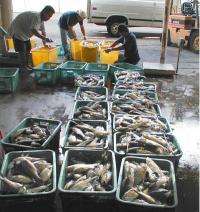
These are moi, or Pacific threadfin, being sorted for market after harvest from an offshore aquaculture cage in Hawaii. Credit: NOAA
Aquaculture, once a fledgling industry, now accounts for 50 percent of the fish consumed globally, according to a new report by an international team of researchers. And while the industry is more efficient than ever, it is also putting a significant strain on marine resources by consuming large amounts of feed made from wild fish harvested from the sea, the authors conclude. Their findings are published in the Sept. 7 online edition of the Proceedings of the National Academy of Sciences (PNAS).
"Aquaculture is set to reach a landmark in 2009, supplying half of the total fish and shellfish for human consumption," the authors wrote. Between 1995 and 2007, global production of farmed fish nearly tripled in volume, in part because of rising consumer demand for long-chain omega-3 fatty acids. Oily fish, such as salmon, are a major source of these omega-3s, which are effective in reducing the risk of cardiovascular disease, according to the National Institutes of Health.
"The huge expansion is being driven by demand," said lead author Rosamond L. Naylor, a professor of environmental Earth system science at Stanford University and director of the Stanford Program on Food Security and the Environment. "As long as we are a health-conscious population trying to get our most healthy oils from fish, we are going to be demanding more of aquaculture and putting a lot of pressure on marine fisheries to meet that need."
Fishmeal and fish oil
To maximize growth and enhance flavor, aquaculture farms use large quantities of fishmeal and fish oil made from less valuable wild-caught species, including anchoveta and sardine. "With the production of farmed fish eclipsing that of wild fish, another major transition is also underway: Aquaculture's share of global fishmeal and fish oil consumption more than doubled over the past decade to 68 percent and 88 percent, respectively," the authors wrote.
In 2006, aquaculture production was 51.7 million metric tons, and about 20 million metric tons of wild fish were harvested for the production of fishmeal. "It can take up to 5 pounds of wild fish to produce 1 pound of salmon, and we eat a lot of salmon," said Naylor, the William Wrigley Senior Fellow at Stanford's Woods Institute for the Environment and Freeman Spogli Institute for International Studies.
One way to make salmon farming more environmentally sustainable is to simply lower the amount of fish oil in the salmon's diet. According to the authors, a mere 4 percent reduction in fish oil would significantly reduce the amount of wild fish needed to produce 1 pound of salmon from 5 pounds to just 3.9 pounds. In contrast, reducing fishmeal use by 4 percent would have very little environmental impact, they said.
"Reducing the amount of fish oil in the salmon's diet definitely gets you a lot more bang for the buck than reducing the amount of fishmeal," Naylor said. "Our thirst for long-chain omega-3 oils will continue to put a lot of strain on marine ecosystems, unless we develop commercially viable alternatives soon."
Naylor and her co-authors pointed to several fish-feed substitutes currently being investigated, including protein made from grain and livestock byproducts, and long-chain omega-3 oils extracted from single-cell microorganisms and genetically modified land plants. "With appropriate economic and regulatory incentives, the transition toward alternative feedstuffs could accelerate, paving the way for a consensus that aquaculture is aiding the ocean, not depleting it," the authors wrote.
Vegetarian fish
Fishmeal and fish oil are important staples at farms that produce carnivorous fish, including salmon, trout and tuna. But vegetarian species, such as Chinese carp and tilapia, can be raised on feed made from plants instead of wild-caught fish. That's one reason why farm-raised vegetarian fish have long been considered environmentally friendly.
In the early 1990s, vegetarian fish farms began adding small amounts of fishmeal in their feed to increase yields. However, between 1995 and 2007, farmers actually reduced the share of fishmeal in carp diets by 50 percent and in tilapia diets by nearly two-thirds, according to the PNAS report. Nevertheless, in 2007, tilapia and carp farms together consumed more than 12 million metric tons of fishmeal—more than 1.5 times the amount used by shrimp and salmon farms combined.
"Our assumption about farmed tilapia and carp being environmentally friendly turns out to be wrong in aggregate, because the sheer volume is driving up the demand," Naylor said. "Even the small amounts of fishmeal used to raise vegetarian fish add up to a lot on a global scale." Removing fishmeal from the diet of tilapia and carp would have a very positive impact on the marine environment, she added.
Regulating fisheries
On the policy front, Naylor pointed to California's Sustainable Oceans Act and the proposed National Offshore Aquaculture Act, which call for reductions in the use of fishmeal and fish oil in feeds. She also applauded plans by the National Oceanographic and Atmospheric Administration to develop a comprehensive national policy that addresses fisheries management issues posed by aquaculture. "No matter how much is done from the demand side, it is essential that there be regulation on the supply side as well," Naylor said. "You won't prevent the collapse of anchoveta, sardine and other wild fisheries unless those fisheries are carefully regulated."
-
Dramatic declines in wild salmon populations are associated with exposure to farmed salmon
Feb 12, 2008 |
not rated yet |
0
-
Ocean Fish Farming Harms Wild Fish, Study Says
Dec 15, 2008 |
not rated yet |
0
-
Fish farms drive wild salmon populations toward extinction
Dec 13, 2007 |
not rated yet |
0
-
British company offers organic cod
Apr 15, 2006 |
not rated yet |
0
-
Salmon marked 'wild' may be farm-raised
Jun 30, 2006 |
not rated yet |
0
-
Engineers build first sub-10-nm carbon nanotube transistor
Feb 01, 2012 |
4.9 / 5 (30) |
30
-
Something old, something new: Evolution and the structural divergence of duplicate genes
Jan 31, 2012 |
4.6 / 5 (7) |
1
-
The hidden nanoworld of ice crystals: Revealing the dynamic behavior of quasi-liquid layers
Jan 30, 2012 |
5 / 5 (3) |
1
-
Stock market network reveals investor clustering
Jan 27, 2012 |
3.9 / 5 (23) |
8
-
Of microchemistry and molecules: Electronic microfluidic device synthesizes biocompatible probes
Jan 26, 2012 |
5 / 5 (1) |
0
-
Cancer drugs and Alzheimer's, Oh my!
7 hours ago
-
Squishing cells
8 hours ago
-
Any books/articles for evolutionary stable strategy models in humans?
19 hours ago
-
Science behind the bore feeling?
Feb 09, 2012
-
Homo Sapien vs. Chimpanzee - Divergence Timeline
Feb 09, 2012
-
a single mRNA strand is attached to sevaral ribosomes?
Feb 08, 2012
- More from Physics Forums - Biology
More news stories
Protein libraries in a snap
(PhysOrg.com) -- A Rice University undergraduate will depart with not only a degree but also a possible patent for his invention of an efficient way to create protein libraries, an important component of biomolecular ...
1 hour ago |
5 / 5 (1) |
0
|
Miami battling invasion of giant African snails
No one knows how they got there. But an invasion of African giant snails has southern Florida in a panic over potential crop damage, disease and general yuckiness surrounding the slimy gastropods.
1 hour ago |
not rated yet |
0
Fighting crimes against biodiversity: How to catch a killer weed
Invasive species which have the potential to destroy biodiversity and influence global change could be tracked and controlled in the same way as wanted criminals, according to new research from Queen Mary, University of London.
2 hours ago |
not rated yet |
0
Ultraviolet protection molecule in plants yields its secrets
Lying around in the sun all day is hazardous not just for humans but also for plants, which have no means of escape. Ultraviolet (UV) radiation from the sun can damage proteins and DNA inside cells, leading ...
16 hours ago |
5 / 5 (5) |
0
|
Deadly bird parasite evolves at exceptionally fast rate
A new study of a devastating bird disease that spread from poultry to house finches in the mid-1990s reveals that the bacteria responsible for the disease evolves at an exceptionally fast rate. What's more, ...
14 hours ago |
5 / 5 (2) |
0
|
Breastfeeding protects against asthma up to six years of age
(Medical Xpress) -- Research by the University of Otago in Christchurch and Wellington has shown that breastfeeding of infants has a clear protective effect against children developing asthma or wheezing up to six years of ...
Study finds stress hormones fluctuate with mood during pregnancy
(Medical Xpress) -- While pregnant, women pay particular attention to factors such as diet and exercise to ensure their babies are born healthy and develop normally. New research from the University of Calgarys Faculty ...
Humans may have helped the decline of African rainforests 3000 years ago
(PhysOrg.com) -- Large areas of rainforests in Central Africa mysteriously disappeared over three thousand years ago, to be replaced by savannas. The prevailing theory has been that the cause was a change ...
Japan scientist makes 'Avatar' robot
A Japanese-developed robot that mimics the movements of its human controller is bringing the Hollywood blockbuster "Avatar" one step closer to reality.
Sleep breathing machine shows clear benefits in children with sleep apnea
Children and adolescents with obstructive sleep apnea had substantial improvements in attention, anxiety and quality of life after treatment with positive airway pressure (PAP)a nighttime therapy in which a machine ...
India's global pharmacy role threatened by EU pact
(AP) -- Efforts by India and the European Union to strengthen trade are threatening India's ability to deliver lifesaving medicines to the world's poorest, analysts say as the two sides push through protracted ...
Sep 07, 2009
Rank: 4.5 / 5 (2)
You can pump cold, deep ocean water through pipes in the soil to condence water from the air to grow conventional crops, then use the nutrient rich deep water to fertilize salt water tollerant plants for animals and grow algae that you feed to cheap fish for fish feed, then use the fish waste from both the feed fish and market fish to fertilize the plants you're growing using the condensed water.
There would be a need for some energy input to pump up the deep ocean water which may or may not be offset by extra algae production for energy depending on how efficient the process is and the markets for chemicals/chemical energy compared to fish but as a facility that produces plant crops, animal feed and aquaculture fish on otherwise unused land it might just be worth the energy investment.
Sep 08, 2009
Rank: 5 / 5 (1)
Perfect. And here I was thinking that "vegetarian" meant the fish weren't getting meat. Always felt so "eco" eating tilapia. And the fisheries were feeding naturally vegetarian fish meat products...The fishing industry needs global regulation.
Sep 08, 2009
Rank: 5 / 5 (1)
Sep 17, 2009
Rank: not rated yet