Scientists Build Nanostructures out of Single DNA Strands
September 8, 2009 By Lisa Zyga Scientists Build Nanostructures out of Single DNA Strands

Enlarge

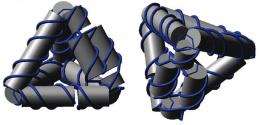
Front and top views of the 3D molecular model of the tetrahedron. Image copyright: Zhe Li, et al.

(PhysOrg.com) -- With its unique double-helical structure, DNA has the ability to be used as a programmable building material to construct designer nanoscale architectures. Complex DNA architectures could have a variety of applications, from DNA-based nanomotors to biosensing and drug delivery. Taking the research a step forward, researchers have recently constructed a nanometer-sized tetrahedron from a single strand of DNA, using a method that could have advantages for assembling similar structures on a large scale.

The researchers, from Arizona State University (ASU) and the Hong Kong University of Science and Technology (HKUST), have published their results in a recent issue of the .

As the researchers explain, the variety of different artificial constructions has been increasing. So far, 3D DNA nanostructures are made from multiple DNA strands (oligonucleotides) with deliberately designed sequences. In this new study, Hao Yan of ASU, Yongli Mi of HKUST, and their colleagues have shown that DNA tetrahedrons can now be self-folded from only a single DNA strand. In addition, they demonstrated a method to replicate the DNA tetrahedrons in vivo, which could also be applied to the design and replication of other DNA nanostructures in the future.

“A self-folded 3D nanocage that can be replicated in vivo tells us how powerful nature's machineries are,” Yan and Mi told PhysOrg.com. “DNA nanostructures can serve as scaffolds to organize other material with controlled spatial arrangement. Spatial dependent biomolecular/nanomaterial interactions can thus be tuned and studied.”

The DNA tetrahedrons, made of four triangular faces, were constructed from a DNA strand that was 286 long. The tetrahedron’s six edges were composed of double helices: five were identical (double helical), while the sixth edge had a more complex “twin double-helical” structure. Four of the edges contained a cleavable site in the center, and all four vertices consisted of an unpaired thymine base to allow adequate flexibility for folding at these corners. Once the DNA strand was paired in this way, the researchers annealed the DNA in a process of heating and then cooling. When annealed, the DNA strand self-assembled into the seven-nanometer-long tetrahedron shape by combining the appropriate base pairs together.

After confirming the successful assembly of the DNA tetrahedron, the researchers then developed a method to replicate the nanostructures using in vivo cloning in order to produce the nanostructures on a large scale. The researchers inserted one of the tetrahedrons into a cloning molecule called a phagemid, and then recovered several replicated tetrahedrons through a process of restriction digestion of the phagemid. This method is fully scalable, with the yield of cloned structures proportional to the size of the culture medium.

As the researchers explain, using only a single DNA strand for creating nanostructures has several advantages, including simplifying the assembly process, increasing yield, offering the ability to scale up production, and creating structures with longer life spans in biological systems, such as inside living cells. This property is especially appealing for in vivo applications such as biosensing and . In the future, the researchers hope to build on this method to synthesize nanostructures out of RNA, as well as build other complex shapes.

More information: Zhe Li, Bryan Wei, Jeanette Nangreave, Chenxiang Lin, Yan Liu, Yongli Mi, and Hao Yan. “A Replicable Tetrahedral Self-Assembled from a Single .” J. Am. Chem. Soc. Doi: 10.1021/ja903768f

Copyright 2009 PhysOrg.com.
All rights reserved. This material may not be published, broadcast, rewritten or redistributed in whole or part without the express written permission of PhysOrg.com.


Rate this story - 5 /5 (4 votes)

Rank Filter

Move the slider to adjust rank threshold, so that you can hide some of the comments.


Display comments: newest first

  • KBK - Sep 08, 2009
    • Rank: 2.5 / 5 (6)
    And now it is not inconceivable to understand that within 10 years or less, man will be able to construct MAN..and thus it comes to the mind, finally, that man modern could have been constructed by an 'outside influence. And that point or action 'completed'---quite easily. However, this conceptually speaking, with regard to 'common' acceptance..could not have happened 10 years ago.

    The record shows, for those who can manage to get them selves to look at it clearly..shows that there is a change in man that was very abrupt, and completely widespread. It shows genetic change. A change of man, overall. It specifically notes a change of approximately 15% of man receiving some sort of genetic change in this time in the past. This was the great change to the product called man that we see today.

    Interestingly enough, the only ones who seem to be able to mentally absorb the idea of outside interference and change in the genetic structure of man..are those who have that genetic difference. The 15% of the population who can accept concepts and understandings that completely skip off the minds of the other 85%. It is not an overall scholastic level (capacity) or similar it is a capacity to psychologically adapt and change, to move forward into the new..it is -that- group which can accept such, and does. The other 85% cannot -and works against the 15% who can.

    Of course, as mentioned, the 85% who -cannot- WILL work against this statement I have made here.

    There is no fixing this.

    The point is that the 85% will ALWAYS work against such understandings,as the threat to their personal psychological state is real to them.

    If you are in that 15% who can reach new things- you will have to understand that you ar in a pitched battle against the very genetic will of the other 85% of humanity.

    So fight hard and fight well.
  • nivekk - Sep 08, 2009
    • Rank: 1 / 5 (5)
    to KBK : agreed.

    "Levels of density will be experienced, by your majority, as the human conditions of confusion, disorientation, and bewilderment. Those who resist density, and there are many, will distort these natural conditions into forms of suffering, illness, and catastrophe. The Warriors of Light amongst you will incorporate density as a value and use disorientation and turbulance as a gateway to your true potential state. What you really want to know is this: How dense can you get?" from http://www.deoxy.org
  • NeilFarbstein - Sep 08, 2009
    • Rank: 1 / 5 (3)
    you sink very dense?
  • Myria83 - Sep 09, 2009
    • Rank: 5 / 5 (2)
    You guys are totally off subject here...
  • Thex1138 - Sep 11, 2009
    • Rank: not rated yet
    KBK - The catalysts for evolution, genetic change are not derived from your imaginary friend.
    Genetic changes are physical influence of environment, behavior, diet, interaction, breeding, social interaction. They can even be driven by the organisms will itself in trace amounts. It occurs over hundred of thousands of years, generational. Not by the snappy fingers of a the imaginary friend.

September 8, 2009 all stories

Comments: 5

5 /5 (4 votes)

  • hide
  • Related Stories

  • Using living cells as nanotechnology factories
    created Oct 08, 2008 | popularity not rated yet | comments 0
  • Physicists create first robust DNA building blocks
    created Dec 09, 2005 | popularity not rated yet | comments 0
  • Self-assembling nanostructures of DNA -- a biotechnologist's dream
    created Feb 05, 2007 | popularity not rated yet | comments 0
  • Researcher Fashions DNA to Further Advances in Nanotechnology
    created Jun 20, 2005 | popularity not rated yet | comments 0
  • For low-cost DNA nanostructures, recycle sticky ends
    created Mar 02, 2007 | popularity not rated yet | comments 0


  • hide
  • Relevant PhysicsForums posts

  • Do we lose weight by respiration ? (Losing carbons)
    created 2 hours ago
  • Sleeping habits and the risk of cancer
    created Feb 08, 2010
  • Pressure in chambers of the heart
    created Feb 07, 2010
  • Primordial soup canned?
    created Feb 07, 2010
  • Where on the r/K selection theory scale do social insects like ants and bees fall?
    created Feb 06, 2010
  • Testosterone levels and Fighting
    created Feb 05, 2010
  • More from Physics Forums - Biology

Other News

Nanoscale Structures with Superior Mechanical Properties Developed

Nanoscale Structures with Superior Mechanical Properties Developed

Nanotechnology / Nanomaterials

created 17 hours ago | popularity 4.6 / 5 (9) | comments 1 | with audio podcast

(PhysOrg.com) -- Researchers at the California Institute of Technology have developed a way to make some notoriously brittle materials ductile -- yet stronger than ever -- simply by reducing their size.


Spray-on liquid glass

Spray-on liquid glass is about to revolutionize almost everything

Nanotechnology / Nanomaterials

created Feb 02, 2010 | popularity 4.7 / 5 (240) | comments 93 | with audio podcast report

(PhysOrg.com) -- Spray-on liquid glass is transparent, non-toxic, and can protect virtually any surface against almost any damage from hazards such as water, UV radiation, dirt, heat, and bacterial infections. ...


IBM Scientists Demonstrate World's Fastest Graphene Transistor

IBM Scientists Demonstrate World's Fastest Graphene Transistor

Nanotechnology / Nanophysics

created Feb 05, 2010 | popularity 4.9 / 5 (38) | comments 25 | with audio podcast

(PhysOrg.com) -- In a just-published paper in the magazine Science, IBM researchers demonstrated a radio-frequency graphene transistor with the highest cut-off frequency achieved so far for any graphene device ...


Conductive eTextiles: Stanford finds a new use for cloth

Conductive eTextiles: Researchers move from making batteries from paper to making batteries from cloth

Nanotechnology / Nanomaterials

created Feb 05, 2010 | popularity 4.3 / 5 (7) | comments 4 | with audio podcast

(PhysOrg.com) -- Stanford researchers have moved from making batteries from paper to making batteries from cloth. Your-T-shirt could become a lighted, moving display.


Carbon Based Chips May One Day Replace Silicon Transistors

Carbon Based Chips May One Day Replace Silicon Transistors

Nanotechnology / Nanomaterials

created Feb 03, 2010 | popularity 4.7 / 5 (18) | comments 3 | with audio podcast weblog

(PhysOrg.com) -- IBM researchers are hopeful that, over the next decade, silicon-based transistors will be replaced by carbon-based transistors. IBM has already laid out the ground work for carbon-based transistors.