World's first floating wind turbine opens in Norway
September 8, 2009
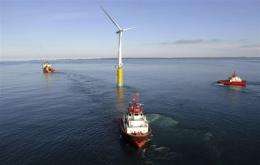
The turbine which measures 65 metres tall and weighs 5,300 tonnes lies some 10 kilometres off the island of Karmoey

Enlarge

The world's first floating full-scale offshore wind turbine in the North Sea off the coast of Norway. Norwegian energy giant StatoilHydro said that the world's first floating full-scale offshore wind turbine has been inaugurated in the North Sea off the coast of Norway.

The world's first floating full-scale offshore wind turbine has been inaugurated in the North Sea off the coast of Norway, Norwegian energy giant StatoilHydro said Tuesday.

The turbine known as Hywind, which measures 65 metres (213 feet) tall and weighs 5,300 tonnes, lies some 10 kilometres (seven miles) off the island of Karmoey near the Scandinavian country's southwestern coastline, the company said.

It rests upon a floating stand that is anchored to the seabed by three cables. Water and rocks are placed inside the stand to provide balast.

StatoilHydro plans to test Hywind over the next two years before it looks to set up any more floating with international partners.

StatoilHydro sees Japan, South Korea, California, the east coast of the United States and Spain as some of the potential markets to where this technology could be exported.

Hywind can be used in waters from 120 metres to 700 metres deep allowing it to be placed much further away from the shore than static wind turbines already in operation.

StatoilHydro's Anne Stroemmen Lycke told AFP that the floating turbine has "great advantages."

"It is not so easily seen from the coast, it can be placed in areas not used by others," she said.

"We could use such wind turbines in countries where are very deep or where there is little space left for land-based turbines," Stroemmen Lycke added.

A total of 400 million kroner (46 million euros, 66 million dollars) has been invested in the 2.3-megawatt floating turbine, making it a far more expensive option than its fixed counterpart.

"Our goal is to bring down the price to the level of fixed wind turbines that are currently installed in waters some 60 metres deep," Stroemmen Lycke said.

France's Technip and Germany's Siemens both worked with the Norwegian energy giant on the Hywind project.

It is set to start producing electricity in the next few weeks, StatoilHydro said.

(c) 2009 AFP

4.6 /5 (26 votes)  

Filter


Move the slider to adjust rank threshold, so that you can hide some of the comments.


Display comments: newest first

AlIIII
Sep 08, 2009

Rank: 1 / 5 (1)
I can't think of what the French could have added.
weewilly
Sep 08, 2009

Rank: 2 / 5 (1)
Nice idea here but let us keep watch for the data results. It is good to see other countries deeply involved in doing something proactive to help out this situation we have. Just remember folks we have never found a more hospitable planet to live on.
Lord_jag
Sep 09, 2009

Rank: 3 / 5 (2)
I can't think of what the French could have added.


They gave the windmill free health care and then translated it's owners manual. Then it made sure the french owners manual was larger than the others.
RayCherry
Sep 09, 2009

Rank: not rated yet
A total of 400 million kroner (46 million euros, 66 million dollars) has been invested in the 2.3-megawatt floating turbine, making it a far more expensive option than its fixed counterpart


The article does not seem to give much credit for this landmark development, and the value of development quoted above should never be used when comparing the cost of creating new units in the future with those land-based units.

When the cost of purchasing the territory of future windfarms is factored in, I am sure that 'off shore' property is going to start looking very attractive, and the costs of installation and maintenance will reduce as fleets of dedicated vessels are created, along with jobs for folks familiar with sailing and onboard crane operation, (re-equiping and retraining fishing fleets making use of existing skills and personnel).

I think this is great news, and I hope the technology spreads rapidly and far ...

Congratulations to the Hywind team.
RayCherry
Sep 09, 2009

Rank: not rated yet
Now is the time to consider the identified risks to birds flying in flocks, (over land or sea), that fly through the wind farms - particularly at night. Perhaps use of strong flourescent / phosphorescent colours that make the mills (particularly the towers and blades) highly visible. At sea, this visibility can be quite 'ugly' to the human eye, but receive no complaints due to their remote location. Use of the same technology on land-based mills will be more politically difficult, but must be enforced to protect the millions of migrating birds finding these wind farms in the flight paths.

Further, the concerns about ElectroMagnetic Fields being created around the turbines producing health risks for local residents can be mitigated, (until confirmed or debunked), by placing wind turbines in these completely uninhabited areas. If this risk is later confirmed, all wind turbines, land and sea based, will need significant upgrades to the EMF shielding.
Bollox
Sep 10, 2009

Rank: not rated yet
I gathered from a public meeting in Llandeilo, uk July '05, that the 153M pound farm was expected to produce zero point 2M (0.2M) pounds worth of energy annually. They therefore pay for themselves within 8 hundred years. Not bad ! Sadly they have an official lifespan of only 25. Still why worry about that ! It's just great what you can do while the oil and money keeps flowing and lots of people think that they look great and it gives them hope. Well done Hywind ! Can you tell us where you got the money to do it with, because it is quite possible to get several percent of cost returned, annually, from a sensible design - but not kill so many birds. Well, you can't have everything !
Bollox
Sep 10, 2009

Rank: 1 / 5 (1)
Never mind "electro-magnetic fields" - what about vampires being attracted to them. Already one has been attacked by UFO balls of light in uk. See "Ecotricity". One "blade" is missing - presumed abducted - and the other two look like
they overheated and went wiggly.
Also, only electrical things produce e-m fields, so how is a turbine going to do so ?
chip_engineer
Sep 12, 2009

Rank: not rated yet
@Bollox (presumably that is your angry nick)

No utility would ever put up wind turbines with an 800 year payback, more like a few decades but I'd have to check ecotricity or similar. You must have misheard or lost a few words in the meeting. Perhaps it was like our US health care town hall meetings, you wouldn't have heard anything then.

Also wind turbines drive electrical generators hence EMF, but I doubt it would have any effect on animals down on the ground and certainly not outside the wooshing sound zone.

JJ
Rank 4.6 /5 (26 votes)
Related Stories
Relevant PhysicsForums posts
  • Tennis Court Speed Measurement
    created12 hours ago
  • Fastest way to cool water
    created20 hours ago
  • Counter-weights
    createdFeb 02, 2012
  • Composite electric glass heating elements
    createdFeb 02, 2012
  • pipe stress analysis
    createdFeb 02, 2012
  • Interested in average household energy consumption in 2011...
    createdFeb 01, 2012
  • More from Physics Forums - General Engineering

More news stories

Hackers intercept FBI, Scotland Yard call (Update)

(AP) -- Trading jokes and swapping leads, investigators from the FBI and Scotland Yard spent the conference call strategizing about how to bring down the hacking collective known as Anonymous, responsible ...

Technology / Internet

created 13 hours ago | popularity 5 / 5 (7) | comments 22

Japanese entrepreneurs aim for Silicon Valley

For an emerging generation of Japanese innovators, the dream isn't a job for life at a big company. They have new ambitions, and they're determined to go places. Especially Silicon Valley.

Technology / Business

created 11 hours ago | popularity 5 / 5 (1) | comments 1

A 'natural' solution for transportation

As the United States transitions away from a primarily petroleum-based transportation industry, a number of different alternative fuel sources—ethanol, biodiesel, electricity and hydrogen—have each ...

Technology / Energy & Green Tech

created 14 hours ago | popularity 3 / 5 (2) | comments 13

Hackers deface website of lawyers for US Marine

Members of the hacker group Anonymous defaced the website on Friday of the law firm that defended a US Marine who faced charges in connection with the 2005 killing of 24 Iraqi civilians.

Technology / Internet

created 8 hours ago | popularity 5 / 5 (2) | comments 2

TV executives crave viewers who watch 2 screens

Forget the small screen and the big screen. The hottest new thing in television is the "second screen" - the one on the tablet computer or cell phone that an increasing number of viewers keep an eye on while they're watching ...

Technology / Telecom

created 7 hours ago | popularity 1 / 5 (2) | comments 0


Amazon fungi found that eat polyurethane, even without oxygen

(PhysOrg.com) -- Until now polyurethane has been considered non-biodegradable, but a group of students from Yale University in the US has found fungi that will not only eat and digest it, they will do so even in the absence ...

Scientists chart high-precision map of Milky Way's magnetic fields

(PhysOrg.com) -- Scientists at the Naval Research Laboratory (NRL) are part of an international team that has pooled their radio observations into a database, producing the highest precision map to date of ...

Whole exome sequencing identifies cause of metabolic disease

Sequencing a patient's entire genome to discover the source of his or her disease is not routine – yet. But geneticists are getting close.

Hearing metaphors activates brain regions involved in sensory experience

When a friend tells you she had a rough day, do you feel sandpaper under your fingers? The brain may be replaying sensory experiences to help understand common metaphors, new research suggests.

Renowned physicist invents microscope that can peer at living brain cells

(PhysOrg.com) -- Ever since scientists began studying the brain, they’ve wanted to get a better look at what was going on. Researchers have poked and prodded and looked at dead cells under electron microscopes, ...

New kind of high-temperature photonic crystal could someday power everything from smartphones to spacecraft

A team of MIT researchers has developed a way of making a high-temperature version of a kind of materials called photonic crystals, using metals such as tungsten or tantalum. The new materials — which ...