Darwin's collections 'cocooned' at London museum
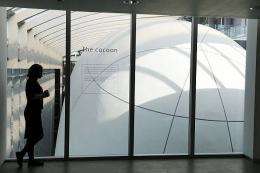
September 8, 2009 A museum employee looks over the "Cocoon" at the Darwin Centre

Enlarge

A museum employee looks over the "Cocoon" at the Darwin Centre at The Natural History Museum in London. The new 78 million pound(129 million dollar) centre is a scientific research and collections facility that can be used by over 200 scientists at a time.

London's Natural History Museum on Tuesday unveiled an eight-storey extension in the shape of a cocoon to house the collections of Charles Darwin.

The new ultra-modern white addition to the imposing Victorian includes the Darwin Centre, a state-of-the-art research and exhibition facility named after the father of the theory of evolution.

The 78 million pound (89 million euro, 129 million dollar) building houses 17 million insect specimens and three million plant specimens as well as a Climate Change Wall of screens showing the impact of global warming.

Sharon Ament, director of public engagement at the museum, said the Darwin Centre "will really show our visitors why and how our scientists tackle some of the most pressing issues we face today -- from the spread of disease to the impact of climate change on the planet's wildlife."

The museum's director, Michael Dixon, said he hoped the extension would boost the 3.8 million visitors it already attracts every year, when it opens to the public on September 15.

"There seems to be a public appetite for being more involved and knowing more about the big environmental issues of the day," he said.

Darwin's seminal 1859 work "On the Origin of Species" set out his , by which species develop from generation to generation by a process of natural selection.

(c) 2009 AFP


print this article email this article download pdf blog this article bookmark this article     Stumble it Digg this share on Facebook retweet share on Reddit add to delicious
Rate this story - not rated yet


September 8, 2009 all stories

Comments: 0

not rated yet
  • Stumble this up

  • Digg this

  • share this

  • hide
  • Related Stories

  • Evolution revolution
    created Nov 22, 2005 | popularity not rated yet | comments 0
  • Darwin egg from Beagle voyage found by museum volunteer
    created Apr 10, 2009 | popularity not rated yet | comments 0
  • Why didn't Darwin discover Mendel's laws?
    created Feb 27, 2009 | popularity not rated yet | comments 0
  • Paleontologist reflects on Darwinian connections
    created Jan 30, 2009 | popularity not rated yet | comments 0
  • Evolution and climate change research advances at Rutgers-Camden
    created Feb 02, 2009 | popularity not rated yet | comments 0


  • hide
  • Relevant PhysicsForums posts

  • What is transpulmonary pressure?
    created Nov 24, 2009
  • Is there a gay gene?
    created Nov 23, 2009
  • Super quick question about Starling forces?
    created Nov 22, 2009
  • Questions about diffusion
    created Nov 22, 2009
  • More from Physics Forums - Biology

Other News

Experts think toxic algae harming endangered fish

Biology / Ecology

created 58 minutes ago | popularity not rated yet | comments 0

(AP) -- Scientists say they think toxins from a blue-green algae plaguing lakes and rivers around the West are harming an endangered fish in the Klamath Basin, adding another obstacle to restoring species that have forced ...


Variable Temperatures Leave Insects wtih a Frosty Reception

Biology / Plants & Animals

created 1hour ago | popularity not rated yet | comments 0

(PhysOrg.com) -- For the first time, scientists at The University of Western Ontario have shown that insects exposed to repeated periods of cold will trade reproduction for immediate survival.


When camouflage is a plant's best protection

Rare woodland plant uses 'cryptic coloration' to hide from predators

Biology / Plants & Animals

created 3 hours ago | popularity not rated yet | comments 0

It is well known that some animal species use camouflage to hide from predators. Individuals that are able to blend in to their surroundings and avoid being eaten are able to survive longer, reproduce, and ...


Destruction spreads 'like a disease'

Biology / Ecology

created 2 hours ago | popularity not rated yet | comments 0

(PhysOrg.com) -- People have cleared more than a quarter of the world’s forests and half of its grasslands, according to a paper published today in the Proceedings of the Royal Society by researchers from The University of Que ...


'Safety valve' protects photosynthesis from too much light

Biology / Cell & Microbiology

created 5 hours ago | popularity not rated yet | comments 0

Photosynthetic organisms need to cope with a wide range of light intensities, which can change over timescales of seconds to minutes. Too much light can damage the photosynthetic machinery and cause cell death. Scientists ...