Patagonia site of world's biggest crater field: study
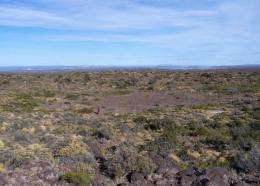
September 8, 2009 A person stands in the basaltic Filu-co plateau, in one of the around 100 craters existing in the Argentine Patagonia

Enlarge

A person stands in one of the around 100 craters existing in the region known as Bajada del Diablo (Devil's Slope) in the Argentine Patagonia, some 1800 kms south of Buenos Aires. Covering 400 square kilometers (154 square miles), the Bajada del Diablo field is peppered with at least 100 depressions left by the collisions of meteorites or comets 130,000 to 780,000 yrs ago.

Argentina can lay claim to the world's largest crater field, a volcanic area in Patagonia known as the "Devil's Slope," according to a study released Tuesday.

Covering 400 square kilometers (154 square miles), the Bajada del Diablo field is peppered with at least 100 depressions left by the collisions of meteorites or comets 130,000 to 780,000 years ago, the study found.

"Each measures between 100 and 500 meters (yards) in diameter and is between 30 and 50 meters deep, which makes it the biggest such field in the world in terms of the size of the craters," said Rogelio Acevedo of the Southern Center for Scientific Investigations.

The study, published in the September edition of the journal Geomorphology, was led by Acevedo and Hugo Corbella, who first identified the field in the 1970s.

Thirty years later, the team obtained financing from the Argentine province of Chubut and the National Geographic Society to survey the field.

In terms of the number of craters, the field is only the second largest in the world after the Sikhote-Aalin field in Siberia, which has 159 craters.

"But in Siberia the craters are smaller," Acevedo said.

With just one impact of the size that struck Patagonia, he said, Buenos Aires "would be pulverized in a matter of seconds."

He said the field's craters, which are visible on Google Earth, are similar to those found on the Moon, Mercury, Mars and Venus, making them worthy of further study.

They are well preserved because the remote sheep-raising region in which they are found is arid and sparsely populated, he said, adding that it will be necessary to protect it from tourists.

But Acevedo suggested, "this exceptional place could become a natural park."

Argentina has another crater field, called Campo de Cielo, in the northern Chaco province. There are only nine such fields in the world.

(c) 2009 AFP


print this article email this article download pdf blog this article bookmark this article     Stumble it Digg this share on Facebook retweet share on Reddit add to delicious
Rate this story - 4.3 /5 (18 votes)


September 8, 2009 all stories

Comments: 0

4.3 /5 (18 votes)
  • Stumble this up

  • Digg this

  • share this

  • hide
  • Related Stories

  • SMART-1 close-up on Zucchius crater’s central peaks
    created Jun 01, 2006 | popularity not rated yet | comments 0
  • Close-up on Cuvier crater ridge
    created Aug 22, 2006 | popularity not rated yet | comments 0
  • Largest crater discovered in Sahara
    created Mar 05, 2006 | popularity not rated yet | comments 0
  • Penguins march into new park
    created Aug 09, 2007 | popularity not rated yet | comments 0
  • Close-up on highlands near crater Pentland
    created Sep 29, 2006 | popularity not rated yet | comments 0


  • hide
  • Relevant PhysicsForums posts

  • Climate Science Update
    created 14 hours ago
  • The IPCC and the term "most"
    created Nov 23, 2009
  • Is global warming a fact?
    created Nov 23, 2009
  • Random variability of wind patterns
    created Nov 23, 2009
  • More from Physics Forums - Earth

Other News

Fermi Telescope Peers Deep into Microquasar

Fermi Telescope Peers Deep into Microquasar (w/ Video)

Space & Earth / Astronomy

created 11 hours ago | popularity 4.5 / 5 (6) | comments 0

(PhysOrg.com) -- NASA's Fermi Gamma-ray Space Telescope has made the first unambiguous detection of high-energy gamma-rays from an enigmatic binary system known as Cygnus X-3. The system pairs a hot, massive ...


The Energy Sources of Ultraluminous Galaxies

The Energy Sources of Ultraluminous Galaxies

Space & Earth / Astronomy

created 11 hours ago | popularity 4.3 / 5 (9) | comments 0

(PhysOrg.com) -- Ultraluminous infrared galaxies ((ULIRGs) are galaxies whose luminosity exceeds that of a trillion suns; for comparison, the Milky Way galaxy has a typical (and much more modest) luminosity ...


Space shuttle Atlantis, 7 astronauts back on Earth (AP)

Space shuttle Atlantis, 7 astronauts back on Earth

Space & Earth / Space Exploration

created 12 hours ago | popularity not rated yet | comments 0

(AP) -- Space shuttle Atlantis and its seven astronauts returned to Earth with a smooth touchdown Friday to end an 11-day flight that resupplied the International Space Station.


China is set to launch its second moon orbiter next October, state media have reported

China to launch second lunar probe: state media

Space & Earth / Space Exploration

created 16 hours ago | popularity 5 / 5 (4) | comments 0

China will launch its second moon orbiter next October, state media reported Friday, as it powers ahead with a space programme that has sparked concerns abroad.


Herschel takes a peek at the ingredients of the galaxies

Herschel takes a peek at the ingredients of the galaxies

Space & Earth / Astronomy

created 9 hours ago | popularity 4.3 / 5 (3) | comments 0

(PhysOrg.com) -- The European Space Agency has today released spectacular new observations from the Herschel Space Observatory, including the UK-led SPIRE instrument. Spectrometers on board all three Hershel ...