Electrical circuit runs entirely off power in trees
September 8, 2009
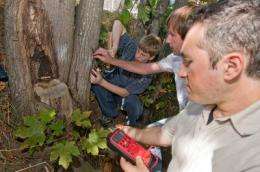
Electrical engineers Babak Parviz and Brian Otis and undergraduate student Carlton Himes (right to left) demonstrate an electrical circuit that runs entirely off tree power. Credit: University of Washington
You've heard about flower power. What about tree power? It turns out that it's there, in small but measurable quantities. There's enough power in trees for University of Washington researchers to run an electronic circuit, according to results to be published in an upcoming issue of the Institute of Electrical and Electronics Engineers' Transactions on Nanotechnology.
"As far as we know this is the first peer-reviewed paper of someone powering something entirely by sticking electrodes into a tree," said co-author Babak Parviz, a UW associate professor of electrical engineering.
A study last year from the Massachusetts Institute of Technology found that plants generate a voltage of up to 200 millivolts when one electrode is placed in a plant and the other in the surrounding soil. Those researchers have since started a company developing forest sensors that exploit this new power source.
The UW team sought to further academic research in the field of tree power by building circuits to run off that energy. They successfully ran a circuit solely off tree power for the first time.
Co-author Carlton Himes, a UW undergraduate student, spent last summer exploring likely sites. Hooking nails to trees and connecting a voltmeter, he found that bigleaf maples, common on the UW campus, generate a steady voltage of up to a few hundred millivolts.
The UW team next built a device that could run on the available power. Co-author Brian Otis, a UW assistant professor of electrical engineering, led the development of a boost converter, a device that takes a low incoming voltage and stores it to produce a greater output. His team's custom boost converter works for input voltages of as little as 20 millivolts (a millivolt is one-thousandth of a volt), an input voltage lower than any existing such device. It produces an output voltage of 1.1 volts, enough to run low-power sensors.
The UW circuit is built from parts measuring 130 nanometers and it consumes on average just 10 nanowatts of power during operation (a nanowatt is one billionth of a watt).
"Normal electronics are not going to run on the types of voltages and currents that we get out of a tree. But the nanoscale is not just in size, but also in the energy and power consumption," Parviz said.
"As new generations of technology come online," he added, "I think it's warranted to look back at what's doable or what's not doable in terms of a power source."
Despite using special low-power devices, the boost converter and other electronics would spend most of their time in sleep mode in order to conserve energy, creating a complication.
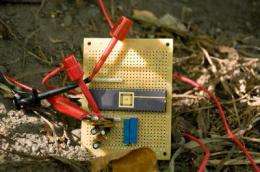
This custom circuit is able to store up enough voltage from trees to be able to run a low-power sensor. Credit: University of Washington
"If everything goes to sleep, the system will never wake up," Otis said.To solve this problem Otis' team built a clock that runs continuously on 1 nanowatt, about a thousandth the power required to run a wristwatch, and when turned on operates at 350 millivolts, about a quarter the voltage in an AA battery. The low-power clock produces an electrical pulse once every few seconds, allowing a periodic wakeup of the system.
The tree-power phenomenon is different from the popular potato or lemon experiment, in which two different metals react with the food to create an electric potential difference that causes a current to flow.
"We specifically didn't want to confuse this effect with the potato effect, so we used the same metal for both electrodes," Parviz said.
Tree power is unlikely to replace solar power for most applications, Parviz admits. But the system could provide a low-cost option for powering tree sensors that might be used to detect environmental conditions or forest fires. The electronic output could also be used to gauge a tree's health.
"It's not exactly established where these voltages come from. But there seems to be some signaling in trees, similar to what happens in the human body but with slower speed," Parviz said. "I'm interested in applying our results as a way of investigating what the tree is doing. When you go to the doctor, the first thing that they measure is your pulse. We don't really have something similar for trees."
-
TI Unveils High-Performance Power Supply Chip for Large Screen LCD Displays, TVs
Apr 13, 2005 |
not rated yet |
0
-
Microchip sets low-power record with extreme sleep mode
Jun 13, 2008 |
not rated yet |
0
-
Contact lenses with circuits, lights a possible platform for superhuman vision
Jan 17, 2008 |
not rated yet |
0
-
Nanotech SRAM for battery devices unveiled
Feb 09, 2006 |
not rated yet |
0
-
Preventing forest fires with tree power: Sensor system runs on electricity generated by trees
Sep 22, 2008 |
not rated yet |
0
-
Engineers build first sub-10-nm carbon nanotube transistor
Feb 01, 2012 |
4.9 / 5 (29) |
30
-
Something old, something new: Evolution and the structural divergence of duplicate genes
Jan 31, 2012 |
4.6 / 5 (7) |
1
-
The hidden nanoworld of ice crystals: Revealing the dynamic behavior of quasi-liquid layers
Jan 30, 2012 |
5 / 5 (3) |
1
-
Stock market network reveals investor clustering
Jan 27, 2012 |
3.9 / 5 (23) |
8
-
Of microchemistry and molecules: Electronic microfluidic device synthesizes biocompatible probes
Jan 26, 2012 |
5 / 5 (1) |
0
-
feed hold button on CNC lathe
1 hour ago
-
Mechanics of Solids ( Final exam question) plz help!
3 hours ago
-
RFAC in Fortran
6 hours ago
-
dynamics 2/32
12 hours ago
-
dynamics
12 hours ago
-
Vibration Absorbtion Problem
17 hours ago
- More from Physics Forums - General Engineering
More news stories
Samsung can continue selling Galaxy tabs in Germany: court
South Korea's Samsung Electronics can continue to sell its Galaxy Tab 10.1N tablet computer in Germany, a German court ruled Thursday, rejecting a bid by arch-rival Apple to have them banned.
16 minutes ago |
not rated yet |
0
Soraa LED light may dim 50-watt halogen rivals
(PhysOrg.com) -- Soraa, a Fremont, California company founded in 2008, this week launched its first product, a light that uses LEDS (light emitting diodes). The "Soraa LED MR16 lamp" is the "perfect" replacement for traditional ...
Researchers discover potential key to lowering energy costs of cell phones and data centers
(PhysOrg.com) -- A systematic analysis of power usage in microprocessors could help lower the energy consumption of both small cellphones and giant data centers, report computer science professors from The University of Texas ...
Technology / Computer Sciences
1 hour ago |
not rated yet |
0
|
China's Alibaba raising $3bn for Yahoo! stake: report
Chinese online commerce giant Alibaba plans to borrow $3 billion to buy back the stake Yahoo! owns in the company, a report said Thursday, as the struggling US Internet firm overhauls its Asia holdings.
2 hours ago |
not rated yet |
0
Lenovo 3Q profit up by half, warns of disk supply
(AP) -- Lenovo Group Ltd., the world's second biggest personal computer maker, said Thursday that quarterly profit grew by more than half but warned hard drive costs would remain high amid a global shortage.
2 hours ago |
not rated yet |
0
Inspired by steel, nanomanufacturing gets wear-resistant carbide tip
(PhysOrg.com) -- Scientists at the University of Pennsylvania, the University of Wisconsin-Madison and IBM Research - Zurich have fabricated an ultrasharp silicon carbide tip possessing such high strength ...
Borexino Collaboration succeeds in spotting pep neutrinos emitted from the sun
(PhysOrg.com) -- To learn more about how the sun works, scientists study particles that are emitted from it into space due to thermonuclear reactions that occur inside; by applying known physics principles, ...
New views show old NASA Mars landers
(PhysOrg.com) -- The High Resolution Imaging Science Experiment (HiRISE) camera on NASA's Mars Reconnaissance Orbiter recorded a scene on Jan. 29, 2012, that includes the first color image from orbit showing ...
Engineers find inspiration for new materials in Piranha-proof armor
(PhysOrg.com) -- Its a matchup worthy of a late-night cable movie: put a school of starving piranha and a 300-pound fish together, and who comes out the winner?
Bird populations near Fukushima are more diminished than expected
(PhysOrg.com) -- Low-level radiation in Fukushima Prefecture appears to have had immediate effects on bird populations, and to a greater degree than was expected from a related analysis of Chernobyl, an international ...
Improving fitness, preventing fat gain key in protecting heart
(Medical Xpress) -- Good news for active adults fighting the battle of the bulge. Exercising and getting fit may protect your heart, even if you have a few extra pounds, according to a study published in the Feb. 14 issue ...

Sep 08, 2009
Rank: 5 / 5 (4)
Sep 09, 2009
Rank: 5 / 5 (3)
http://www.ploson....0002963
Sep 09, 2009
Rank: 4.8 / 5 (4)
lol! then they should have tried it on themselves first!
Sep 09, 2009
Rank: 3 / 5 (1)
Sep 09, 2009
Rank: 2 / 5 (2)
Sep 09, 2009
Rank: 5 / 5 (3)
Sep 09, 2009
Rank: 5 / 5 (2)
Sep 09, 2009
Rank: 3.3 / 5 (3)
Organic solar cells har har har.
Sep 09, 2009
Rank: 5 / 5 (1)
Next steps: find any negative effects on the trees, and find out which ones can produce energy most efficiently. I would imagine that older/taller/well canopied trees would have more electricity to manage, and if electricity production encourages their replanting and preservation then I hope this will be a good thing ... for us, and the trees.
Sep 09, 2009
Rank: not rated yet
Are we on the verge of discovering Ents? :-o
Sep 09, 2009
Rank: not rated yet
Sep 09, 2009
Rank: 1 / 5 (1)
Sep 10, 2009
Rank: not rated yet
Sep 20, 2009
Rank: 5 / 5 (1)
Sep 21, 2009
Rank: not rated yet