Prototype Method Detects and Measures Elusive Hazards
September 8, 2009
Prototype NIST Method Detects and Measures Elusive Hazards

Enlarge

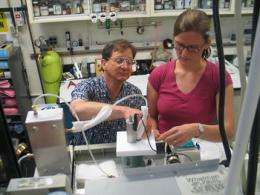
NIST research chemist Tom Bruno and postdoctoral researcher Tara Lovestead assemble an apparatus for detecting and measuring explosives and toxins. The sample is inside the blue column (lower center). Bruno enhanced the technique, called headspace analysis, to make it suitable for detecting low concentrations of polar, low-volatility compounds. Credit: Burrus/NIST

(PhysOrg.com) -- A chemist at the National Institute of Standards and Technology has demonstrated a relatively simple, inexpensive method for detecting and measuring elusive hazards such as concealed explosives and toxins, invisible spoilage in food or pesticides distributed in soil by wind and rain. The prototype method is more sensitive than conventional techniques for detecting traces of these materials, which are polar—like water molecules, having distinct electrically positive and negative ends—and do not readily evaporate.

As described in a new paper, NIST researcher Tom Bruno enhanced a technique called “headspace analysis,” which is the detection and analysis of trace levels of chemical compounds from a solid or liquid that are released into the surrounding atmosphere. Bruno’s enhancements greatly improve the efficiency of sample collection, for the first time making the technique suitable for detecting low concentrations of polar, low-volatility, compounds such as explosives. Preliminary results indicate the method is sensitive enough to measure amounts of target materials that constitute as little as 0.0000002 percent of a sample.

The sample collection device consists of several coils of fine tubing just 0.32 millimeters in inner diameter. Bruno modified the inner coating, which efficiently attracts and retains chemicals across its large surface area. The device can be used with a sample-heating oven as part of a laboratory analysis system or taken into the field for sample collection. To extract target molecules from a sample, the coil is placed inside an insulated cylinder and chilled with a cold air stream to minus 40 degrees Celsius. A gas, such as , is swept across the sample held in the oven or the coil device, gathering up target molecules along the way, and through the fine tubing. Chilling the coils—part of Bruno’s innovation—makes collection of target molecules more efficient. The tubing is washed with a solvent, or heated, to release the captured molecules for analysis.

Bruno found that the mass of the collected molecules increases with rising oven and sweep gas temperatures, offering a way to detect specific target molecules under particular field conditions. NIST researchers demonstrated the new method using several explosives, including the pure explosive TNT and the plastic explosive mixture C-4. Among other applications, NIST researchers have used the method to improve sampling and analysis of fire retardants in a car interior, a topic of interest because of concerns expressed by some that the “new car smell” may be a health hazard. They also are using the method to detect volatile protein decomposition products in spoiled meats. Environmental applications could include detection of pesticides deposited on soils subject to weathering effects.

More information: T.J. Bruno. Simple, quantitative headspace analysis by cryoadsorption on a short alumina PLOT column. 2009. Journal of Chromatographic Science, Vol. 47, pp. 569-574, August.

Provided by National Institute of Standards and Technology (news : web)


Rank not rated yet
Related Stories
Relevant PhysicsForums posts
  • AAS or Colorimeter method to determine zinc in a plant.
    createdFeb 11, 2012
  • Stoichiometry
    createdFeb 10, 2012
  • Boiling and melting point of impure substances
    createdFeb 10, 2012
  • Safe nitrogen compound to decompose a 500 deg C in a furnace?
    createdFeb 09, 2012
  • [ask]electron inside drinking water
    createdFeb 08, 2012
  • How to avoid formation of Lithium Chromate ???
    createdFeb 08, 2012
  • More from Physics Forums - Chemistry

More news stories

Hydrogen from acidic water: Researchers develop potential low cost alternative to platinum for splitting water

A technique for creating a new molecule that structurally and chemically replicates the active part of the widely used industrial catalyst molybdenite has been developed by researchers with the Lawrence Berkeley ...

Chemistry / Materials Science

created Feb 09, 2012 | popularity 4.8 / 5 (15) | comments 21 | with audio podcast

Fool's gold may prove an unlikely alternative to overexploited catalytic materials

Catalytic materials, which lower the energy barriers for chemical reactions, are used in everything from the commercial production of chemicals to catalytic converters in car engines. However, with current catalytic materials ...

Chemistry / Materials Science

created Feb 10, 2012 | popularity 4.4 / 5 (8) | comments 8 | with audio podcast

Research provides octagonal window of opportunity for carbon capture

(PhysOrg.com) -- Filtering carbon dioxide, a greenhouse gas, from factory smokestacks is a necessary, but expensive part of many manufacturing processes. However, a collaborative research team from the National ...

Chemistry / Materials Science

created Feb 08, 2012 | popularity 5 / 5 (1) | comments 5 | with audio podcast

Flexible paper robots

(PhysOrg.com) -- These inexpensive robots can stretch, bend and twist under control, and lift objects up to 120 times their own weight. Being soft, they can apply gentle and even pressure, and adapt to varied ...

Chemistry / Materials Science

created Feb 09, 2012 | popularity 5 / 5 (5) | comments 4 | with audio podcast

New form of hafnium oxide developed

(PhysOrg.com) -- A novel material developed by researchers at the University of Cambridge is opening up new possibilities for next generation electronic and optoelectronic devices, and paving the way for further ...

Chemistry / Materials Science

created Feb 07, 2012 | popularity 4.6 / 5 (5) | comments 4 | with audio podcast


Google might launch Drive for cloud storage soon

(PhysOrg.com) -- Google's next big move, according to the Wall Street Journal, is a cloud storage service called Drive. Hardly first to the plate, Google is simply catching up to introducing its cloud reposi ...

Latin America mining boom clashes with conservation

Latin America is experiencing a mining boom as prices rise fuelled by a hike in global demand, but the region is also being hit by a wave of violent protests, strikes and rallies by environmentalists.

Walney offshore wind farm is world's biggest (for now)

(PhysOrg.com) -- The Walney wind farm on the Irish Sea--characterized by high tides, waves and windy weather--officially opened this week. The farm is treated in the press as a very big deal as the Walney ...

Love a click away in Indonesia's Twitter Republic

He was a geeky kid from Yogyakarta, she a glamorous city girl in Jakarta. In a country with one of the world's most vibrant social networking scenes they fell in love on Twitter.

GPS court ruling leaves US phone tracking unclear

A US Supreme Court decision requiring a warrant to place a GPS device on the car of a criminal suspect leaves unresolved the bigger issue of police tracking using mobile phones, legal experts say.

Europeans protest controversial Internet pact

Tens of thousands of people marched in protests in more than a dozen European cities Saturday against a controversial anti-online piracy pact that critics say could curtail Internet freedom.