War, genocide 'difficult knowledge' to teach younger students
September 8, 2009
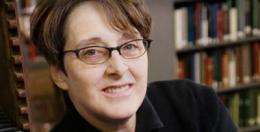
Education professor Brenda M. Trofanenko says the study of genocide and "difficult knowledge" of historical events is best left to high school students. Credit: L. Brian Stauffer
Whether they're found in a museum or a textbook, historical narratives about traumatic events such as war and genocide are better left to older students, who have typically developed a more refined historical consciousness, says a University of Illinois professor who studies and teaches historical instruction.
According to Brenda M. Trofanenko, a professor of curriculum and instruction in the College of Education at Illinois, the "difficult knowledge" of such events as the Holocaust, the Ukranian Holodomor and the genocides in Rwanda and Srebrenica should be the province of high school history classes, not elementary and upper-elementary classes.
"It's curricular creep in the sense that subjects that were once considered relevant only to high school kids previously are now filtering down to elementary and upper-elementary school students," Trofanenko said.
In public schools in California, Illinois and Massachusetts, the study of genocide is a mandatory unit of instruction in every elementary and high school.
Although those states are "quite forward-thinking" in mandating genocide education as a distinct subject, Trofanenko believes elementary school is too young to begin a serious discussion about such a weighty historical topic.
"I've heard of children as young as grade three are being taught about the Holocaust," she said. "That's far too young, to my mind."
Trofanenko, who presented a paper about teaching difficult knowledge at the Curating Difficult Knowledge conference at Concordia University in Montreal last April, says elementary school students lack the baseline historical knowledge and critical sensibility necessary to understand the various implications of state-sponsored mass murder.
"Younger students don't have the ability to capture all the information and knowledge necessary to understand both the historical and emotional context of difficult knowledge like genocide. They don't understand the big picture yet. Once they have an understanding of concepts such as significance, continuity and change, cause and consequence, and moral judgment, students can logically think through and ask questions about why events have happened."
To critics who would argue that educators can't shield younger students from the difficult topics of history, Trofanenko says that high school students are better equipped, both emotionally and intellectually, to deal with traumatic events in world history.
"It's called 'difficult knowledge' by educators and historians for a reason," Trofanenko said. "How do you portray death and dying to a 12-year-old? How do you properly convey the gravity of certain historical situations to a sixth- or seventh-grader? In order to deal with the emotional aspects of it, students have to be able to logically understand what was happening at the time. Elementary school students aren't ready for that yet. It's easier to talk to a 16-year-old about how people died because of their religious or political beliefs than it is a sixth grader."
A fact-based, fill-in-the-blank approach to learning about genocide - a teaching staple of virtually all elementary school history classes - isn't the best pedagogical approach to teaching historically difficult subjects, Trofanenko says.
"When you do that, when you turn the Holocaust or the Holodomar into a "Jeopardy!"-type game in order to drill facts into students' heads, you trivialize it," she said. "Looking only at facts or the raw data of how many people were killed discounts a lot of significant aspects, including the emotional toll. This is not to say that students don't need to know the extent of genocide, but it's not the only element within the larger picture."
Teaching difficult knowledge not only requires educators to think carefully about their own theories of learning, but it also necessitates a pedagogical willingness to approach the limits of a young learner's knowledge of history.
"This requires more than satisfying standards," she said. "It means a better understanding of how young people deal with emotion and emotional issues associated with world events."
Trofanenko says teachers need to get back to engaging in historical inquiry - asking questions about what genocide is, why it was allowed to happen, and how it's occurred even during their lifetime.
"Teachers need to look at genocide generally and not treat it as an isolated, discrete event," she said. "It needs to be taught as something that has happened during our students' lifetimes. They need to know why these terrible events occurs, not just the information that results from it."
Source: University of Illinois at Urbana-Champaign (news : web)
-
Rote memorization of historical facts adds to collective cluelessness
Feb 12, 2009 |
not rated yet |
0
-
Online tutorials help elementary school teachers make sense of science
Jun 18, 2009 |
not rated yet |
0
-
University of Denver bullying victimization study
Feb 22, 2008 |
not rated yet |
0
-
Ability grouping in elementary school hampers minority students' literacy
Apr 21, 2009 |
not rated yet |
0
-
Cooperative learning methods top list of effective approaches for secondary mathematics
Jun 26, 2009 |
not rated yet |
0
-
Engineers build first sub-10-nm carbon nanotube transistor
Feb 01, 2012 |
4.9 / 5 (33) |
30
-
Something old, something new: Evolution and the structural divergence of duplicate genes
Jan 31, 2012 |
4.6 / 5 (7) |
1
-
The hidden nanoworld of ice crystals: Revealing the dynamic behavior of quasi-liquid layers
Jan 30, 2012 |
5 / 5 (4) |
1
-
Stock market network reveals investor clustering
Jan 27, 2012 |
3.9 / 5 (23) |
8
-
Of microchemistry and molecules: Electronic microfluidic device synthesizes biocompatible probes
Jan 26, 2012 |
5 / 5 (2) |
0
-
Can I forget a language?
Feb 10, 2012
-
The Biggest Lie Ever
Feb 09, 2012
-
What are the limits of learning?
Feb 06, 2012
-
Isn't that grammatically wrong?
Feb 06, 2012
-
What does it mean when traders are indifferent?
Feb 04, 2012
-
Peak of Our Civilization
Feb 04, 2012
- More from Physics Forums - Social Sciences
More news stories
A frank discussion of the power law and linking correlation to causation
(PhysOrg.com) -- Michael Stumpf a mathematics professor at Imperial College in London, and Mason Porter a lecturer at Oxford have teamed together to write and publish a perspective piece in Science regarding the in ...
US workers are 'giving away the store,' costing firms billions
Nearly 70 percent of the nation's service employees give away free goods and services from hamburgers to cable TV costing companies billions of dollars a year, according to a groundbreaking study.
Other Sciences / Economics & Business
Feb 09, 2012 |
3 / 5 (5) |
11
Employers feel no love for unscrupulous practice of 'service sweethearting'
A new study led by two Florida State University marketing professors finds that some frontline service employees who are rewarded for hikes in customer loyalty and satisfaction also may engage in "service ...
Other Sciences / Economics & Business
Feb 10, 2012 |
3.3 / 5 (3) |
10
New insights into how to correct false knowledge
The abundance of false information available on the Internet, in movies and on TV has created a big challenge for educators.
Other Sciences / Social Sciences
Feb 07, 2012 |
4.9 / 5 (7) |
9
|
Neanderthal demise due to many influences, including cultural changes: study
As an ice age crept upon them thousands of years ago, Neanderthals and modern human ancestors expanded their territory ranges across Asia and Europe to adapt to the changing environment.
Other Sciences / Archaeology & Fossils
Feb 07, 2012 |
4.4 / 5 (5) |
8
|
Scientists discover molecular secrets of 2,000-year-old Chinese herbal remedy
For roughly two thousand years, Chinese herbalists have treated Malaria using a root extract, commonly known as Chang Shan, from a type of hydrangea that grows in Tibet and Nepal. More recent studies suggest that halofuginone, ...
New method to examine batteries -- MRI from the inside
There is an ever-increasing need for advanced batteries for portable electronics, such as phones, cameras, and music players, but also to power electric vehicles and to facilitate the distribution and storage of energy derived ...
Overeating may double risk of memory loss
New research suggests that consuming between 2,100 and 6,000 calories per day may double the risk of memory loss, or mild cognitive impairment (MCI), among people age 70 and older. The study was released today and will be ...
A mitosis mystery solved: How chromosomes align perfectly in a dividing cell
Although the process of mitotic cell division has been studied intensely for more than 50 years, Whitehead Institute researchers have only now solved the mystery of how cells correctly align their chromosomes during symmetric ...
Lab study raises questions over nano-particle impact
Tests involving chickens have raised questions about the impact on health from engineered nano-particles, the ultra-fine grains commonly used in drugs and processed foods, scientists said on Sunday.
Google might launch Drive for cloud storage soon
(PhysOrg.com) -- Google's next big move, according to the Wall Street Journal, is a cloud storage service called Drive. Hardly first to the plate, Google is simply catching up to introducing its cloud reposi ...
Sep 09, 2009
Rank: 1 / 5 (1)
Interesting to see what has not been mentioned.