Yawning toons make an ape gape
September 8, 2009
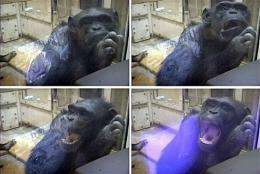
A chimpanzee yawning after being shown videos of other chimps yawning in 2003

Enlarge

This combo of handout pictures released by Japanese professor at the Primate Research Institute at Kyoto University, Tetsuro Matsuzawa, shows a chimpanzee yawning after being shown videos of other chimps yawning at a laboratory in Inuyama, Aichi Prefecture, in 2003. Computer animations of yawning chimpanzees provoke the same irresistible grins in real chimps, according to an unusual study.

Computer animations of yawning chimpanzees provoke the same irresistible grins in real chimps, according to an unusual study released Wednesday.

"Contagious yawning" is well known among humans, and earlier studies have shown that chimps are not immune to its suggestive influence either.

But the new research is the first to show that images seen on a monitor can provoke teeth-baring yawns in non-human primates too.

Matthew Campbell and colleagues of the Yerkes National Primate Research Center in Lawrenceville, Georgia divided 24 chimps ranging in age from nine to 43 years old into pairs.

Each pair was exposed to animated chimps in two short 3-D videos on a 48-centimetre (19-inch) screen. Only one of the videos showed the animals yawning.

The chimps may doing something deeper than simple imitation, for they may have an emotional tie with the cartoon character, the researchers believe.

"Contagious yawning is controlled by the same mechanism that makes emotions contagious," the study notes. "Our results strongly suggest an empathetic response to the animations."

The technique could provide an important tool for exploring and cognition, the study adds.

The study is published in a British scientific journal, .

(c) 2009 AFP

Filter


Move the slider to adjust rank threshold, so that you can hide some of the comments.


Display comments: newest first

Birthmark
Sep 08, 2009

Rank: not rated yet
Yep I yawned when I seen the monkey yawning. Heard the sympathy area in your brain lights up when someone yawns.
Rank not rated yet
Related Stories
Relevant PhysicsForums posts
  • Factors affecting beet root cell membrane
    created9 hours ago
  • Stem cell question.
    createdFeb 10, 2012
  • Protease cleavage
    createdFeb 10, 2012
  • Pertubance in a model
    createdFeb 10, 2012
  • Cancer drugs and Alzheimer's, Oh my!
    createdFeb 09, 2012
  • Squishing cells
    createdFeb 09, 2012
  • More from Physics Forums - Biology

More news stories

A mitosis mystery solved: How chromosomes align perfectly in a dividing cell

Although the process of mitotic cell division has been studied intensely for more than 50 years, Whitehead Institute researchers have only now solved the mystery of how cells correctly align their chromosomes during symmetric ...

Biology / Cell & Microbiology

created 5 hours ago | popularity 5 / 5 (6) | comments 0 | with audio podcast

Researchers find extensive RNA editing in human transcriptome

In a new study published online in Nature Biotechnology, researchers from BGI, the world's largest genomics organization, reported the evidence of extensive RNA editing in a human cell line by analysis of RNA-seq data, demons ...

Biology / Biotechnology

created 5 hours ago | popularity 5 / 5 (4) | comments 0 | with audio podcast

The proteins ensuring genome protection

Researchers from the University of Geneva (UNIGE), Switzerland, have discovered the crucial role of two proteins in developing a cell 'anti-enzyme shield'. This protection system, which operates at the level of molecular ...

Biology / Cell & Microbiology

created 5 hours ago | popularity 5 / 5 (3) | comments 0 | with audio podcast

Entire genome of extinct human decoded from fossil

(PhysOrg.com) -- In 2010, Svante Pääbo and his colleagues presented a draft version of the genome from a small fragment of a human finger bone discovered in Denisova Cave in southern Siberia. The ...

Biology / Biotechnology

created Feb 07, 2012 | popularity 4.7 / 5 (59) | comments 48 | with audio podcast

Why are there so few fish in the Earth's oceans?

(PhysOrg.com) -- A Stony Brook University researcher has found that, contrary to popular belief, there are not plenty of fish in the sea.

Biology / Plants & Animals

created Feb 08, 2012 | popularity 4.2 / 5 (18) | comments 27 | with audio podcast


Scientists discover molecular secrets of 2,000-year-old Chinese herbal remedy

For roughly two thousand years, Chinese herbalists have treated Malaria using a root extract, commonly known as Chang Shan, from a type of hydrangea that grows in Tibet and Nepal. More recent studies suggest that halofuginone, ...

Overeating may double risk of memory loss

New research suggests that consuming between 2,100 and 6,000 calories per day may double the risk of memory loss, or mild cognitive impairment (MCI), among people age 70 and older. The study was released today and will be ...

New method to examine batteries -- MRI from the inside

There is an ever-increasing need for advanced batteries for portable electronics, such as phones, cameras, and music players, but also to power electric vehicles and to facilitate the distribution and storage of energy derived ...

Lab study raises questions over nano-particle impact

Tests involving chickens have raised questions about the impact on health from engineered nano-particles, the ultra-fine grains commonly used in drugs and processed foods, scientists said on Sunday.

Starve a virus, feed a cure? Findings show how some cells protect themselves against HIV

A protein that protects some of our immune cells from the most common and virulent form of HIV works by starving the virus of the molecular building blocks that it needs to replicate, according to research published online ...

Google might launch Drive for cloud storage soon

(PhysOrg.com) -- Google's next big move, according to the Wall Street Journal, is a cloud storage service called Drive. Hardly first to the plate, Google is simply catching up to introducing its cloud reposi ...