Home power plants project unveiled in Germany
September 9, 2009 by Aurelia End
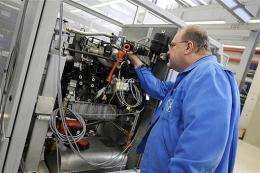
A technician of German automaker Volkswagen's adjusts a mini gas-fired power plant at the VW plant in the northern German city of Salzgitter. An ambitious project was unveiled in Germany on Wednesday to install mini gas-fired power plants in people's basements and produce as much electricity as two nuclear reactors within a year.
An ambitious project was unveiled in Germany on Wednesday to install mini gas-fired power plants in people's basements and produce as much electricity as two nuclear reactors within a year.
The Hamburg-based renewable energy group Lichtblick and its automaker partner Volkswagen say the plants would produce not only heating and hot water but also electricity, with any excess power fed into the local grid.
The two firms said the concept of "SchwarmStrom" (literally, "swarm power") would allow Germany to abandon nuclear and coal power stations sooner and help compensate for the volatility of renewables like wind and solar power.
The plants also reduce harmful carbon dioxide emissions by up to 60 percent compared to conventional heat and electricity generation, they added in a joint statement.
In the coming year the programme will install 100,000 of the mini plants, producing between them 2,000 megawatts of electricity, the same as two nuclear plants, Lichtblick and VW said.
"SchwarmStrom is revolutionising power production in Germany. It clears the way for more renewable energy and an exit from power from nuclear and coal," the statement added.
"The home power plants together form a huge, invisible power station that doesn't make the countryside ugly or require additional infrastructure."
The project "is thoroughly feasible if the project reaches the forecast size," Claudia Kemfert of the DIW research institute told AFP.
She added by way of comparison that "just getting rid of incandescent light bulbs would be the same as shutting down one nuclear reactor."
Gas plants have an advantage over nuclear power stations in that the heat produced by the latter is wasted, the DIW energy expert said.
But "the most ecological would be to feed these mini-plants with biogas" rather than natural gas, Kemfert noted.
Lichtblick said another advantage of its plan was that tens of thousands of generators could be mobilised to meet a surge in demand or if drought made it hard to cool nuclear plants or a calm spell idled wind turbines.
VW will contribute to the project by providing a gas-powered engine similar to one used in its popular Golf model.
But LBBW auto analyst Stefan Sigrist told AFP: "This is mainly a marketing offensive. It is chic for VW to bask in a greener light."
Although the generators are not a new concept, the project is novel in that Lichtblick would retain control over the plants after their installation.
Households would pay around 5,000 euros (7,250 dollars) to have the generators set up along with an appropriate heating system.
But individuals would then pay a lower price for heating and receive a modest "rent" for hosting the generator, as well as a bonus at the end of the year calculated on electricity revenues that resulted from Lichtblick's sales.
(c) 2009 AFP


Tucson Power once tried to sell 1kw panels to customers, but had problems with the panels.
As a former homeowner from Tucson, I would lease my roof to a solar panel, but I would not commit to the 10-20 year payback to buy one.
I like your idea though it is not very different from the power meters attached to houses, the only real difference is that we are used to the idea of a power meter attached to our house that we do not own and are proibited from touching.
http://www.physor...367.html
-or hydrogen from urea-
1. How many of you want an internal combustion engine running in your basement? Want to hazard a guess how many people will be killed each year by 100,000 generators by CO poisoning?
2. How efficient is this thing compared to a coal or nuclear plant? It cannot be even close.
3. Did you notice the moron Germans decided to get rid of all their nuclear plants?
4. What is the maintenance cost? Who does it, how, when, how to arrange access?
5. What if the Russians cut off the gas supply?
6. What is the cost/benefit of major new gas turbine plants, instead?
7. What does this have to do with renewable energy?
8. How inefficient is this economically, and how many jobs will it kill? Green jobs in Spain kill real jobs at a ratio of at least 2:1. I'll bet this is similar.
9. Did you notice how they claim to reduce CO2 by 60% compared to conventional heat? That's because they'll produce CO instead.
I'd like to see the calculations of the benefits/trade offs.
At least it would be a step in the right direction of 'decentralizing' the grid, and setting it up for better renewable tech on an individual house basis.
It is a large scale test, and I am "reasonably sure" that German safety standards will not have permitted it to go this far if the apparatus was going to increase the risks to the residents.
As for the cost of the fuel 'skyrocketting', this solution only extends temporarily the dependence on the oil/gas industry until such a time as renuable energy truly becomes an alternative for countries such as Germany who find solar and wind ineffective. Once the other countries can provide electricty from renuable sources at a competitive price, you can be sure that these gas-based systems will become superfluous.
In the meantime, it appears that Germany is serious about cutting Greenhouse Gas emissions and we should greet this experiment, if only that reason alone.
They aren't just going to throw an gas engine in your basement, plug it into the wall, and call it a day. Unless they love lawsuits they'll install ventilation and other safeguards, hence the high cost of installation. Otherwise you could go buy a generator and do it yourself for a couple hundred dollars.
Also, lol at the phrase "moron Germans"
1. Like a fuel oil or coal furnace
2. Depends on what they replace- see #1
3. And you are a Pimmelkopf
4,5. See #1
6-9. See #3
Yes, they're phasing out their nuclear plants and phasing in 26 brand spanking new coal plants: http://www.spiege...,00.html .
This isn't anthracite coal we're talking about either; heck, much of it isn't even bituminous coal. 97% of Germany's coal reserves are lignite, semi-combustible dirt; actual production is 86% lignite, 13% bituminous and 1% anthracite.
An uncomfortable fact is that the efficiency gains made by Germany in the early 90's was not due to their 'green' policies, which only increased dependency on russian natural gas and are set to increase dependency on idiotic dirt-burners. It was a one-off event from the collapse of the Soviet union and the retiring of their extremely inefficient east-German factories and power plants.
No, I think you're confused. They're buying 2 gigawatts of solar panels to be installed in inner Mongolia from first solar. They'll be built over the next decade.
That will provide as much power on average as ~500 MW nuclear capacity. In the same time frame they have plans to build 60 GW of nuclear. That 60 GW of nuclear will avoid ~70-80 GW of new coal. They'll still be adding new coal and the IEA thinks they'll double coal production by 2030.
Here's the kicker though. Those solar plants need hydropower and natural gas to operate. That 'green' energy isn't diplacing coal like nuclear does, it's displacing a little bit of gas and hydropower. That also puts a limit on the amount of solar and wind you can incorporate into the grid that can't be circumvented without insane levels of storage and transmission capacity.
Glad to see the 'Power Units' actually in use and growing in number.
Roy Stewart,
Phoenix AZ
Centralized gas powered generators with a local industrial partner to use all the waste heat directly, probably the simplest and most efficient.
But worst is centralized gas powered generators throwing all heat to atmosphere, but can be easily converted to the best by adding a partner.
The next options seem about even in efficiency to me
Centralized gas powered generators with residential steam pipes and some heat losses, already quite common in parts of Europe.
Distributed gas powered generators with local heat consumption used for heating and maybe cooling with heat driven systems. Perhaps the more interesting.
Of course they are at the mercy of Gazprom.
As for German nuclear plants, I am assuming they have reached their end of useful life, has anyone ever shut down a working nuclear plant before its due date?
JJ
Yes. Most of the plants that have been shut down are of two kinds, generation I and experimental designs and reactors shut down for political reasons.
Nuclear plants are typically licensed for an arbitrary period of time like 30 or 40 years. The utility must contact the regulatory agency for review and potential renewal of the operating license.
Nearly all generation II reactors in the US that have come up for review at the end of the first 40 years have sought and been granted and extension to 60 years without much problem at all and extension to 80 is quite likely when the time comes. Therefor it is safe to assume that most of the german plants, which are gen II, slated for shut down between now and 2020 could be extended for at least another 20 years with just minor upgrades(like replacing the steam turbines).
Informative as ever, thanks. Great to hear that extensions are usually granted when the plants still have good life with appropriate upgrades.
Let me guess is this where you now will come in and inform us all about how the Germans are really the "Architects" of "Intelligent Design".
When you were offered the choice you should have taken the Red pill.
http://www.market...09-09-13
-Pipelines across Asia to Europe from LNG terminals in the Indian oceanSuckup Alert- we have the opportunity to analyze a curmudgeon and his latest attempt to garner the power to suppress and depress. Unreal. Probably doesn't even know he's doing it. No power to glean here sir. Honest.