Proposed Quantum Computer Consists of Billions of Electron Spins
September 9, 2009 By Lisa Zyga
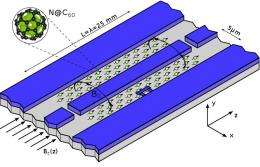
The physical setup of the quantum computer consists of a superconducting transmission line cavity coupled to an ensemble of electron spins and a transmon Cooper pair box. The cavity dimensions allow 100 billion electron spins to be coupled to the cavity mode, which could be used to make hundreds of physical qubits. Image copyright: J.H. Wesenberg, et al.
(PhysOrg.com) -- While researchers have already demonstrated the building blocks for few-bit quantum computers, scaling these systems up to large quantum computers remains a challenge. One of the biggest problems is developing physical systems that can reliably store thousands of qubits, and enabling bits and pairs to be addressed individually for gate operations.
With this issue in mind, scientists have recently proposed a quantum computing scheme that uses an ensemble of about 100 billion electron spins. They show that hundreds of physical qubits can be made from these collective electron spin excitations. The researchers, Janus Wesenberg from the University of Oxford, and coauthors from Oxford, Yale University and the University of Aarhus in Denmark, have published the proposed system in a recent issue of Physical Review Letters.
The system can also perform qubit encoding and provide one- and two-bit gates for quantum computing. In the setup, the electron spins are coupled to a superconducting transmission line cavity. In turn, this cavity is coupled to a transmon Cooper pair box that carries out the gate operations.
“A single electron spin only interacts very weakly with its environment: this makes it a good quantum memory, except that it is very hard to initialize or read out,” Wesenberg explained to PhysOrg.com. “In the ensemble register we make use of the fact that the collective interaction between an ensemble of billions of spins and a microwave cavity is greatly enhanced by the so-called superradiant effect. This makes it possible to transfer a microwave photon (carrying a qubit), from the cavity to the spin ensemble in a few tens of nanoseconds compared to a significant fraction of a second for a single spin. Once the photon has been transferred to the ensemble, it lives as an delocalized excitation.
“The state of the system is a quantum superposition of each spin being excited, that is, flipped relative to the very strong magnetic field that has been applied to the system. There is an infinite number of ways in which a single excitation can be superpositioned in this way, and these can be described in terms of spin waves. By applying a magnetic gradient pulse, we can transfer an excitation that lives as one kind of spin wave to another kind of spin wave.”
As Wesenberg added, the study brings up two independent new ideas.
“Firstly, there is the idea to couple an ensemble of electron spins to a stripline resonator,” he said. “While this is a novel idea, it is a straightforward extension of previous work (by Peter Zoller and many others), on coupling ensembles of polar molecules, Rydberg atoms etc. to such stripline cavities. The main advantage of using electron spins is that they can simply be smeared onto the stripline substrate without any need for complex trapping arrangements. Secondly, there is the idea of using the holographic principle to address a large number of modes in the ensemble by means of a controllable magnetic gradient. This is a relatively straightforward extension of work by one of the authors (K. Mølmer), on holographic storage.”
As the scientists explain in their study, one of the advantages of this setup is that a large number of spins can be controlled without requiring single spin measurement. Depending on the materials used, the system could achieve spin coherence times of up to tens of milliseconds, which could be used to build a solid-state device.
“The immediate plan is to demonstrate experimentally that this works,” Wesenberg said. “First in the semi-classical setting (which is essentially electron spin resonance spectroscopy), and later in the quantum regime. Experiments to this end are underway at Yale and Oxford.”
More information: J.H. Wesenberg, et al. “Quantum Computing with an Electron Spin Ensemble.” Physical Review Letters 103, 070502 (2009). DOI: 10.1103/PhysRevLett.103.070502
Copyright 2009 PhysOrg.com.
All rights reserved. This material may not be published, broadcast, rewritten or redistributed in whole or part without the express written permission of PhysOrg.com.
-
Researchers develop optical technique for controlling electron spins in quantum dot ensembles
Nov 15, 2007 |
not rated yet |
0
-
Graphene quantum dot may solve some quantum computing problems
Jan 15, 2008 |
not rated yet |
0
-
Ultrafast quantum computer uses optically controlled electrons
Aug 15, 2007 |
not rated yet |
0
-
Single-photon source may meet the needs of quantum communication systems
Nov 09, 2006 |
not rated yet |
0
-
Indium arsenide may provide clues to quantum information processing
Jul 23, 2007 |
not rated yet |
0
-
Engineers build first sub-10-nm carbon nanotube transistor
Feb 01, 2012 |
4.9 / 5 (30) |
30
-
Something old, something new: Evolution and the structural divergence of duplicate genes
Jan 31, 2012 |
4.6 / 5 (7) |
1
-
The hidden nanoworld of ice crystals: Revealing the dynamic behavior of quasi-liquid layers
Jan 30, 2012 |
5 / 5 (3) |
1
-
Stock market network reveals investor clustering
Jan 27, 2012 |
3.9 / 5 (23) |
8
-
Of microchemistry and molecules: Electronic microfluidic device synthesizes biocompatible probes
Jan 26, 2012 |
5 / 5 (1) |
0
-
second law of thermodynamics
12 hours ago
-
Static Electric Orbiting of H2O Droplet to Knitting Needle
12 hours ago
-
Acousto optical modulators
14 hours ago
-
Jerk during Gravitation
15 hours ago
-
2 springs attached by a rigid massless bar
15 hours ago
-
Thermal conductivity value of (.17-.20)W/m.K
16 hours ago
- More from Physics Forums - Classical Physics
More news stories
Explained: Sigma
It's a question that arises with virtually every major new finding in science or medicine: What makes a result reliable enough to be taken seriously? The answer has to do with statistical significance -- but ...
23 hours ago |
5 / 5 (13) |
32
Borexino Collaboration succeeds in spotting pep neutrinos emitted from the sun
(PhysOrg.com) -- To learn more about how the sun works, scientists study particles that are emitted from it into space due to thermonuclear reactions that occur inside; by applying known physics principles, ...
Physics research suggests new pathways for cancer progression
Observing that certain cancer cells may exhibit greater flexibility than normal cells, some scientists believe that this capability promotes rapid tumor growth. Now computer simulations developed by Boston University Biomedical ...
20 hours ago |
5 / 5 (1) |
0
Quantum physicist explains $100K offer for proof scaled-up quantum computing is impossible
(PhysOrg.com) -- MIT researcher Scott Aaronson has certainly riled the physics community with his offer this past Friday, of $100,000 to anyone who can prove that scaled-up quantum computing is impossible. ...
Physicists 'record' magnetic breakthrough
An international team of scientists has demonstrated a revolutionary new way of magnetic recording which will allow information to be processed hundreds of times faster than by current hard drive technology.
Feb 07, 2012 |
4.5 / 5 (39) |
14
|
Protein libraries in a snap
(PhysOrg.com) -- A Rice University undergraduate will depart with not only a degree but also a possible patent for his invention of an efficient way to create protein libraries, an important component of biomolecular ...
Sleep breathing machine shows clear benefits in children with sleep apnea
Children and adolescents with obstructive sleep apnea had substantial improvements in attention, anxiety and quality of life after treatment with positive airway pressure (PAP)a nighttime therapy in which a machine ...
Neurologic improvement detected in rats receiving stem cell transplant
In a study to be presented today at the Society for Maternal-Fetal Medicine's annual meeting, The Pregnancy Meeting, in Dallas, Texas, researchers will report that early transplantation of human placenta-derived mesenchymal ...
NASA budget will axe Mars deal with Europe: scientists
US President Barack Obama's budget proposal to be submitted next week for 2013 will cut NASA's budget by 20 percent and eliminate a major partnership with Europe on Mars exploration, scientists said Thursday.
Breastfeeding protects against asthma up to six years of age
(Medical Xpress) -- Research by the University of Otago in Christchurch and Wellington has shown that breastfeeding of infants has a clear protective effect against children developing asthma or wheezing up to six years of ...
Study finds stress hormones fluctuate with mood during pregnancy
(Medical Xpress) -- While pregnant, women pay particular attention to factors such as diet and exercise to ensure their babies are born healthy and develop normally. New research from the University of Calgarys Faculty ...
Sep 09, 2009
Rank: 2.3 / 5 (3)
Although, a company like google probably could afford one or two, and they most likely already have the algorithms figured out to make better searches and the like.
Sep 09, 2009
Rank: 3.5 / 5 (4)
Sep 09, 2009
Rank: 3 / 5 (4)
Sep 09, 2009
Rank: 2.3 / 5 (3)
Sep 09, 2009
Rank: 2.7 / 5 (3)
Sep 09, 2009
Rank: 1.8 / 5 (4)
Sep 09, 2009
Rank: 2.3 / 5 (3)
"HP Pavilion 2-bit quantum processor w/ 1 billion trillion electrons"
The "cycles per second" race will be replaced by a "number of electrons" race.
...That might have been funnier a few years ago when there was still a "cycles per second" race with CPUs..
Sep 09, 2009
Rank: 2.7 / 5 (3)
Good job!
Seems to be the right direction to take.
The goal then would be to reduce the number of electron spins in the array to make it smaller and smaller until we reach the single electron spin measurement.
Good luck!
Sep 09, 2009
Rank: 3 / 5 (4)
Sep 09, 2009
Rank: 3 / 5 (2)
Gatist!
Sep 10, 2009
Rank: 2 / 5 (4)
nanotech_republika_pl. Who has made a staggering TWO posts in TWO years. Both this month.
Heck even AlIIII was at least a bit funny.
Ethelred
Death to short posts. Tell Physorg what you think.
Hry b4 al psts luk lik ts
Sep 10, 2009
Rank: 1.5 / 5 (2)
Sep 10, 2009
Rank: 3 / 5 (3)
Ethelred: I was wondering about that. Maybe physorg should consider putting an initial rating of the comments to 3.0 (meaning neutral), thus making 1.0 and 5.0 the limits, that can only ever be approximated. Rather than this system allowing for one voter to throw the meaningless ones (or any other rank in that matter).
Sep 10, 2009
Rank: 3 / 5 (2)
Right. Whats a cubit. - Bill Cosby as Moses.
http://en.wikiped...ki/Qubit
To some extent it depends on what you use them for, I think. Mostly it would be something between 2^8 and 2^9. Good for breaking AES 256 up to WHATEVERCRYPT 999. So use more than 1000 bits for your encryption and you are safe.
Qubits are not going to be used for information storage, at least at the beginning. They will be used much as Registers are used in standard computers. A place where numbers, or rather bits, are manipulated.
Ethelred
Death to short posts. Tell Physorg what you think.
Hry b4 al psts luk lik ts
Sep 10, 2009
Rank: 3 / 5 (2)
Shoots anything like RSA that is based on difficulty (or at least slowness) of factorization all to hell too.
Sep 10, 2009
Rank: 3 / 5 (4)
That seems better than what we have. Personally I am all for throwing the rating system out the window. If nothing else it would get rid of some of the sock puppets that exist only to rate people without fear of a well earned reprisal.
Ethelred
Death to short posts. Tell Physorg what you think.
Hry b4 al psts luk lik ts
See bottom of page for links like CONTACT US. Who knows maybe someone will read the feedback. Or at least pass it through a Qubit register and parse the total bit mass of fury. Not to be confused with furry.
Sep 10, 2009
Rank: 2.5 / 5 (4)
Sep 10, 2009
Rank: 1 / 5 (1)
Sep 10, 2009
Rank: 3 / 5 (2)
If smart mines and AA missiles had quantum computers to filter images through pattern recognition software, they would be able to ignore decoys, and invading armies and bombers would be at a disadvantage.
Sep 10, 2009
Rank: 1 / 5 (1)
Sep 10, 2009
Rank: 3.3 / 5 (4)
Please stop yelling. It gives me a headache.
Sep 12, 2009
Rank: not rated yet
Sep 12, 2009
Rank: 5 / 5 (3)