Largest-ever collection of coins from Bar-Kokhba revolt found
September 9, 2009
The largest cache of rare coins ever found in a scientific excavation from the period of the Bar-Kokhba revolt of the Jews against the Romans has been discovered in a cave by researchers from the Hebrew University of Jerusalem and Bar-Ilan University.
The coins were discovered in three batches in a deep cavern located in a nature reserve in the Judean hills. The treasure includes gold, silver and bronze coins, as well as some pottery and weapons.
The discovery was made in the framework of a comprehensive cave research and mapping project being carried out by Boaz Langford and Prof. Amos Frumkin of the Cave Research Unit in the Department of Geography at the Hebrew University, along with Dr. Boaz Zissu and Prof. Hanan Eshel of the Martin (Szusz) Department of Land of Israel Studies and Archaeology at Bar-Ilan University, and with the support of the Israel Nature and Parks Authority.
The some 120 coins were discovered within a cave that has a "hidden wing," the slippery and dangerous approach to which is possible only via a narrow opening discovered many years ago by Dr. Gideon Mann, a physician who is one of the early cave explorers in modern Israel. The opening led to a small chamber which in turn opens into a hall that served as a hiding place for the Jewish fighters of Bar-Kokhba.
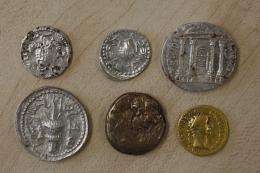
Most of the discovered coins are in excellent condition and were overstruck as rebels' coins on top of Roman coins. The new imprints show Jewish images and words (for example: the facade of the Temple in Jerusalem and the slogan "for the freedom of Jerusalem"). Other coins that were found, of gold, silver and bronze, are original Roman coins of the period minted elsewhere in the Roman Empire or in the Land of Israel.
Bar-Kokhba coins of this quality and quantity have never before been discovered in one location by researchers in the Land of Israel, although over the years antiquities looters have found and sold large numbers of coins from this period. The high value of such coins has served as an incentive for thefts in recent decades, especially in the Judean hills, where many such caves exist.
Prof. Frumkin points out the significance of this particular cave, owing to its size, its proximity to Betar, and the large collection of coins found there. Ancient Betar was the site of the "last stand" of the rebels led by Bar-Kokhba in their struggle against Roman rule in Judea from 132-35 CE.
"This discovery verifies the assumption that the refugees of the revolt fled to caves in the center of a populated area in addition to the caves found in more isolated areas of the Judean Desert," said Prof. Frumkin. He also noted that the discovery adds significantly to our knowledge of the Bar-Kokhba revolt, about which there is not a great deal of historical information.
Dr. Zissu points out that one of the fascinating aspects of the Bar-Kokhba revolt is the intensive use of the rebels and Jewish refugees of natural and man-made caves as hiding and refuge places in the face of extensive Roman search-and-destroy missions. Those who fled to the caves took with them food, weapons, drinks, coins and various documents. Sometimes they even took with them the keys to their houses that they abandoned in the hope that one day they would be able to return to them.
Apparently, the people who left behind the cache of coins that has now been found did so during the period of the revolt, following their flight from their homes or from battle with the Romans; however they were unable to return to their hiding place to recover their valuables.
Source: The Hebrew University of Jerusalem
-
Archaeologists to establish true value of Roman silver coins
Mar 05, 2006 |
not rated yet |
0
-
Israeli archaeologists discover ancient quarry
Jul 06, 2009 |
not rated yet |
0
-
Archaeological excavations uncover Roman temple in Zippori (Sepphoris)
Aug 11, 2008 |
not rated yet |
0
-
Unique Underground Ecosystem Revealed by Hebrew University Researchers Uncovers Eight Previously Unknown Species
May 31, 2006 |
not rated yet |
0
-
Ashmolean opens online coin bank
Oct 26, 2006 |
not rated yet |
0
-
Engineers build first sub-10-nm carbon nanotube transistor
Feb 01, 2012 |
4.9 / 5 (28) |
26
-
Something old, something new: Evolution and the structural divergence of duplicate genes
Jan 31, 2012 |
4.6 / 5 (7) |
1
-
The hidden nanoworld of ice crystals: Revealing the dynamic behavior of quasi-liquid layers
Jan 30, 2012 |
5 / 5 (3) |
1
-
Stock market network reveals investor clustering
Jan 27, 2012 |
4 / 5 (22) |
8
-
Of microchemistry and molecules: Electronic microfluidic device synthesizes biocompatible probes
Jan 26, 2012 |
5 / 5 (1) |
0
-
What are the limits of learning?
4 hours ago
-
Neuroscientists: What is a Principal Cell Layer?
15 hours ago
-
How does slime mould grow?
Feb 04, 2012
-
Why are mosquitoes and bedbugs successful?
Feb 04, 2012
-
Amazon fungi found to eat plastic
Feb 01, 2012
-
Tips Picking up TEM grids?
Feb 01, 2012
- More from Physics Forums - Biology
More news stories
Fossil cricket: Jurassic love song reconstructed
Some 165 million years ago, the world was host to a diversity of sounds. Primitive bushcrickets and croaking amphibians were among the first animals to produce loud sounds by stridulation (rubbing certain body parts together). ...
Other Sciences / Archaeology & Fossils
11 hours ago |
5 / 5 (2) |
1
|
Do we no longer care about the collective good?
The Transformation of Solidarity, a book co-edited by University of Queensland sociologist Dr Mara Yerkes, tackles the subject of globalisation of national economies and societies where we put a high value ...
Other Sciences / Social Sciences
20 hours ago |
3.9 / 5 (8) |
34
East views the world differently to West
Cultural differences between the West and East are well documented, but a study shows that concrete differences also exist in how British and Chinese people recognise people and the world around them. Easterners really do ...
Other Sciences / Social Sciences
16 hours ago |
5 / 5 (5) |
7
Namibia sponge fossils are world's first animals: study
Scientists digging in a Namibian national park have uncovered sponge-like fossils they say are the first animals, a discovery that would push the emergence of animal life back millions of years.
Other Sciences / Archaeology & Fossils
19 hours ago |
4.6 / 5 (10) |
0
Spectator rage: The dark side of professional sports
Preventing violent outbreaks of "spectator rage", similar to the deadly riots that broke out following a soccer game in Egypt, requires assessment and action by sports team owners and stadium managers, according to a report ...
Other Sciences / Social Sciences
9 hours ago |
not rated yet |
0
Nicira promises virtual networks will transform networking
(PhysOrg.com) -- For the past four years, founders of the start-up company Nicira have been developing cutting-edge software that they predict will transform the networking technology underlying the Internet. ...
Navy to begin tests on electromagnetic railgun prototype launcher
The Office of Naval Research (ONR)'s Electromagnetic (EM) Railgun program will take an important step forward in the coming weeks when the first industry railgun prototype launcher is tested at a facility ...
Study of diving beetles suggest sperm evolution may be driven by changes in female reproductive organs
Studying female reproductive tracts and sperm in diving beetles (Dytiscidae), researchers from the University of Arizona and Syracuse University have obtained a glimpse into a bizarre and amazing world of spe ...
New insight from whole-genome sequencing of Europe's 2011 E. coli outbreaks
Using whole-genome sequencing, a team led by researchers from Harvard School of Public Health (HSPH) and the Broad Institute has traced the path of the E. coli outbreak that sickened thousands and killed over 50 people in Ger ...
Redder ladybirds more deadly, say scientists
A ladybird's colour indicates how well-fed and how toxic it is, according to an international team of scientists. Research led by the Universities of Exeter and Liverpool directly shows that differences between ...
After Megaupload closure, BTJunkie shuts down
BTJunkie, a popular file-sharing indexing site, said Monday it was voluntarily shutting down, less than three weeks after the US closure of Megaupload in a crackdown on piracy of music, films and other materials.