The Shrinky Dink solution
September 9, 2009 by Erin Knapp The Shrinky Dink solution

Enlarge

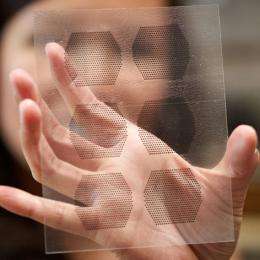
Inspired by Shrinky Dinks, Michelle Khine, a UCI biomedical engineering assistant professor, pioneered an easy, quick and cheap way to fabricate microfluidic chips. Image: Dave Lauridsen

Toys don't usually inspire high-tech innovation, but Michelle Khine's childhood favorite did just that.

The UC Irvine assistant professor in biomedical engineering drew upon the hours she spent playing with Shrinky Dinks — thin plastic sheets that can be colored with paint or ink and then shrunk with heat — to solve a problem in her research on how chemical cues affect cell activity.

The work earned Khine a spot on Technology Review's 2009 TR35, an annual list of 35 innovators under 35 in business and technology worldwide. Technology Review is published by the Massachusetts Institute of Technology.

"They say desperation is the mother of all invention, but I also have to credit my actual mother," Khine says. "When I was 6 years old, she introduced me to what became my lifelong No. 1 toy: Shrinky Dinks."

After earning her doctorate, Khine joined the founding faculty at UC Merced in 2006. The fledgling campus didn't have the sophisticated lab equipment of her grad school days, so Khine had to find a way to create fluid channels thinner than a human hair on the biochips she employed in her research. She wondered if she could pattern the pathways on a Shrinky Dink sheet with her desktop laser printer and then miniaturize them in a toaster oven.

It worked. As the plastic shrank, the ink particles on its surface clumped together and formed tiny ridges. After removing it from the oven, Khine applied a flexible polymer called PDMS to the cooling sheet. The ink ridges created channels in the PDMS, and when Khine peeled the polymer off the Shrinky Dink mold, she had a completed device.

The use of PDMS to construct miniscule features on wafers is called soft lithography, and it typically involves several days of turnaround time and considerable infrastructure, operating expenses (such as for a clean room) and equipment.

With the Shrinky Dink method, Khine says, researchers can easily and cheaply design and develop custom microfluidic chips within minutes. "And all they'll need is a laser printer and a toaster oven," she says.

This simplified fabrication process could revolutionize the way engineers conduct experiments and manufacture products, Khine believes, and could be used in stem cell research, to create cardiac patches for heart attack sufferers and to significantly improve the detection sensitivity of bioassays, which are utilized in pharmaceutical development and point-of-care diagnostics.

In fact, Khine's toy-inspired innovation led to the first start-up company at UC Merced, Shrink Nanotechnologies Inc., exclusive licensee of her patent-pending advances.

Khine continues to use Shrinky Dink-style fabrication at UCI, and she encourages other young engineers to approach their research creatively.

"My advice?" she says. "Be true to your inner child. Don't work - play! If you love what you do, you'll do great things."

Provided by University of California, Irvine


print this article email this article download pdf blog this article bookmark this article     Stumble it Digg this share on Facebook retweet share on Reddit add to delicious
Rate this story - 4.5 /5 (2 votes)


September 9, 2009 all stories

Comments: 0

4.5 /5 (2 votes)
  • Stumble this up

  • Digg this

  • share this

  • hide
  • Related Stories

  • Print-and-Peel Method Creates Microfluidic Devices
    created Dec 04, 2006 | popularity not rated yet | comments 0
  • Doctors warn about camphor poisoning in children
    created Apr 27, 2009 | popularity not rated yet | comments 0
  • Smart Contact Lenses
    created Jul 30, 2008 | popularity not rated yet | comments 0
  • Researchers Invent Way to Mass Produce Microscopic Plastic Components
    created May 23, 2006 | popularity not rated yet | comments 0
  • Camphor-containing products may cause seizures in children
    created May 06, 2009 | popularity not rated yet | comments 0


  • hide
  • Relevant PhysicsForums posts

  • transient heat transfer
    created 4 hours ago
  • Trying to adapt a fuel gage circuit
    created 22 hours ago
  • Pushing the piston.
    created Nov 22, 2009
  • Do Camcorders/ Video camera have Sensors in them?
    created Nov 22, 2009
  • More from Physics Forums - General Engineering

Other News

The KLM airplane which runs on biokerosene is seen at Schiphol airport, near Amsterdam

KLM flies world's first 'passenger flight on biofuel'

Technology / Energy

created 42 minutes ago | popularity not rated yet | comments 0

A Boeing 747, one of four engines powered by a 50-percent biokerosene mix, circled the Netherlands for an hour on Monday for what airline KLM called the world's first passenger flight using biofuel.


IBM Researchers Lower Language Barrier With Text Translator

Technology / Computer Sciences

created 1hour ago | popularity 4 / 5 (1) | comments 0

IBM Researchers are helping to break the language barrier with the advent of technology dubbed "n.Fluent" -- smart software that translates text between English and 11 other languages. IBM employees use it to instantaneously ...


HP's profit up 14 pct despite sales drop (AP)

HP's profit up 14 pct despite sales drop

Technology / Business

created 1hour ago | popularity not rated yet | comments 0

(AP) -- Hewlett-Packard Co.'s profit jumped 14 percent in the latest quarter, helped by cost-cutting and better results from its technology services division.


Friends go online at Foursquare to meet offline (AP)

Friends go online at Foursquare to meet offline

Technology / Internet

created 1hour ago | popularity not rated yet | comments 0

(AP) -- Laura Fitton's ascent has been staggering: In less than a year, she's become mayor of nine different places in several different states, all without giving any speeches or kissing any babies.


Feeling the way

Feeling the way: Robotic device can help visually impaired people

Technology / Engineering

created 1hour ago | popularity not rated yet | comments 0

(PhysOrg.com) -- For many people, it has become routine to go online to check out a map before traveling to a new place. But for blind people, Google maps and other visual mapping applications are of little ...